DEV3 Technologies home

DEV3 Ambulora – Rehabilitation & Long-Stay Hospital Management System with Gemini AI admin tools

Self-hosted hospital system for rehabilitation, long-stay and elder-care hospitals on Next.js and MongoDB: a calm icon-rail workspace, ward care, bed board, nursing, pharmacy, billing, HR and a family portal. Built on the DEV3 hospital operations engine. 21 one-click demo roles.
by DEV3 TechnologiesVerified AuthorUpdated 25 Nov 2026

Black Friday: up to 30% off

This item is 30% off: $69.30 instead of $99

Ends in
--
Days
--
Hrs
--
Min
--
Sec

Video tour. Pick a section below to browse 31 screenshots in 1 sections.

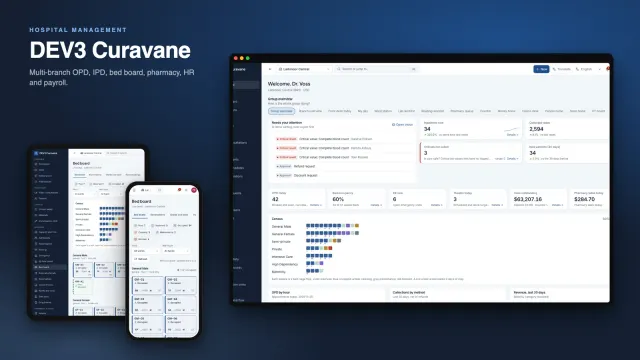
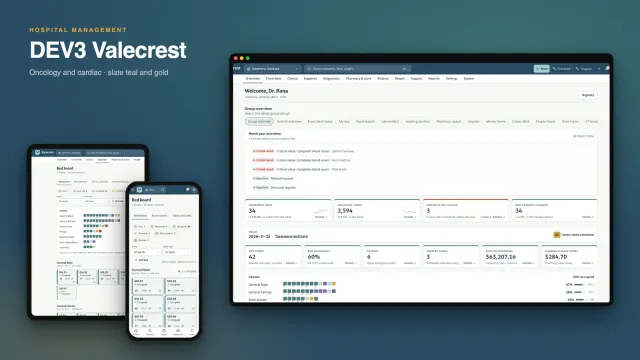
Similar products · 2 more designs

Same features, a different design. Each is its own product: pick one and buy it on its own.

App & phone tours

Tap play to watch each app. Nothing downloads until you do.

  • Mobile web0:16

DEV3 Ambulora is a self-hosted hospital management system for rehabilitation, long-stay and elder-care hospitals, built by DEV3 Technologies on Next.js 16 (App Router and Server Actions) and MongoDB. One installation runs a hospital group with many branches. Each branch has its own timezone, currency, tax, letterhead, wards and stock, and staff see only the branches they are allowed to. It is a responsive web app: it works in a phone browser, and there is no native mobile app.

Demo data included: npm run seed builds a demo hospital group, and with DEMO_MODE=true the sign-in page offers one-click logins for 21 roles (password demo-pass-2026). All names, hospitals and data are fictional (the fictional Himbela Recovery Hospital demo group, three branches in Lalitpur, Bhaktapur and Dhulikhel). Payments, SMS and email are simulated: nothing is charged or sent.

What's new in 1.1

A compact, slicker layout made for 1920 px screens, in light and dark: tighter navigation, 40 px table rows, compact KPI tiles and wider content, a split sign-in page and a public site with a 1200–1240 px layout. Features, data and permissions are unchanged.

What makes Ambulora different

Built on the DEV3 hospital operations engine, the same full feature set that large multi-branch hospitals need, with a workspace designed for rehabilitation, long-stay and elder-care hospitals: a warm cream canvas, leaf green and honey; Lexend headings; an icon rail with a context panel instead of a dense sidebar, large touch targets and a text-size control on the public site.

Every corner of a hospital group

  • A new workspace. Grouped navigation with favourites, command search for patients, a + New menu, role homes that open on an attention queue and drill to a filtered list, an inbox for approvals and results to verify, and one data grid everywhere (saved views, column chooser, density, bulk actions, export, phone cards). A patient banner with allergies, alerts, payer and balance follows the patient through every clinical screen. Light and dark themes.
  • Clinical safety. Problem list, coded allergies with conflict blocks, medication reconciliation, order sets and pathways, early-warning scores with escalation, barcode medication administration with witnessed overrides, care plans.
  • Patient flow. Capacity board, bed and transfer requests, expected discharge, an ED tracking board with timers, OT timings, month, agenda and resource calendars, video consultations, medical records with chart tracking and coding queue.
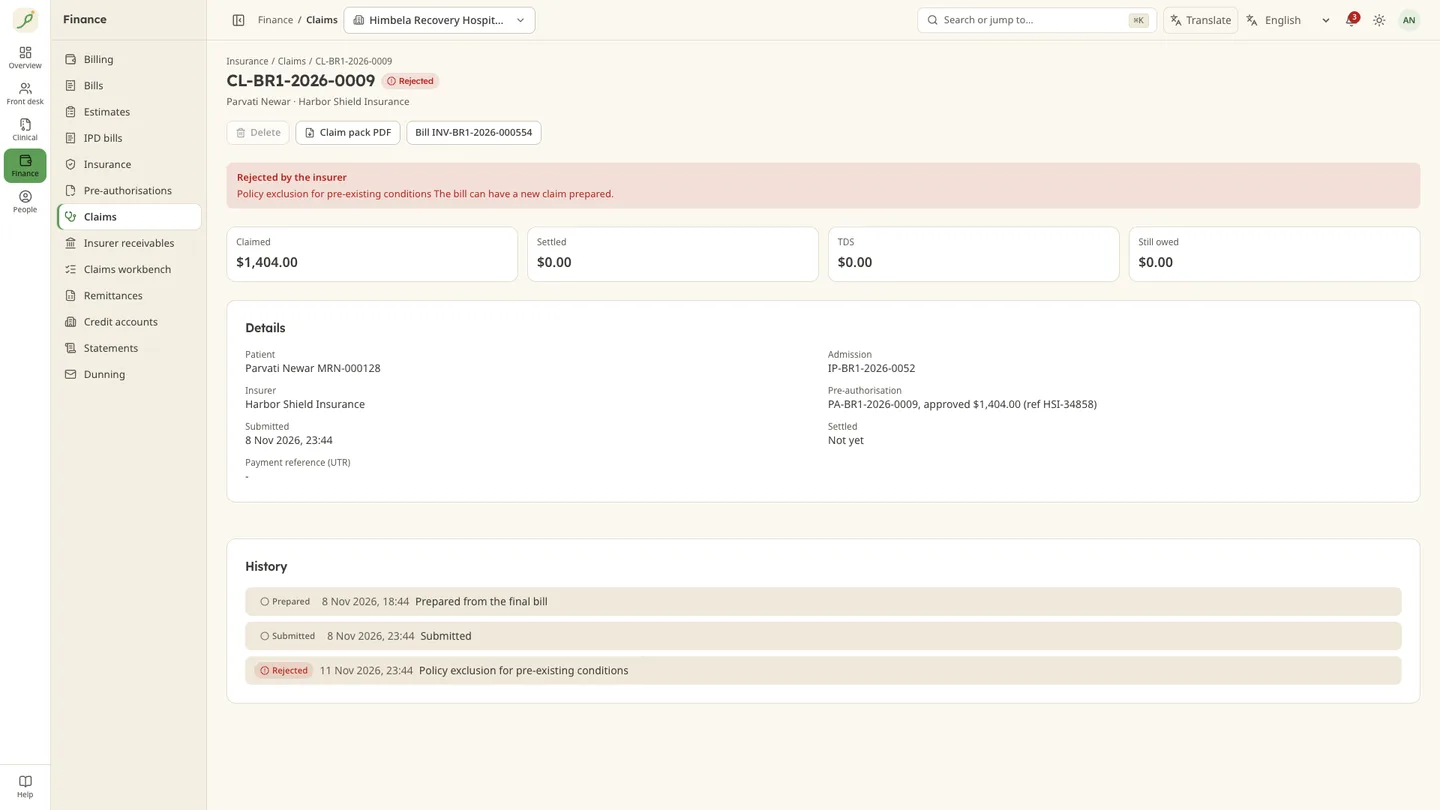
  • Revenue cycle. Cost estimates, credit control, a claims workbench with denials and resubmission, remittance import and matching, corporate credit accounts, statements and dunning, check-up packages.
  • Diagnostics and pharmacy. Analyser import with reflex rules, label sheets, sample rejection and amended reports, a radiology reading worklist with a critical-finding call gate, formulary and substitution rules, restricted-drug stewardship approvals, an implant register with lot recall.
  • Quality and specialty. Incidents with RCA and CAPA, infection surveillance, surveys and NPS, grievances, maternity, immunisation, CSSD, mortuary, biomedical waste, planned maintenance.
  • Insight and interoperability. A performance pack with drill-down, a report builder with saved and scheduled reports, an integrations hub, signed webhooks, a FHIR R4 read API with per-branch keys, an HL7 ADT feed, a per-patient access report and restricted charts with audited break-the-glass.
  • Gemini AI admin tools. Optional, draft-only helpers in the modules: nothing is saved, signed or sent by AI, and identity is removed before any call. Off until you add your own key.
  • Portal, kiosk and mobile. Portal pre-registration, estimates, deposits and video-visit join, a kiosk and a TV display, and a phone workspace with offline dose intents.

Front desk and OPD

  • Patient registration with a duplicate check, one MRN across branches, a printable MRN card, merge of duplicates, consents and policies.
  • Appointments with a doctor calendar, live slots, schedules and leave blocks, a waiting list, token queue, kiosk check-in and a TV display that shows no patient names.
  • Consultation workspace: vitals, history, ICD diagnosis (a starter list, with a note to load your licensed code set), orders, prescriptions with allergy and interaction warnings and an audited override, prescription PDF.

Inpatient care

  • Six-step admission wizard (patient, payer, package, bed, consent, deposit) and a wristband.
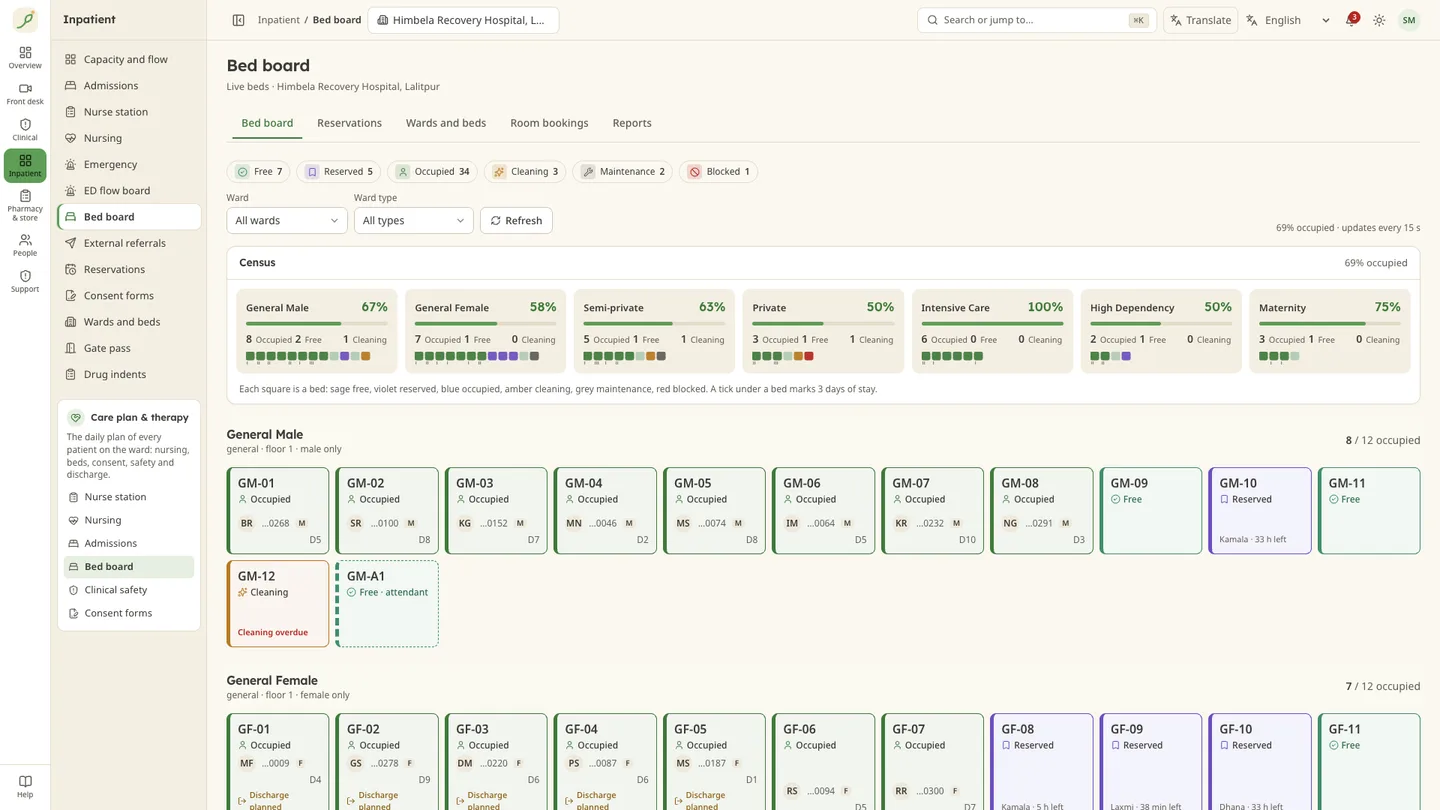
  • Ward, room and bed masters with day and hourly tariffs, a live bed board, reservations with expiry, transfers between beds, wards and branches, room booking.
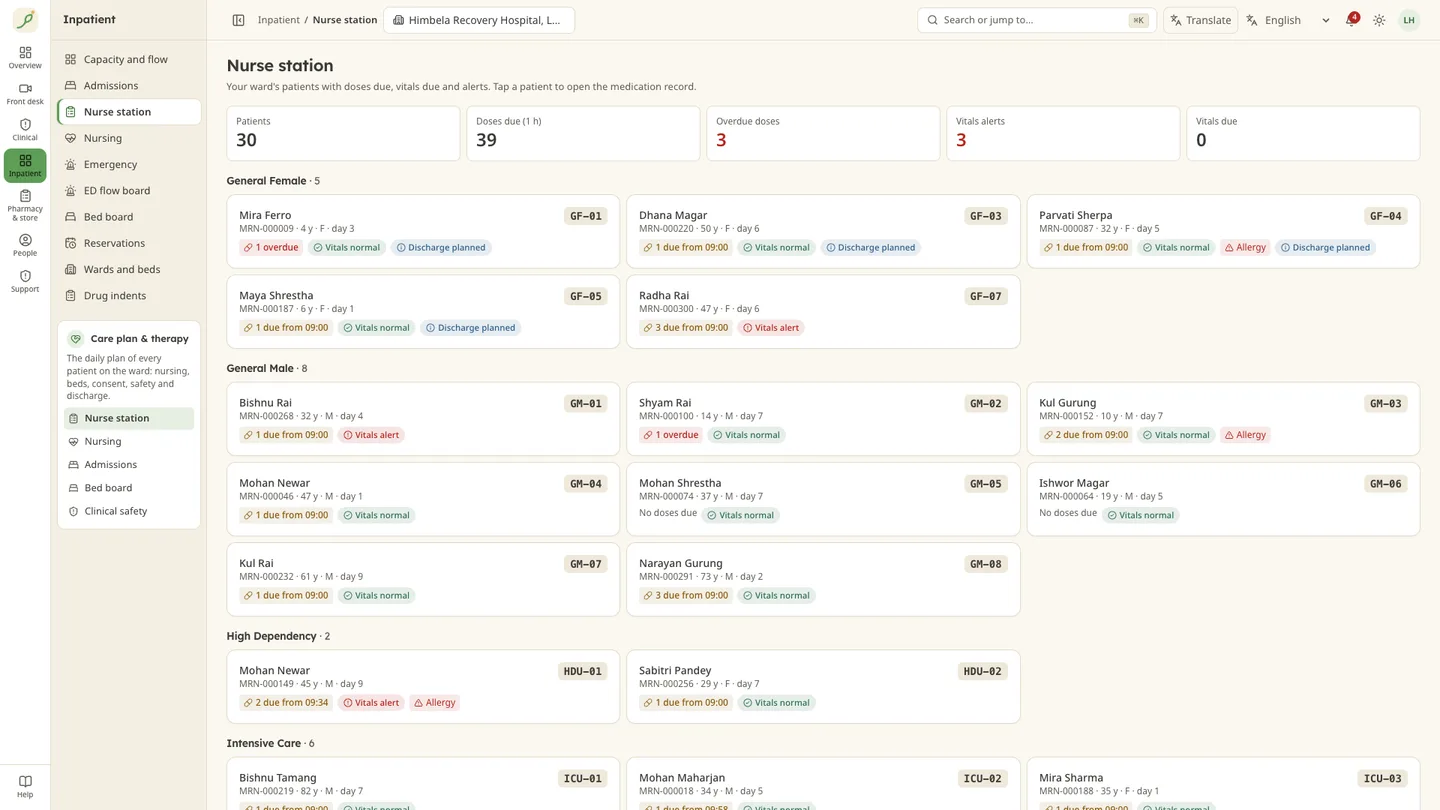
  • Inpatient chart with rounds, nursing notes, vitals trends, orders, diet and I/O, a nurse station and a 24-hour MAR with late and missed doses and witnessed controlled doses.
  • Emergency board with triage levels, unknown-patient registration and an MLC register.
  • Operation theatre calendar with room, surgeon and anaesthetist conflict checks, a WHO-style safety checklist and consumables issued from the OT store.
  • Discharge with a checklist, summary PDF and a bill-clearance rule: discharge with unpaid dues is blocked unless a permitted role approves.

Diagnostics, pharmacy and store

  • Laboratory: collect, in-lab and verify queues, reference ranges by sex and age, critical values, outsourced tests between branches, signed report links.
  • Radiology: modality schedule, report templates and image attachments.
  • Pharmacy: first-expiry-first-out dispensing, substitution, POS with split payment, returns, a controlled-drug register with witness, expiry and low-stock alerts, ward drug indents.
  • Store and procurement: stores, indents, requisitions, purchase orders, goods receipts by batch and expiry, supplier invoices and payments, inter-branch transfers, stock counts and adjustments, reorder suggestions.

Billing, insurance and accounts

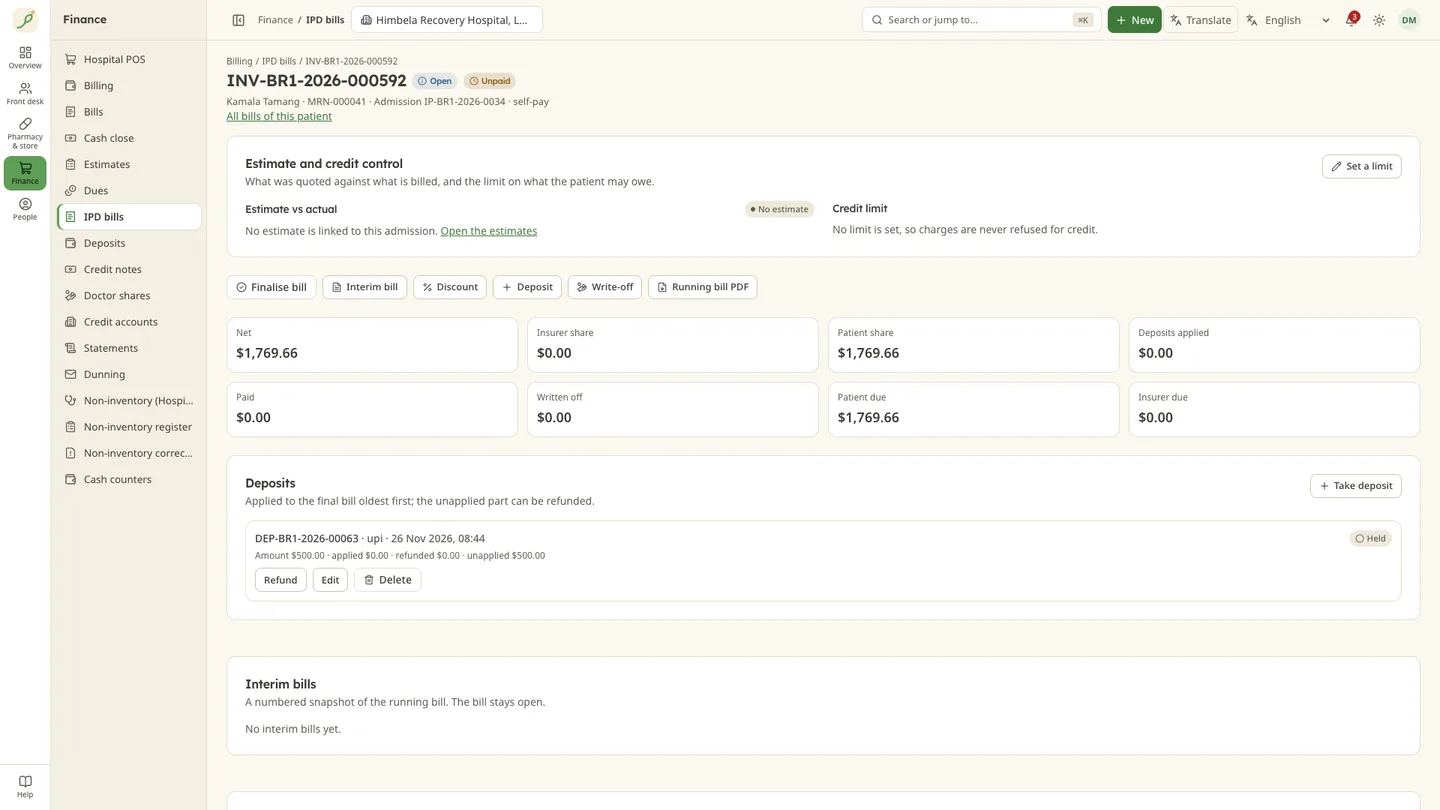
  • OPD counter bills, a live bill for each admission, packages with absorbed and excluded items, deposits, interim and final bills, discount, write-off, refund and re-open approvals with role limits, credit notes and cash close by cashier.
  • Insurance and TPA: pre-authorisations, payer split with approved ceilings, claims, settlement and deductions, insurer receivables.
  • Doctor revenue share and referral commission, simple accounts (day book, expenses, other income, profit and loss).

HR and payroll

  • Employees, documents, contracts, licence expiries, onboarding and exit checklists, duty roster with conflict rules, attendance with CSV import, leave with two-level approval, overtime, loans.
  • Payroll with salary structures, a monthly run, approve, lock and pay, branded payslip PDFs. A locked month refuses changes.

Support services

Blood bank (donors, screening, cross-match, issue), ambulance fleet and trips with charges posted to the bill, housekeeping tasks created on discharge, linen ledger, maintenance tickets and assets with AMC dates, diet orders and a kitchen list.

Reports and dashboards

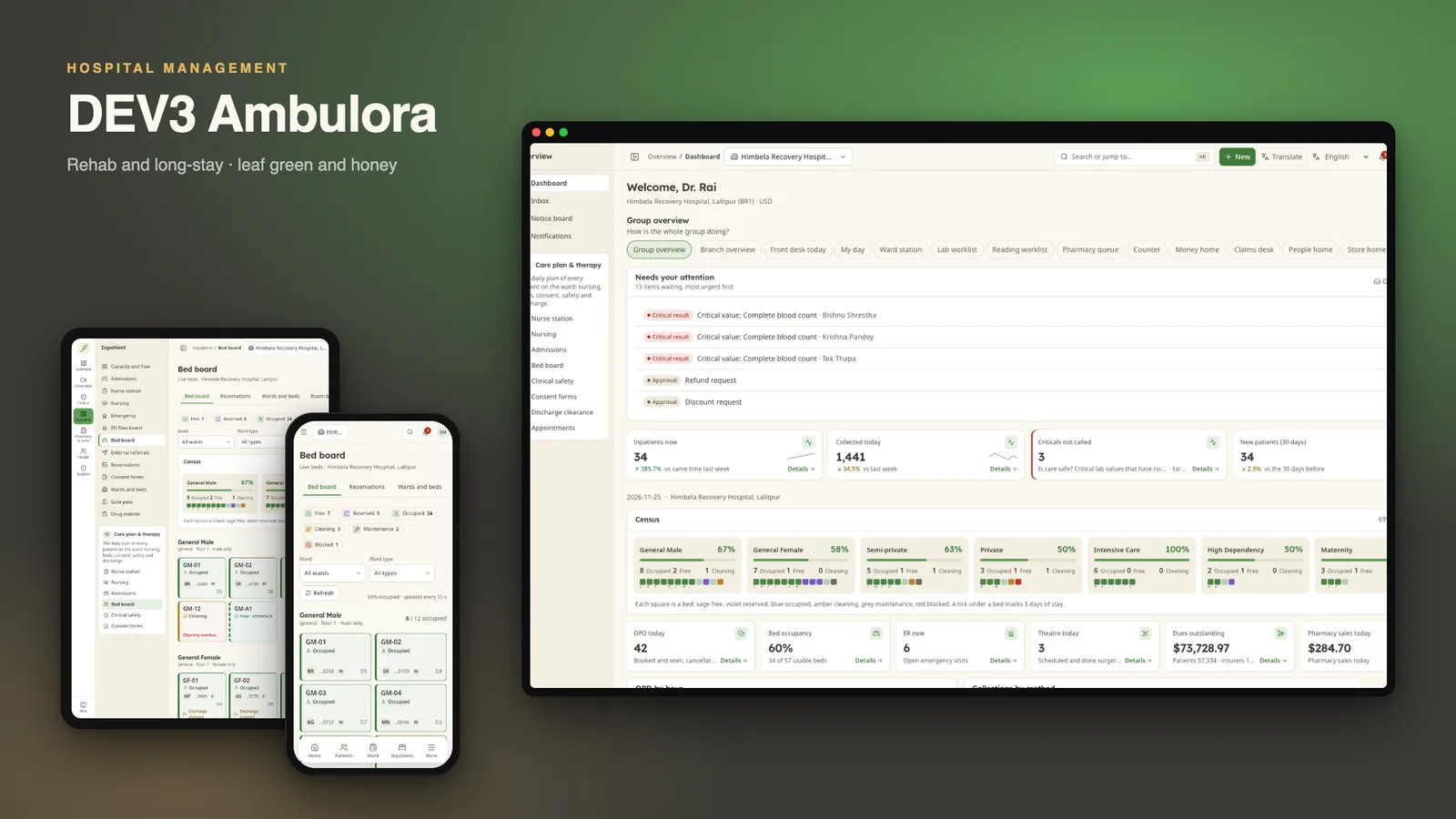
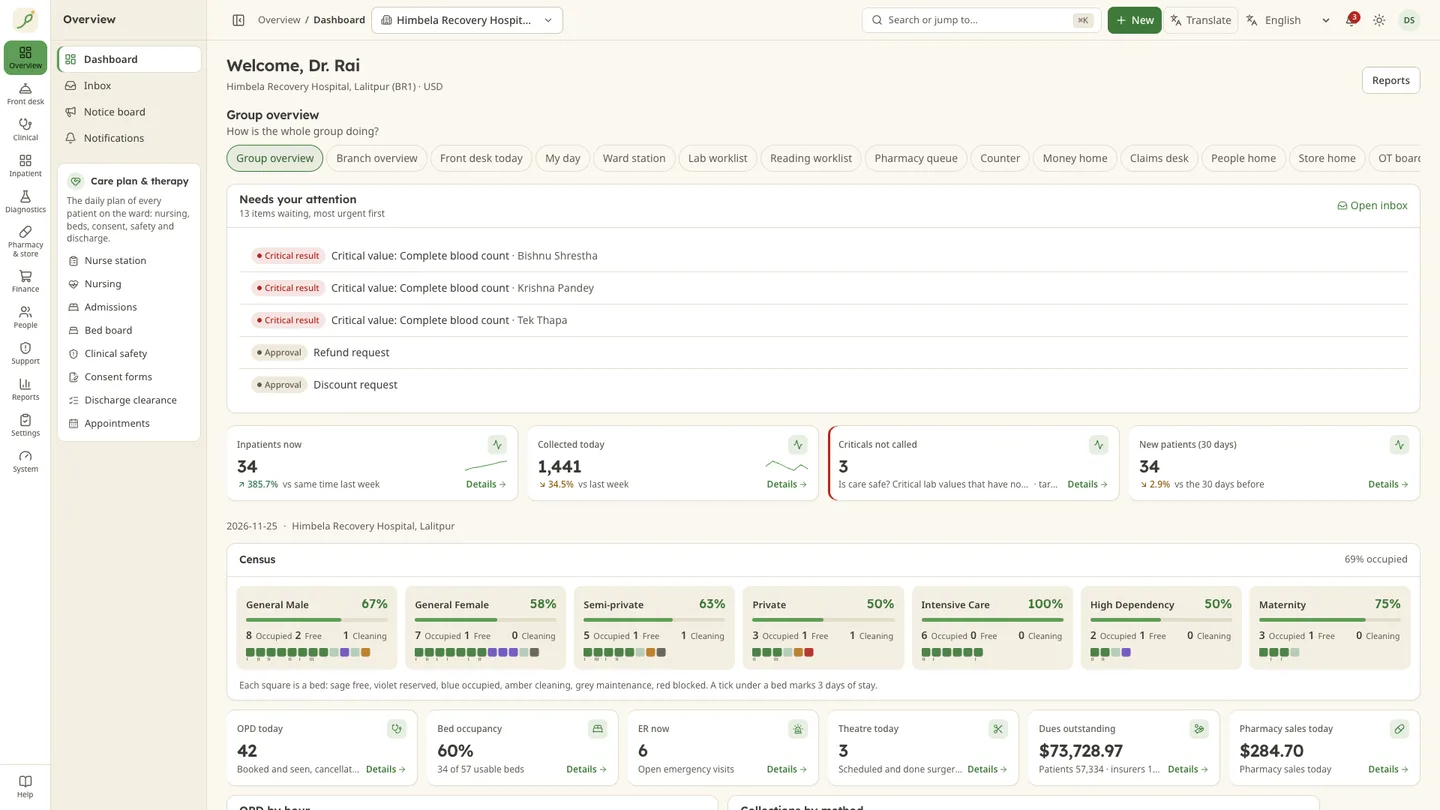
A group dashboard (census, occupancy, revenue and payroll across branches), a branch dashboard with the Census Strip, a "My day" view for roles without module access, and about 60 reports with date and branch filters and CSV and PDF export.

Access, safety and audit

  • 21 demo roles, dynamic roles and a permission matrix (about 330 permissions), a permission matrix with own, department, branch or all scope, and branch-scoped staff.
  • Two-factor sign-in, lockout, password age, session list with remote sign-out, an audit log with before and after values, break-glass access.
  • Every module has list, view, add, edit and delete. When a delete is blocked, the app tells you why.

Public website and patient portal

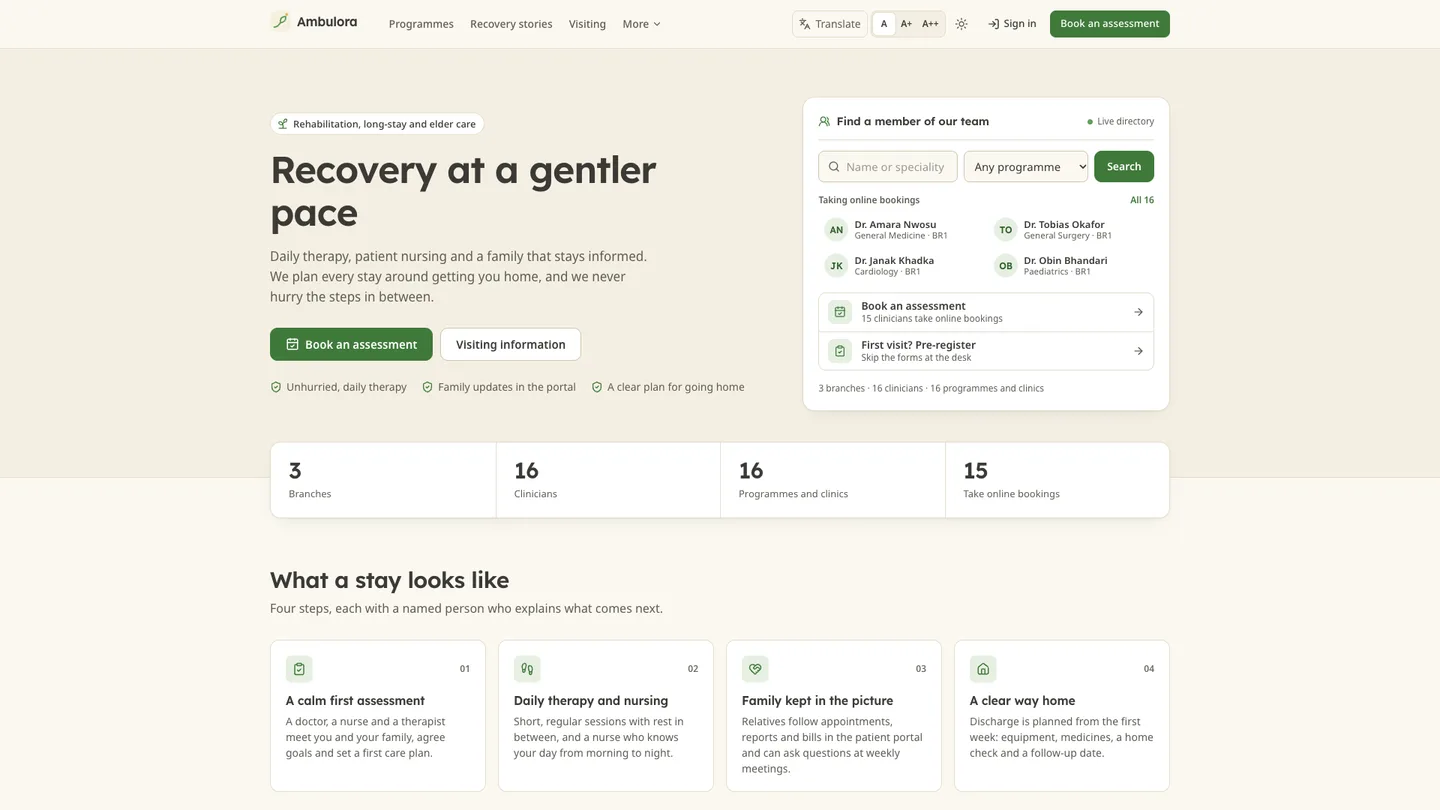
  • A hospital website with departments, doctors, branches, online booking with a simulated SMS code, contact form and pages managed in a built-in editor.
  • A patient portal: appointments, reports, prescriptions, bills with online payment (simulated gateway), documents and family links.

What's in the package

  • Full TypeScript source of the web app and the background worker, .env.example, the HTML documentation and a START-HERE guide.
  • 3,500+ automated tests (Vitest), including race tests on real MongoDB, static checks on access control, and browser smoke flows.
  • The upgrade guide and migrations from 1.0.x. A demo seeder: three branches, about 100 staff, 300 patients, six months of activity and live today's data.

Requirements

  • Node.js 20.9 or newer and npm
  • MongoDB 6 or newer (a single node works; a replica set is recommended)
  • Your own SMTP account and payment gateway keys if you want real email and payments. Out of the box, email goes to a log and payments are simulated.

Good to know

  • It is not a certified clinical system. You are responsible for clinical content, licensed code sets and local regulations. Controlled drugs in the demo use generic class labels.
  • SMS is simulated and has no provider connector. Payments use a simulated gateway until you connect your own.
  • Web only: responsive for phones and tablets, with no native iOS or Android app.

How it's built

Architecture, stack, key decisions and the quality gates DEV3 Ambulora passed before release.

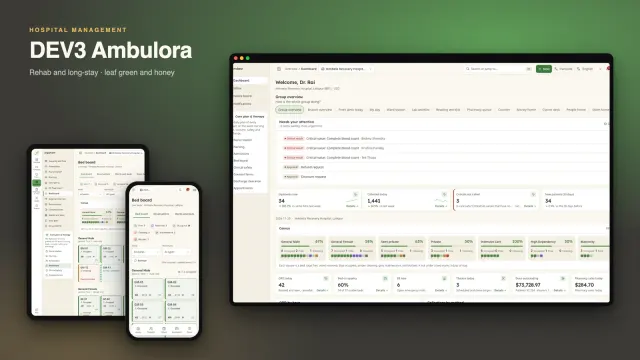
A calm hospital management system for long stays: an icon rail with a section panel, ward census cards, care plans and a family portal, in a compact layout built for 1920 px screens.

The problem it solves

Give rehabilitation and long-stay hospitals a self-hosted system built around weeks-long admissions (census, care plans, interim bills, family contact) while keeping every module a multi-branch hospital group runs.

Architecture and approach

Ambulora is one Next.js 16 application (the DEV3 hospital operations engine with its own design) with MongoDB, written in TypeScript. There is no separate API server and no native app. The design choices below are the ones that matter when you read or extend the code.

One group, many branches

Every record that belongs to a branch carries a branch id, and every read goes through a scope filter built from the signed-in user's role. Patients and employees are group-wide, so one MRN works across branches. Branch settings (currency, tax, timezone, numbering) override the group value and can be reset.

Roles and permissions

There are 21 built-in roles and custom roles. Each permission is a module and action with a scope: own, department, branch or all. Menus, buttons and server actions use the same check, and a role-menu snapshot is checked in the browser flows.

Money

Amounts are whole cents. Rounding is half-up in one place. Each invoice stores the currency rate it was created with, so later rate changes do not alter old bills. All charges go through one posting service, which prevents double posting with request keys.

Bed charges and bills

Bed-days follow a midnight census with a 12:00 discharge cut-off and half-day rule, all configurable by branch. A live bill is opened with the admission and receives charges from the bed, nursing, pharmacy, lab, OT and blood bank. The payer split (insurer and patient) is recomputed whenever a pre-authorisation is decided.

Safe under concurrency

The app does not need MongoDB transactions, so it runs on a single node. Writes that must not race use conditional single-document updates, unique and partial indexes and short named locks. Race tests run parallel requests against a real MongoDB, covering double-clicked payments, parallel refunds, parallel finalise clicks and parallel dispense.

Stock

Stock moves only through one kernel, by batch and expiry, first-expiry-first-out. Pharmacy, store, OT and ward indents all use it, which keeps the ledgers and the controlled-drug register consistent.

Audit and locks

Every write records who, when and a before and after diff. Clinical records are signed and then locked, with addenda. Payroll and other periods lock, and writes into a locked period are refused with a message.

Documents

PDFs (prescriptions, reports, bills, payslips, discharge summaries, tables) are rendered on demand with React PDF; nothing sensitive is stored as a file except uploads.

Quality gates

The package ships with more than 3,500 Vitest tests, integration tests on real MongoDB, static checks for server-action guards and client/server import boundaries, and headless browser flows with a responsive sweep at 375 and 768 pixels.

Quality gates and results

Every screen is checked at 1920, 1440 and 390 px in light and dark, with right-to-left layouts, an axe accessibility pass with no violations and more than 3,500 automated tests on real MongoDB.

Tech stack

Area Technologies
Application Next.js, React, TypeScript
Data MongoDB
Styling Tailwind

Inside the build

Hospital website: Departments, doctors and branches with a book-an-appointment call to action. Hospital website — Departments, doctors and branches with a book-an-appointment call to action.
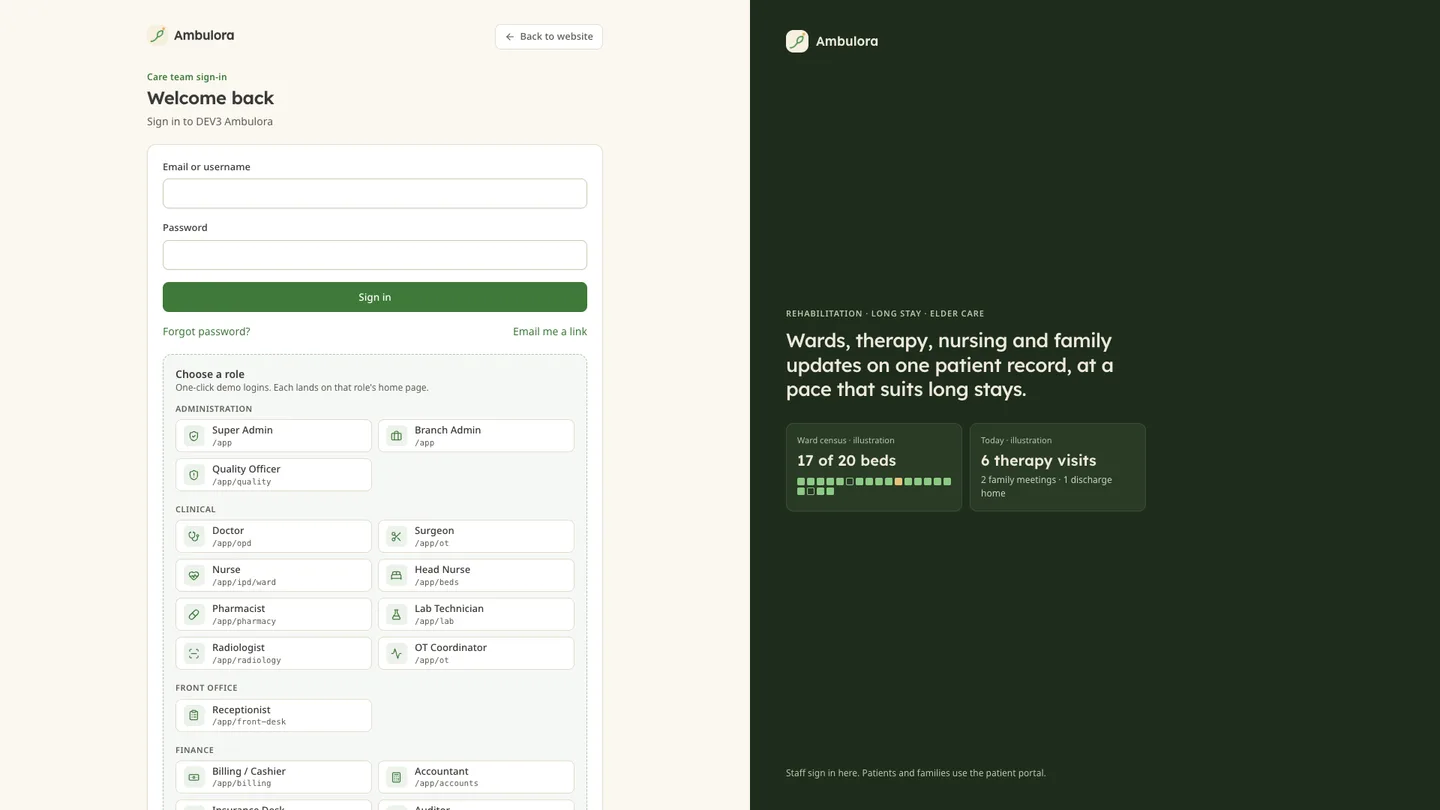
Role sign-in: One-click demo sign-in for every hospital role, from doctor to auditor. Role sign-in — One-click demo sign-in for every hospital role, from doctor to auditor.
Guides & articles

Practical guides and engineering write-ups for DEV3 Ambulora.

Hospital management system for rehabilitation and long-stay care: 6 things to check

Last updated
Hospital management system for rehabilitation and long-stay care: 6 things to check: DEV3 Ambulora

Hospitals for rehabilitation, long-stay and elder-care hospitals keep patients for long pathways and need more than an appointment book. This checklist covers six things to check before you pick a self-hosted hospital management system, with DEV3 Ambulora as the worked example.

Video tour of Ambulora: the hospital website, sign-in, dashboards, bed board, OPD, wards, theatre, pharmacy, payroll and reports

The Ambulora hospital website

  1. Patient flow you can see. A live bed board, transfers, expected discharge and an ED board with timers. Bed board

  2. Inpatient care with safety checks. Ward lists, medication rounds with barcode checks, early-warning scores and care plans. Ward medication rounds

  3. Billing that follows the stay. A live bill per admission with deposits, interim bills, estimates and insurer splits. Inpatient bill

  4. Insurance and claims. Pre-authorisations, a claims workbench, denials and resubmission. Insurance claim

  5. Control across branches. Roles with own, department, branch or all scope, an audit log and group dashboards. Group dashboard

  6. Ownership. Self-hosted on your own server and MongoDB, full TypeScript source, and Gemini AI admin tools that stay off until you add your own key.

Ambulora is a Next.js and MongoDB hospital management system that covers all six, with a compact layout made for 1920 px screens, light and dark themes and phone layouts at 390 px.

Frequently asked questions

The complete source code (version 1.1.0) as a download from your account, with the setup and usage guides shown on this page. You can modify the code to suit your product.

Questions about this product (0)

Answers from the DEV3 team and the community.

Ask a question

No questions yet.

Wondering about setup, licensing or customisation? Ask, and the DEV3 team will help.

More from this author

View all

Related in Enterprise SaaS Starters

View all