DEV3 Technologies home

DEV3 Hawsera – Freight Forwarding SaaS (Quotes, HBL/MBL, Customs, Job Costing, Portals) with Gemini AI

Self-hosted freight forwarding SaaS on Next.js 16 and MongoDB: rate cards and quotes, ocean, air and road jobs, consols, house and master bills, customs, job costing, invoices, agent profit share and customer and agent portals. Gemini AI admin tools, demo data.
by DEV3 TechnologiesVerified AuthorUpdated 26 Nov 2026

Black Friday: up to 30% off

This item is 30% off: $69.30 instead of $99

Ends in
--
Days
--
Hrs
--
Min
--
Sec

Video tour. Pick a section below to browse 39 screenshots in 12 sections.

App & phone tours

Tap play to watch each app. Nothing downloads until you do.

  • Mobile web0:05

Hawsera is a freight forwarding operating system you run as the operator, built by DEV3 Technologies on Next.js 16, React 19, TypeScript, Tailwind 4 and MongoDB. Each tenant is one forwarder with one or more offices: sales build quotes from rate cards, operations turn them into ocean, air and road jobs, documents and customs follow the cargo, accounts invoice and collect, and customers and overseas agents follow progress in their own portals. The demo data is fictional: a UK and Hong Kong forwarder with 168 jobs, 177 customers, carriers and agents, and a second company to show tenant isolation.

Web only (no mobile app source). The look is operational: dense tables at 1920 pixels, milestone rails on every job, mode chips, container numbers in IBM Plex Mono, one maritime blue accent, light and dark themes.

Rates and quotes

  • Rate cards: buy and sell rates by mode, lane and carrier with versions, validity, weight breaks, per-container and per-kilo bases, minimums and maximums, surcharge rules and margin rules. A rate search compares the best options for a lane in one screen.
  • Quote builder: multi-option quotes, charge lines in any currency with stored FX, a margin floor that sends a quote for approval, versions, a print view and a public accept link with an audit trail. Chargeable weight (volumetric against actual, W/M for ocean LCL) is calculated on the server.

Shipments and tracking

  • Jobs for every mode: ocean FCL and LCL, air, road and courier, import, export and cross-trade, with a guided wizard, multi-leg routing, containers with seals and weights, cargo lines and parties (customer, shipper, consignee, notify, overseas agent).
  • Milestone state machine: each mode has its own milestone catalogue and allowed moves, planned against actual dates with drift, and blocked jumps (a customs hold stops a job passing clearance). A simulated tracking feed shows how carrier and airline APIs plug in.
  • Booking inbox, task templates and exceptions: customer booking requests convert to jobs, checklists come from templates, and delays, holds and damages are raised, assigned and resolved on the job.
  • Demurrage and detention: free days and tariff steps per container, clocks that stop at gate-out, and an exposure report.

Consolidation, documents and customs

  • Consols: master loads (LCL and air) with house shipments, a stuffing plan with volume and weight limits, cost allocation across houses and deconsolidation that never double counts.
  • Documents: house and master B/L, sea waybill, HAWB and MAWB, packing list, commercial invoice, arrival notice and delivery order from editable templates, with numbering, versions, void, customer draft approval by link and release control (originals or telex release).
  • Customs declarations: HS codes, duty and tax lines and disbursements through a simulated adapter. Live filing (ACE, ICS2, ICEGATE and the like) is an integration point you add.

Money

  • Job costing: cost lines against revenue with stored FX, accruals and actuals, variance, close and reopen.
  • Invoices, credit notes, bills and payments: race-safe line claims so a charge is billed once, vendor bills with variance approval, payment allocation with FX gain and loss, receivables aging, customer statements, dunning and a credit hold that stops new bookings and releases.
  • Agents and profit share: agent agreements, profit share per job and settlements between offices and overseas agents.

Portals, CRM, reports and AI

  • Customer and agent portals: magic-link sign-in with its own session. Customers see their jobs, documents (a B/L is hidden until release), quotes, invoices and statements, request bookings and approve drafts; agents post milestones on their assigned jobs and see no money. A public /track page needs a reference plus a second factor.
  • CRM: leads, opportunities and activities with conversion into customers.
  • Reports: sixteen reports (on-time departure and arrival, lanes, TEU and kilos, exceptions, carriers, quotes and win rate, pipeline, profit by office, mode and customer, aging, DSO, unbilled revenue, D&D exposure) with filters, charts, CSV and print.
  • Gemini AI admin tools: summarise a job, draft a delay notice, explain a chart, write a monthly summary, draft a follow-up and map a plain-English search to filters. They use your own key; in the demo a labelled sample driver answers.
  • Platform: multi-tenant with plans and limits, offices with office-scoped roles, 8 organisation roles with server-side permissions, an audit log on every change, saved views, CSV import and export on lists, bulk actions, a REST API under /api/v1 with keys and webhooks, notification rules, a setup wizard, a public site and a language switcher.

Safe by design

  • Money is stored in integer minor units. Invoice lines, payments, consol allocations and counters are conditional updates, so two people acting at once cannot bill a charge twice or over-allocate a payment.
  • Every tenant query goes through a guard that fails closed. Portal access is scoped to one party in one tenant, and a customer asking for another customer's job gets not found.
  • 811 app tests and 81 core tests pass, including race tests, 403 tests for every role and regression tests for each finding of a full independent review, all fixed before release.

Good to know

  • Payments are simulated (card payment in the portal works only on demo and test installs). The product records and allocates payments; it does not move money.
  • Carrier, airline and customs connections are simulated. The tracking feed and the customs adapter sit behind interfaces; live APIs are yours to add.
  • No PDF engine. Documents and quotes use print views.
  • AI needs your own key. Without one the AI buttons use the labelled sample driver in the demo.
  • Email is stored in the admin Outbox until you set an SMTP driver.
  • You need Node.js 20.9+, MongoDB 6+ as a (single-node) replica set, HTTPS and a cron or systemd timer for the daily jobs.

What you get

The application source with the core under packages/next-core, a setup wizard, demo data, .env.example, scripts (seed, daily jobs, quote expiry, tracking tick, billing renewal), tests, the buyer documentation, START-HERE.txt and the licence. Setup wizard and demo data included.

How it's built

Architecture, stack, key decisions and the quality gates DEV3 Hawsera passed before release.

The engineering behind Hawsera: chargeable weight and margin maths on integer money, a per-mode milestone state machine, race-safe invoice line claims, consol cost allocation and a portal scoped to one party, with the known limits written down.

The problem it solves

A forwarder's job file touches sales, operations, documents and accounts at once. Two clerks must not bill the same charge, a customer must never see another customer's job or a bill of lading before release, and a quote in three currencies must still add up to the cent.

Architecture and approach

Hawsera is a Next.js 16 application on MongoDB. Every tenant-owned model passes through a guard that requires a tenant id on each query and throws when a filter has none; the tests list the models so a new one cannot skip it. Money is integer minor units, rounded half-up once per line, with the FX rate stored on the record so history never changes.

Rates and quotes

Charge bases (per container, per kilo, per W/M, percent of freight) share one line formula with minimums and maximums. Chargeable weight compares actual and volumetric weight with a divisor per mode. A margin floor sends a quote for approval, and approval is bound to the quote version, the customer and the office, so editing a quote withdraws the approval.

Jobs and milestones

Each mode has its own milestone catalogue and allowed moves. A move is a conditional update on the current status, so two people posting at once cannot skip a step, and holds such as customs block jumps past clearance. Demurrage and detention clocks run per container and stop at gate-out.

Consols, documents and money

Master costs are allocated across houses by weight, volume or count with the remainder given to the largest share, and deconsolidation is idempotent. Invoice lines are claimed with a conditional update before they are listed, so a charge is billed once; payments allocate against open balances under the same rule, and a credit hold is checked on every booking, release and invoice path.

Portals

Customers and agents sign in with single-use magic links and their own session. Every read is scoped by tenant, party and role: an agent sees no money, a consignee sees no prices, a house bill of lading appears only after release, and a guessed identifier returns not found.

Quality gates and results

The release passed seven gates (static checks, 811 app tests and 81 core tests, build with a JavaScript budget, seed, a headless smoke run with happy paths, an install from the zip and a secret scan) and an independent review of every stage whose findings were fixed before release. The known limits are written in the listing: simulated payments, tracking and customs adapters, print views instead of a PDF engine, and AI that needs your own key.

Tech stack

Area Technologies
Application Next.js 16, React 19, REST API
Data MongoDB (replica set), Mongoose
Frontend Tailwind CSS 4, IBM Plex fonts
Quality Vitest, Headless smoke run

Inside the build

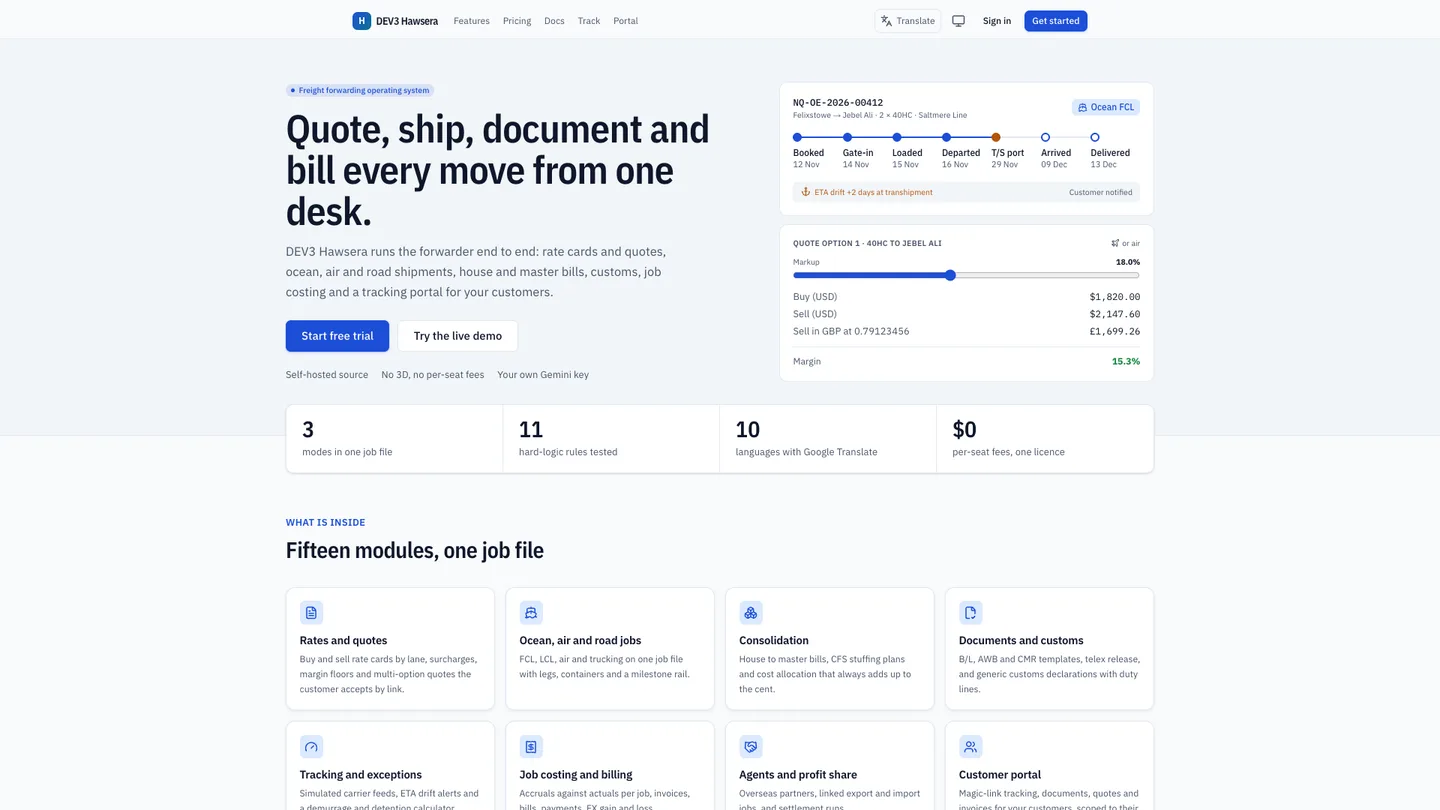
Home: A freight forwarding workspace for quotes, shipments, documents and money in one place. Home — A freight forwarding workspace for quotes, shipments, documents and money in one place.
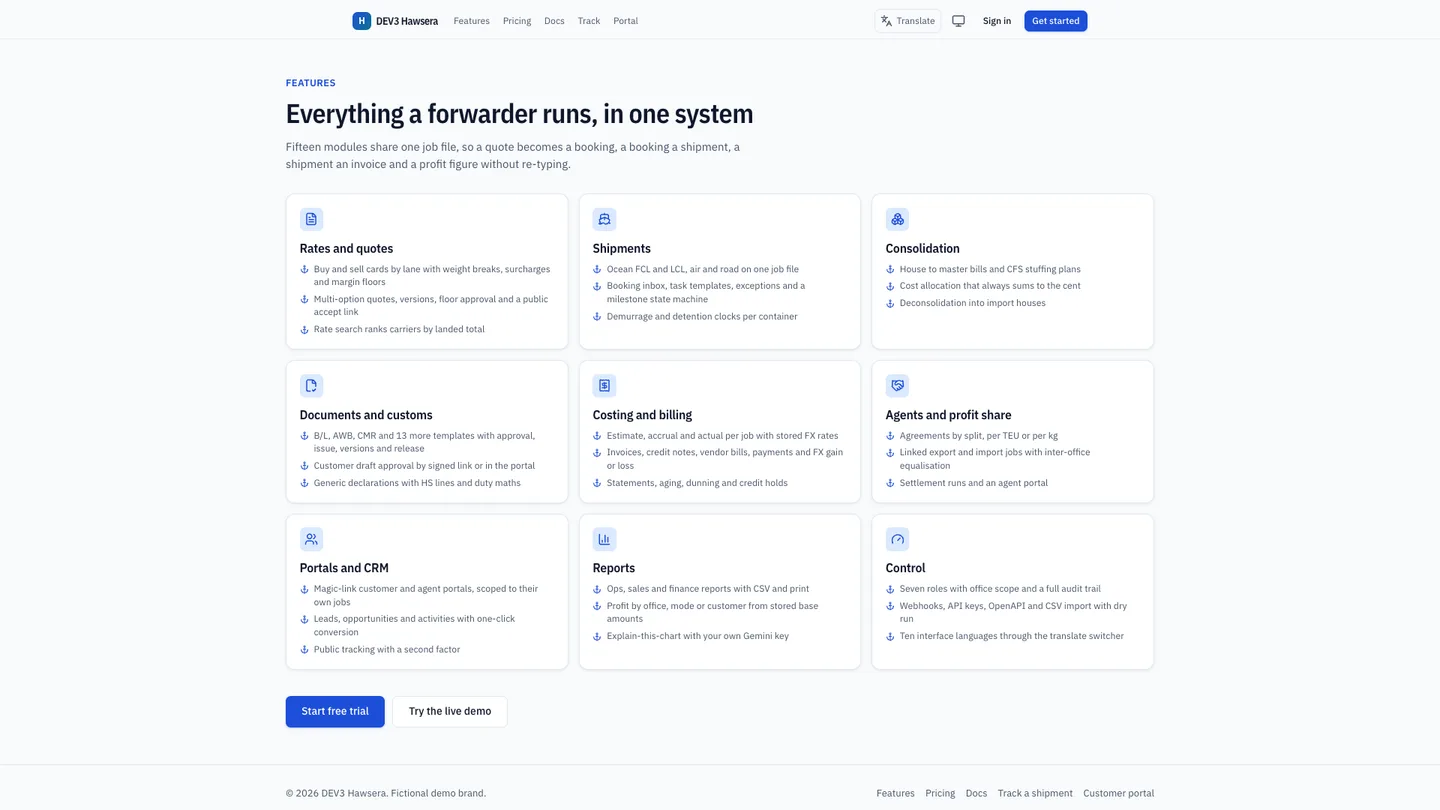
Features: Rates, quotes, shipments, consols, customs, costing and portals at a glance. Features — Rates, quotes, shipments, consols, customs, costing and portals at a glance.

Guides & articles

Practical guides and engineering write-ups for DEV3 Hawsera.

Freight forwarding software: 6 things to check before you pick one

Last updated
Freight forwarding software: 6 things to check before you pick one: DEV3 Hawsera

Forwarding software looks alike in a feature list until you ask the awkward questions: what stops a charge being billed twice, who can see a bill of lading before the shipper has paid, and what a customer can see about someone else's cargo. Here are six things to check, with DEV3 Hawsera as the worked example.
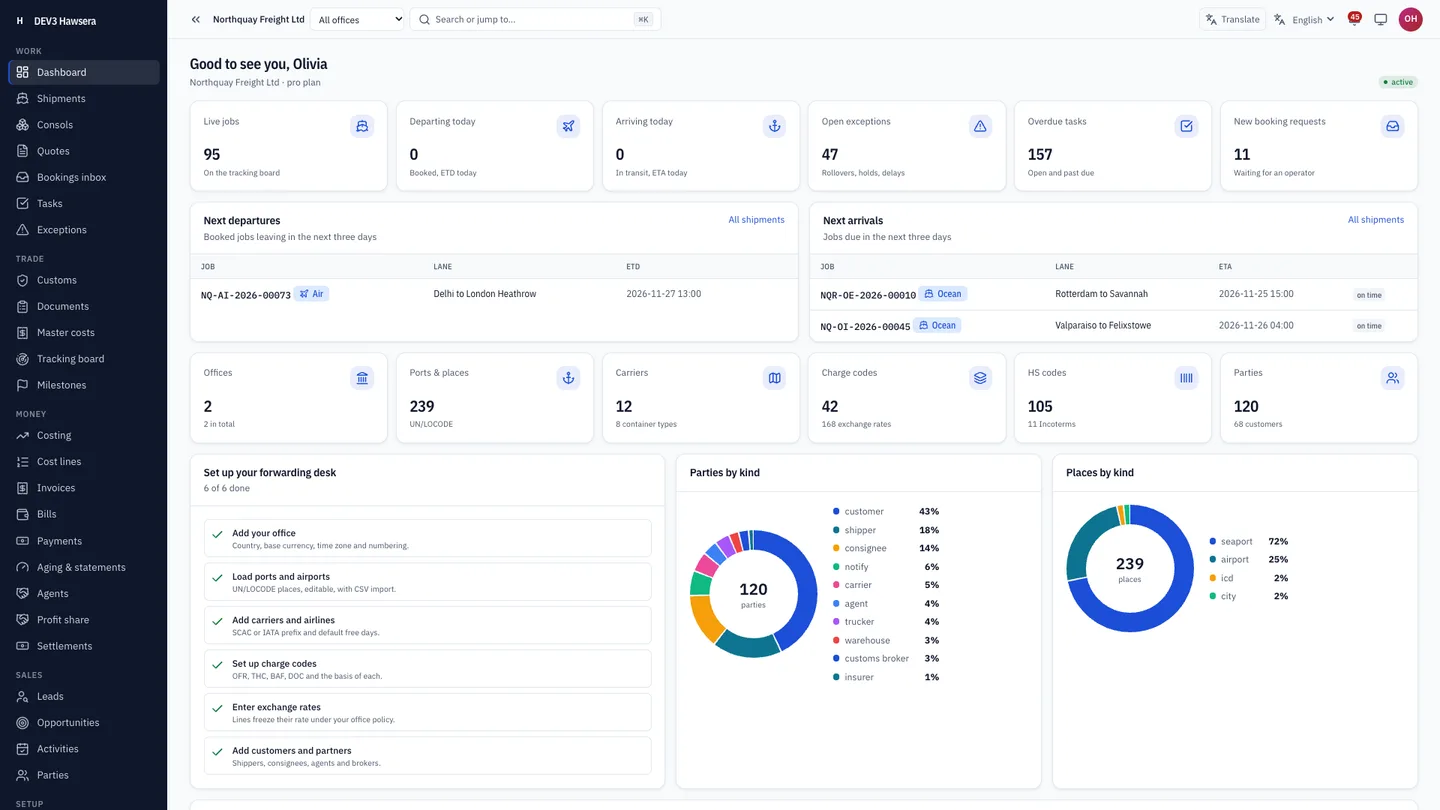
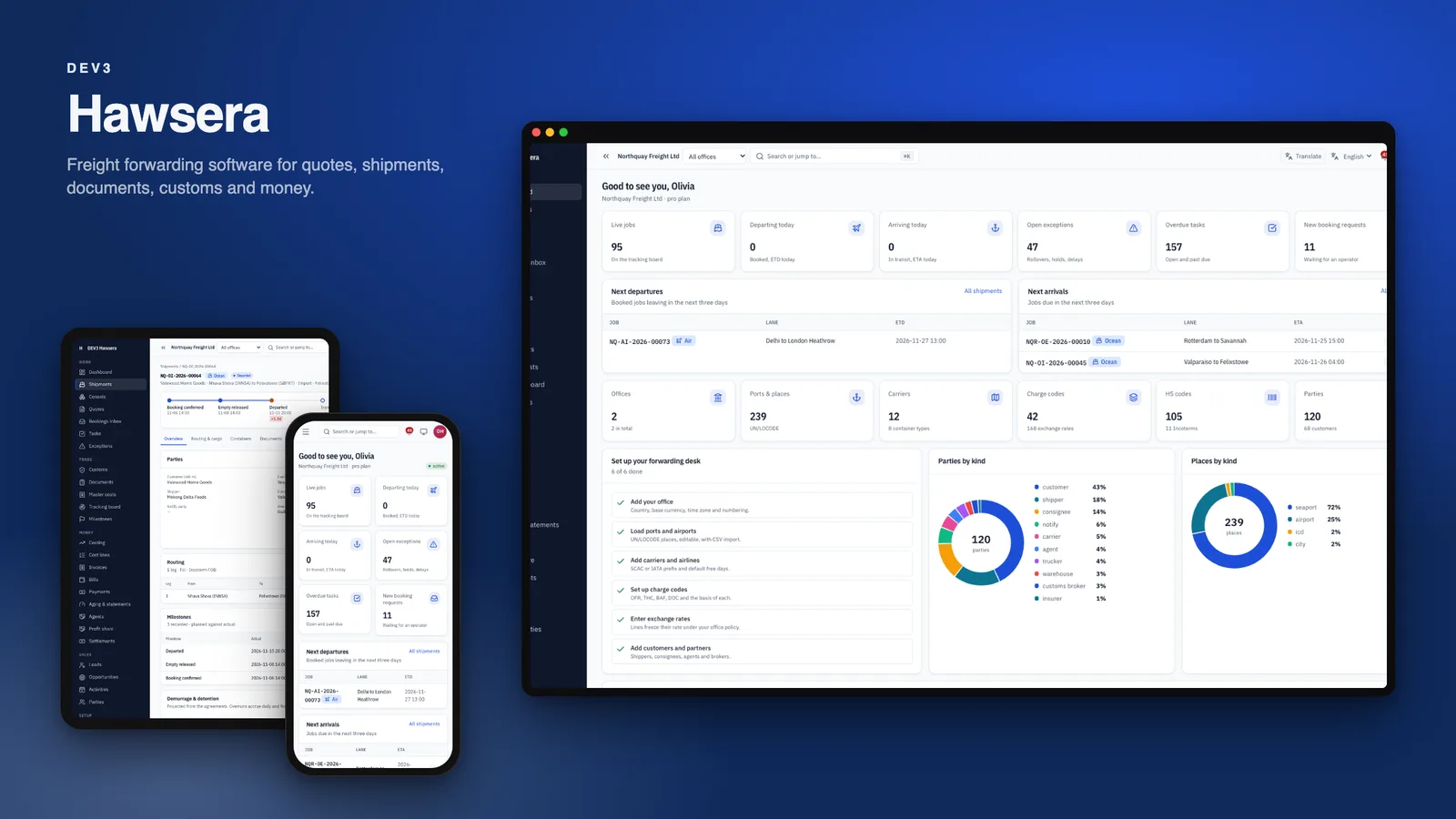
The dashboard with live jobs, departures, exceptions and open tasks

A walk through shipments, tracking, quotes, consols, invoices and reports

1. Are quotes built from rate cards, with a margin floor?

A quote should come from buy and sell rates with validity, minimums and surcharges, and a quote below your margin floor should need a second person. Hawsera calculates chargeable weight and every line on the server and binds an approval to the exact quote version.
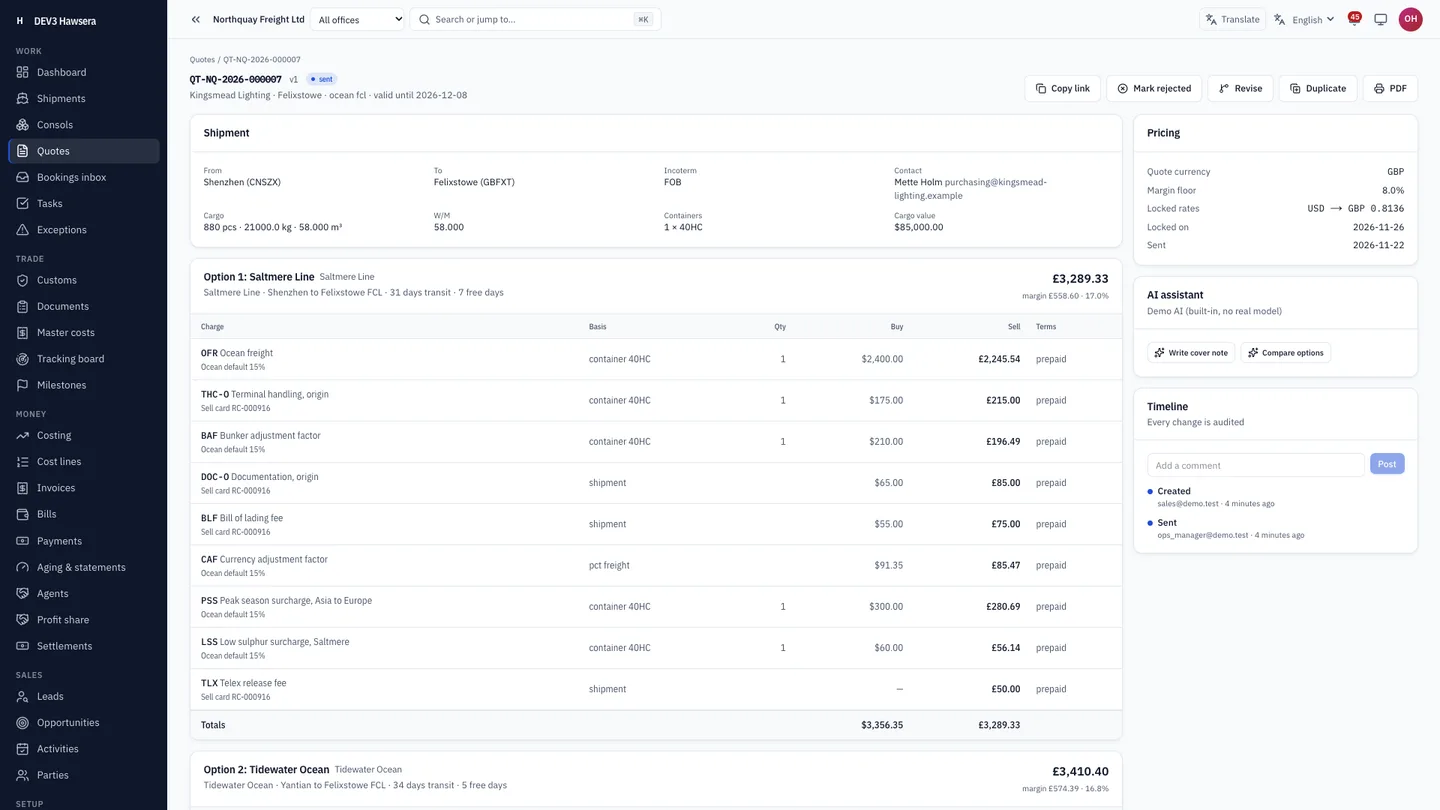
Quote detail with charge lines, margin and the accept link

2. Does each job follow a milestone path for its mode?

Ocean, air and road jobs have different steps. Look for planned against actual dates, blocked jumps (a customs hold must stop a job at clearance) and exceptions raised on the job.
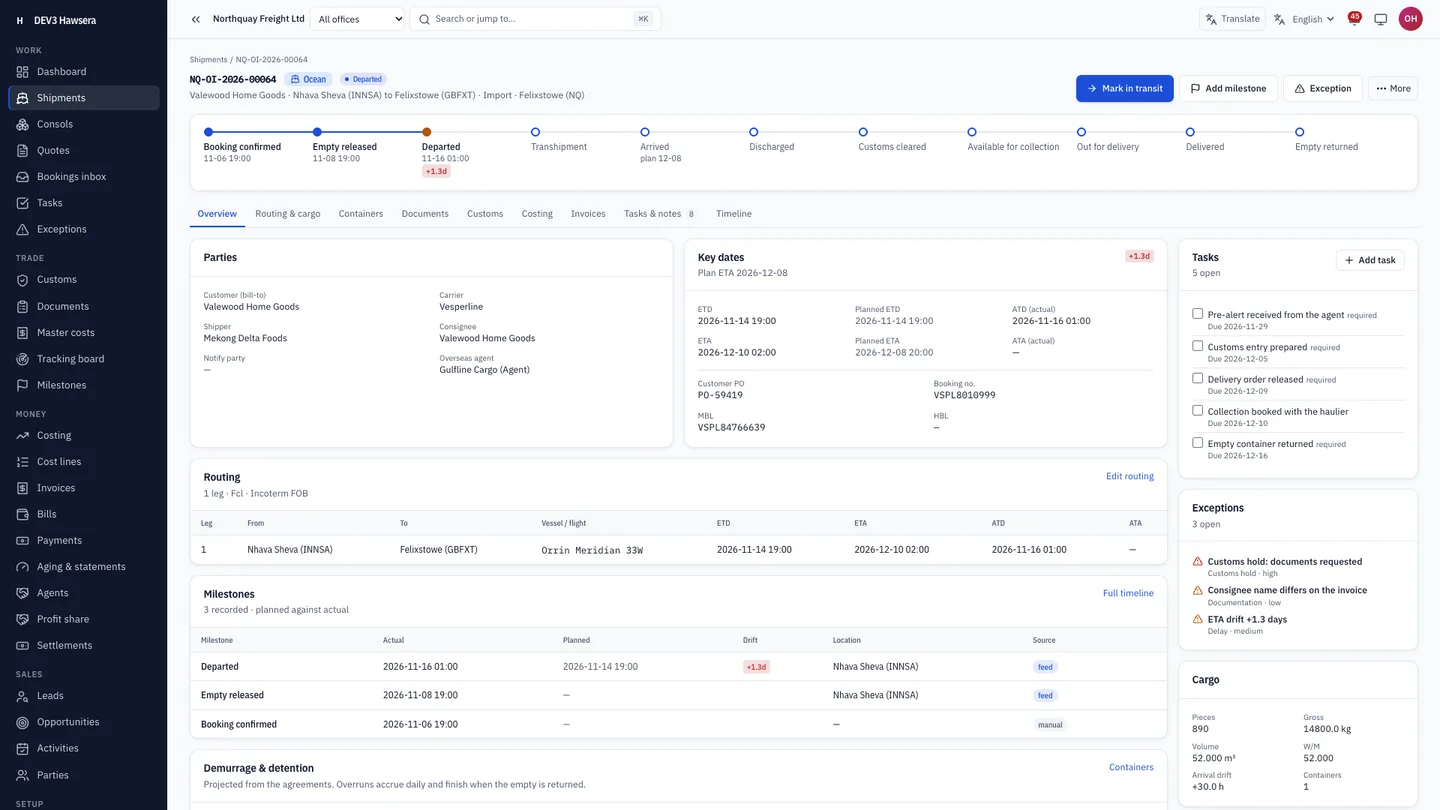
The job workspace with the milestone rail

3. Can you see the whole fleet at a glance?

A tracking board by milestone shows late and held jobs without opening each file. Hawsera's feed is simulated so you can see where carrier and airline APIs plug in.
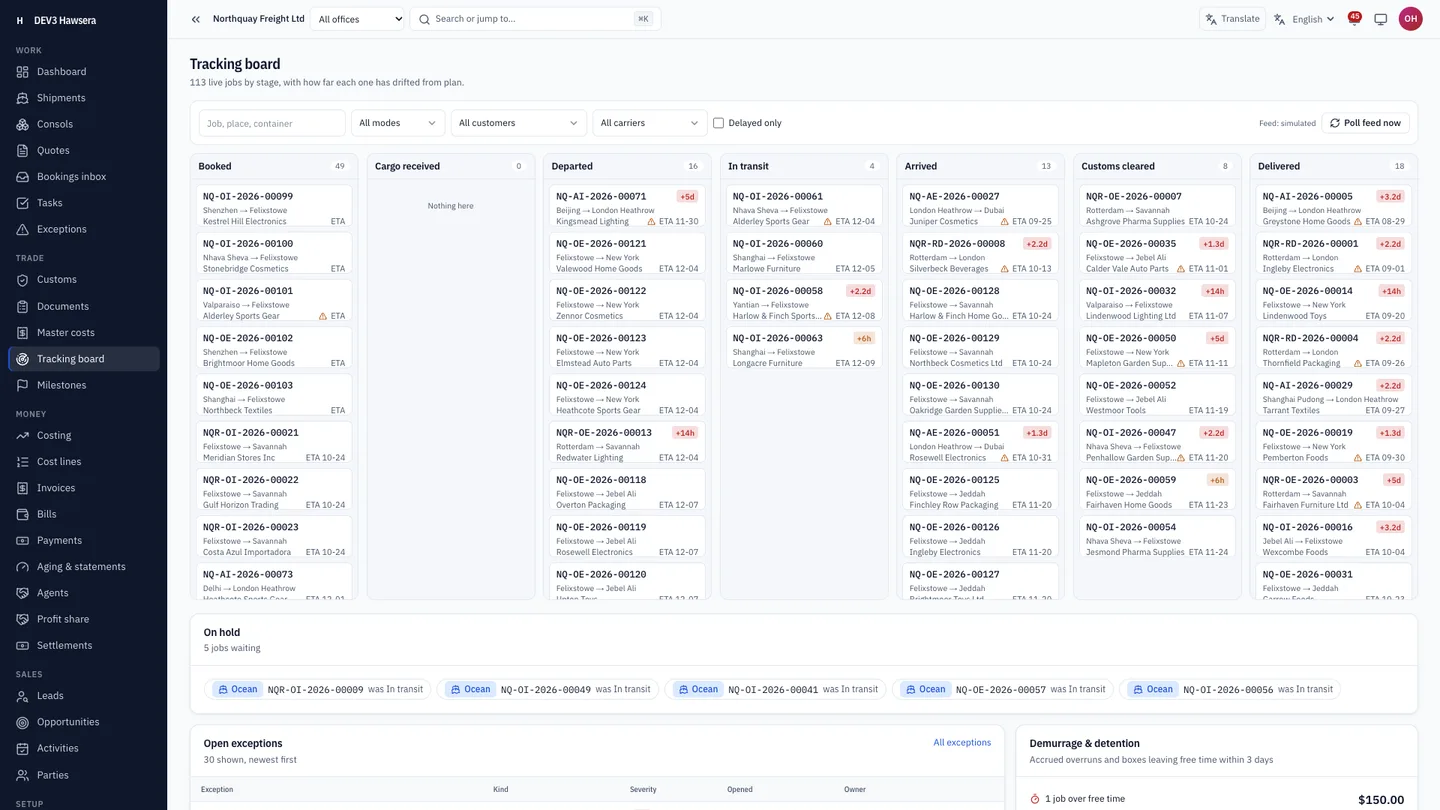
The tracking board by milestone

4. Are documents and release under control?

A house bill of lading is leverage. Look for templates, versions, void, customer draft approval and release control, so originals do not leave the building until accounts say so.
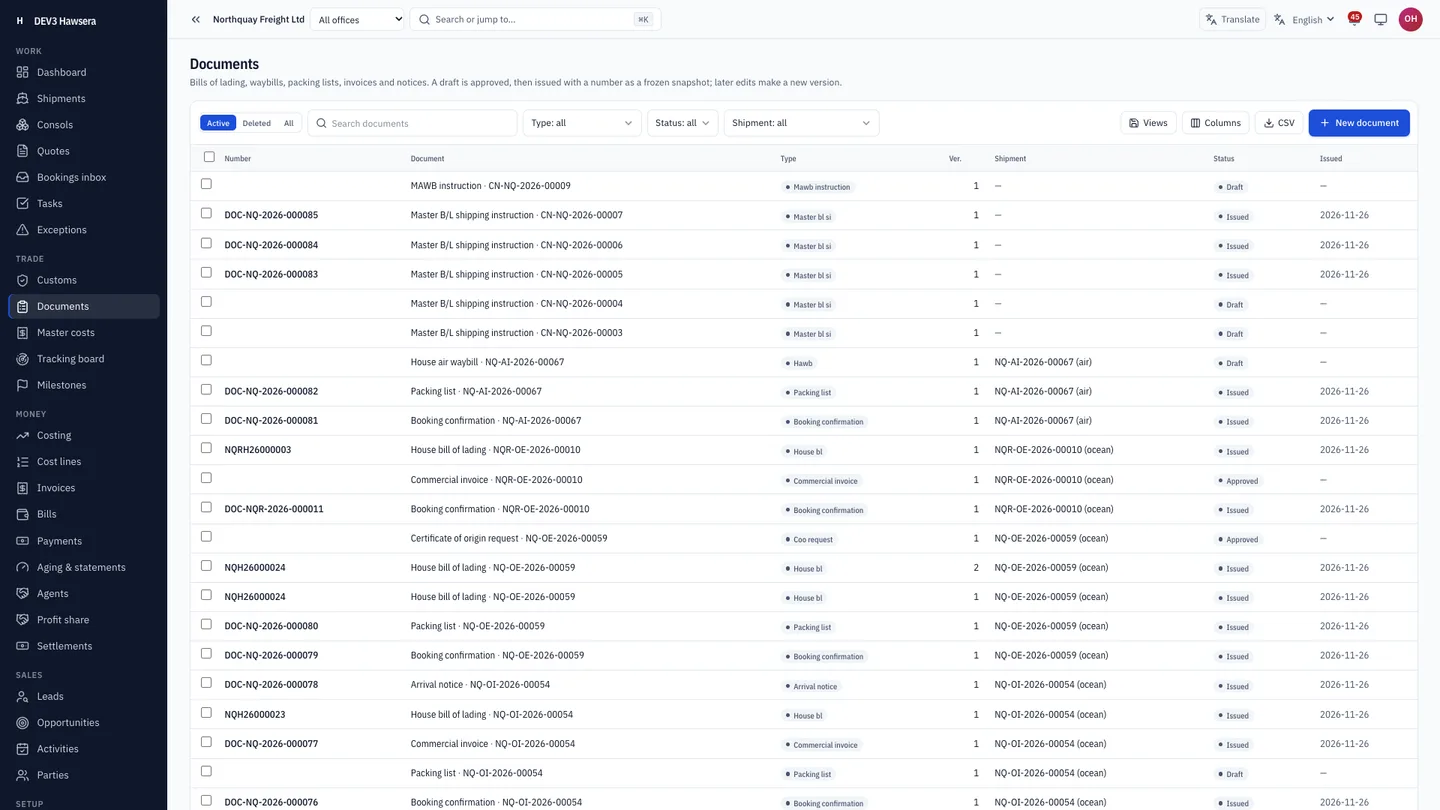
Documents with versions and release control

5. Does costing tie to invoicing?

Costs, accruals, invoices, credit notes, vendor bills and payments should share one job file, with aging and a credit hold. Hawsera claims each invoice line once, so a charge cannot be billed twice.
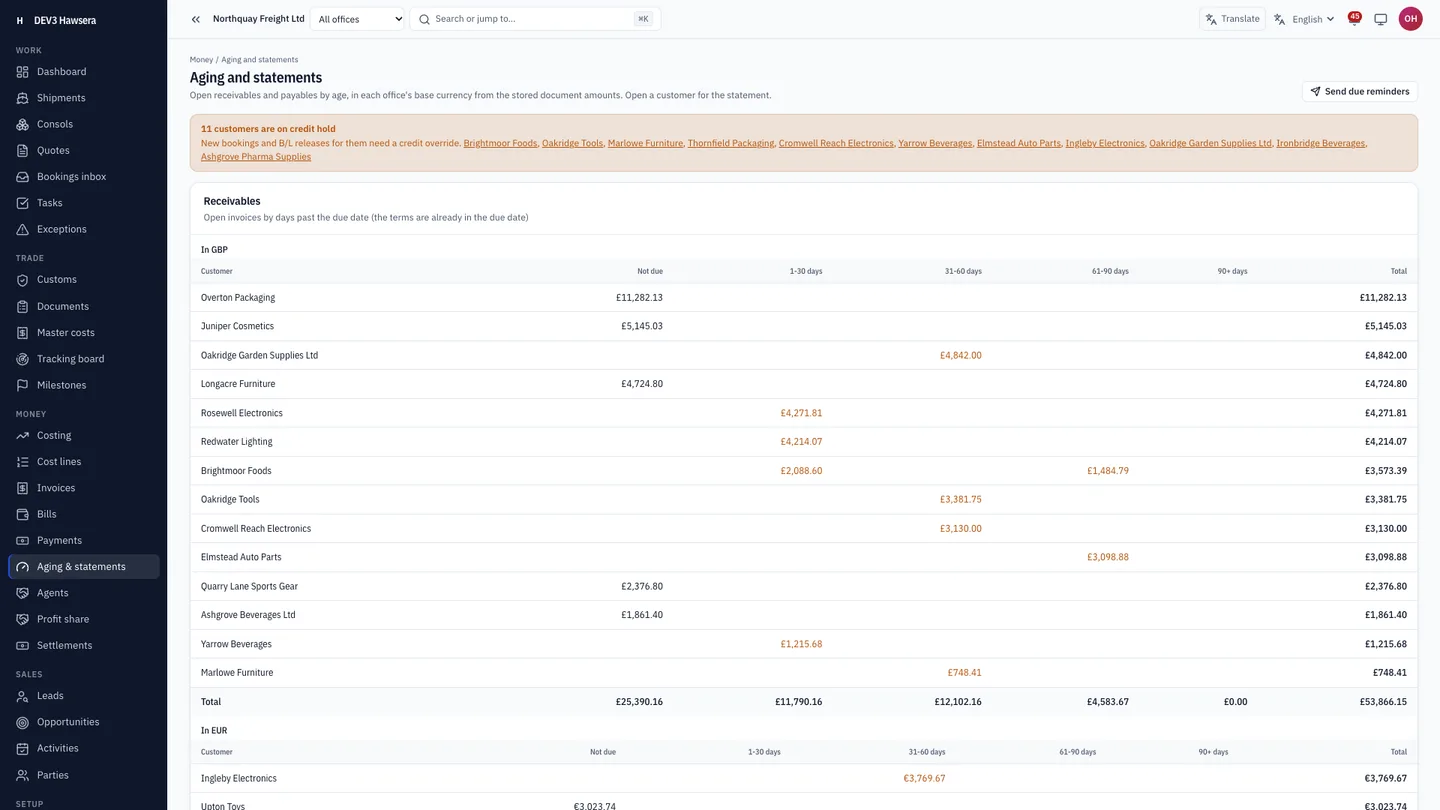
Receivables aging by customer

6. What are the honest limits?

Hawsera records payments but does not move money. Tracking and customs adapters are simulated, documents use print views instead of a PDF engine, and AI needs your own key. They are listed on the item page so you can plan around them.
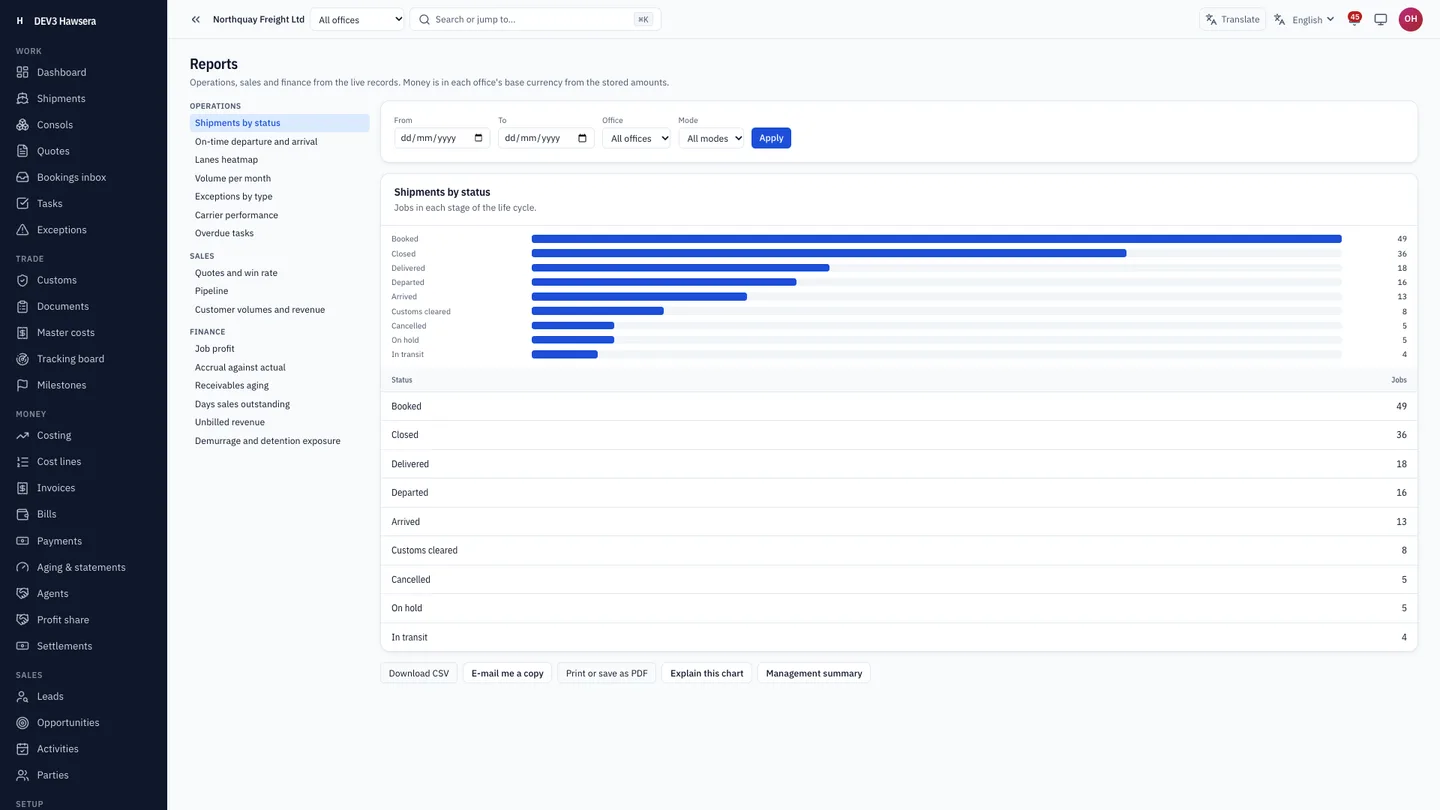

Reports with filters, charts and CSV

Frequently asked questions

The complete source code (version 1.0.0) as a download from your account, with the setup and usage guides shown on this page. You can modify the code to suit your product.

Questions about this product (0)

Answers from the DEV3 team and the community.

Ask a question

No questions yet.

Wondering about setup, licensing or customisation? Ask, and the DEV3 team will help.

More from this author

View all

Related in Enterprise SaaS Starters

View all