DEV3 Technologies home

DEV3 Fixturly – Sports League & Club Management SaaS with Fixture Generator & Gemini AI Admin Tools

Self-hosted league and club management on Next.js 16 and MongoDB: registrations and fees, teams, a constraint-aware fixture generator, results and standings, referees, venues and a public league site. Gemini AI admin tools, setup wizard and demo data included.
by DEV3 TechnologiesVerified AuthorUpdated 26 Nov 2026

Black Friday: up to 30% off

This item is 30% off: $69.30 instead of $99

Ends in
--
Days
--
Hrs
--
Min
--
Sec

Video tour. Pick a section below to browse 35 screenshots in 19 sections.

App & phone tours

Tap play to watch each app. Nothing downloads until you do.

  • Mobile web0:08

Fixturly is a sports league and club management platform you run yourself, built by DEV3 Technologies on Next.js 16, React 19, TypeScript, Tailwind 4 and MongoDB. Each tenant is one league, association or multi-team club: it opens a season, takes registrations and fees, builds teams, generates the fixture list, scores matches, publishes the tables and pays its referees. The demo data is fictional: a youth football league (Riverbend, with two seasons and fifteen divisions), a social netball association and a basketball club.

The engine is sport-neutral and ships ten editable presets (football, futsal, basketball, netball, hockey, rugby, cricket, volleyball, handball, baseball and softball) that set the periods, score parts, card types, points and stat keys. Web, plus an installable PWA for match day (/m) for coaches, referees and scorekeepers, with an offline queue for scoring. Every page works at 390 px. The look is a crisp scoreboard: sport red on zinc, Barlow type, crest chips and form pills, light and dark.

Seasons, competitions and rules

  • Setup: seasons with a life cycle, competitions, divisions by age band and gender, and per-competition rules: points for a win, draw and loss, an ordered tie-breaker chain, forfeit and walkover scores, rest days, roster limits and an age cut-off date.
  • Presets: ten sport presets you can edit per league. Lists everywhere have filters, saved columns, bulk actions and CSV import and export.

Registration and people

  • Form builder: registration forms per season and division with fees, early-bird and late prices, waivers, capacity and custom fields.
  • Family basket: one checkout for several children with sibling tiers, promo codes and hardship waivers, and a held place that expires.
  • Waitlist: offers go to the first in line with an expiry, in priority order for returning and sibling players.
  • People and consent: players, guardians and adults, versioned consent wording, photo permission that hides a minor's surname, merge and duplicate finder, age-out to a self-managed account, erasure and JSON data export. Medical notes are encrypted at rest.

Fees and finance

  • Invoices and payments: fee schedules, installment plans with automatic retries, simulated checkout, refunds by policy with a quote, credit and sibling re-tiering.
  • Club dues and reports: dues per club, aged balances and finance reports, with a family payments page.

Clubs, teams, venues and bookings

  • Teams: clubs, teams and rosters with shirt numbers, captains and place limits, a team builder board and player cards with QR.
  • Venues: fields suited to an age band, weekly slot templates, closures and a booking calendar with a clash guard that stops two matches taking one field.

Fixtures, results and standings

  • Fixture generator: single or double round-robin placed on venue slots by a constraint search: blackout dates, rest days, shared coaches, travel grouping and a seed. Lock a match, re-run, review the draft round by round, then publish. A match that cannot be placed says why.
  • Changes: move, postpone, cancel or swap a match, move a whole bad-weather day, request a reschedule that a scheduler approves, and subscribe to a signed calendar link per team, person, venue or division.
  • Results: score entry with approval, a dispute path, forfeits and a reopen step.
  • Standings: a configurable tie-breaker chain, head-to-head, adjustments with a reason, form pills and an explanation of the order.
  • Tournaments: groups into knockout brackets with the best third-placed teams, byes and penalties.

Match day, discipline and transfers

  • Match sheet: eligibility-checked line-ups, an append-only event log (goals, cards, substitutions) that replays safely after an offline gap, a score derived from the events, and first sign-off wins.
  • Suspensions: cards turn into suspensions by rule (a red card, a number of yellows), appeals, and transfers that carry a suspension to the new team.

Officials

  • Referee profiles, availability, an assignment board with suggestions, conflict and travel-buffer checks, parallel-accept protection, ratings, pay rates, pay runs and statements, and a phone page for assignments.

Communication, public site and reports

  • Announcements to a league, club or team with recipient rules and one-time sends; team threads with minor safeguards; events with RSVP and attendance; volunteer shifts.
  • Public league site per league: tables, fixtures, results, news, clubs, venues, sponsors, embeds with an iframe snippet, a sitemap and a theme with a contrast check.
  • Reports hub, settings, notification rules, webhooks, an imports hub, an audit log and English, Spanish and Arabic.

Gemini AI admin tools

Draft announcements, explain a standings table, summarise a match report from its events and fix a messy import. Prompts carry figures and role tokens, never names. You add your own key; in the demo a labelled sample driver answers.

Safe by design

  • Every tenant query goes through a guard that fails closed, and roles are scoped by club, team, person or competition. Money is whole minor units; seats, pay runs, results and bookings are claimed with conditional writes, so parallel requests cannot oversell a division, double-book a field or lose an edit.
  • 1,610 app tests pass, including races and a 403 test for every role; a headless smoke run covers 603 routes and 83 happy paths. Independent reviews of registration, finance, fixtures, match day, officials and public data were done at each stage and their findings fixed.

Good to know

  • Simulated services. Payments, email, SMS and AI run on simulated drivers until you add your own keys.
  • Scheduled work (holds, waitlist offers, installments) runs when you call the cron endpoint.
  • No video streaming and no native apps; match day is a PWA. Cricket scoring is basic (limited overs).
  • You need Node.js 20.9+, MongoDB 6+ as a (single-node) replica set and HTTPS.

What you get

The application source with the core under packages/next-core, a setup wizard, demo data, .env.example, scripts (seed), tests, the buyer documentation, START-HERE.txt and the licence. Setup wizard and demo data included.

How it's built

Architecture, stack, key decisions and the quality gates DEV3 Fixturly passed before release.

The engineering behind Fixturly: a deterministic fixture generator with locks, a tie-breaker chain, results with one approval, a field clash guard, referee assignment that survives parallel accepts and an offline match sheet that replays safely, with the known limits written down.

The problem it solves

A league looks simple until two schedulers publish the same division, two coaches take the last place, a field is booked twice, a result is approved while a dispute is open, two referees accept one slot or a scorekeeper loses signal at half time. Each must end with one correct state, for many leagues sharing one install, with children's data that must never leak.

Architecture and approach

Fixturly is a Next.js 16 application on MongoDB. Every tenant-owned model passes through a guard that requires an organisation id on each query and throws when a filter has none; a test lists the models so a new one cannot skip it, and roles scoped to a club, team, person or competition are filtered in the same layer. Money is whole minor units. The fixture generator is a pure function: rounds go to match weeks and each match takes a (venue, field, time) slot by a most-constrained-first search with backtracking, honouring blackouts, rest days and shared-coach pairs; the same seed gives the same draft, locked matches survive a re-run, and a match that cannot be placed returns its blockers. Publishing claims each match with a conditional update on the version it read and then takes the field through a booking guarded by a unique cell, so two publishers or a late booking put back only the affected match. Standings are computed from approved results with a configurable tie-breaker chain, head-to-head re-applied to smaller groups and an explanation. The match sheet is an append-only event log whose score is derived from the events; the offline queue replays by key, and the first sign-off wins. Referee accepts, pay runs, registration seats and waitlist offers are claimed with conditional updates, and erasure scrubs a person while keeping fee records.

Quality gates and results

The release passed seven gates (static checks, 1,610 app tests with parallel-request races and a 403 test for every role, build with a JavaScript budget, seed, a headless smoke run over 603 routes with 83 happy paths, an install from the zip and a secret scan), and independent reviews after the registration, finance, fixtures, match-day, officials and public-site stages, whose findings were fixed before release. The known limits are written in the listing: simulated payment, mail and SMS drivers until you add your own keys, basic cricket scoring, no video streaming and scheduled work that runs from a cron call.

Tech stack

Area Technologies
Application Next.js 16, React 19, REST API
Data MongoDB (replica set), Mongoose
Match day Installable PWA, Offline scoring queue with replay
Frontend Tailwind CSS 4, Barlow fonts
Quality Vitest, Headless smoke run

Inside the build

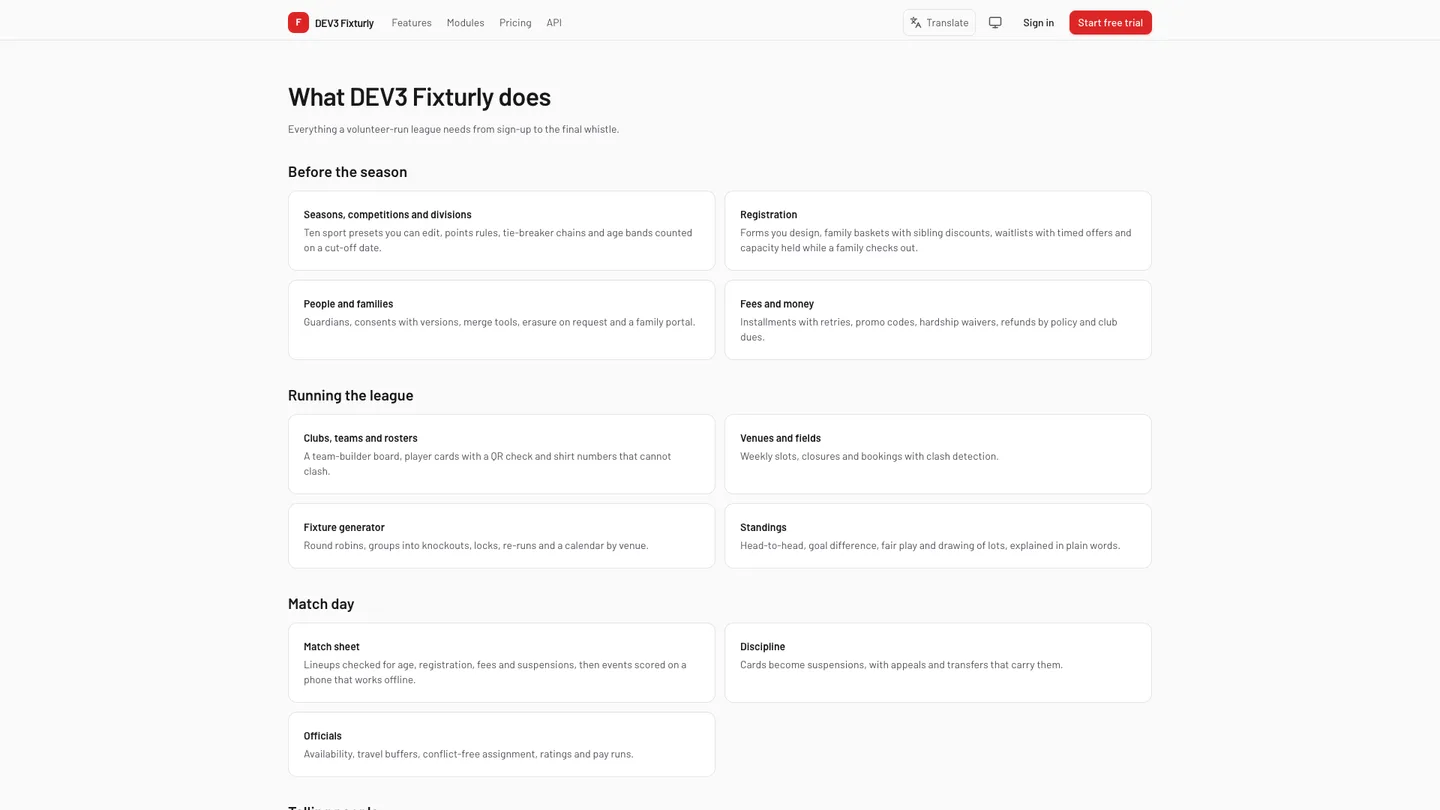
Fixturly: League and club management with fixtures, standings, registration and match day in one place. Fixturly — League and club management with fixtures, standings, registration and match day in one place.
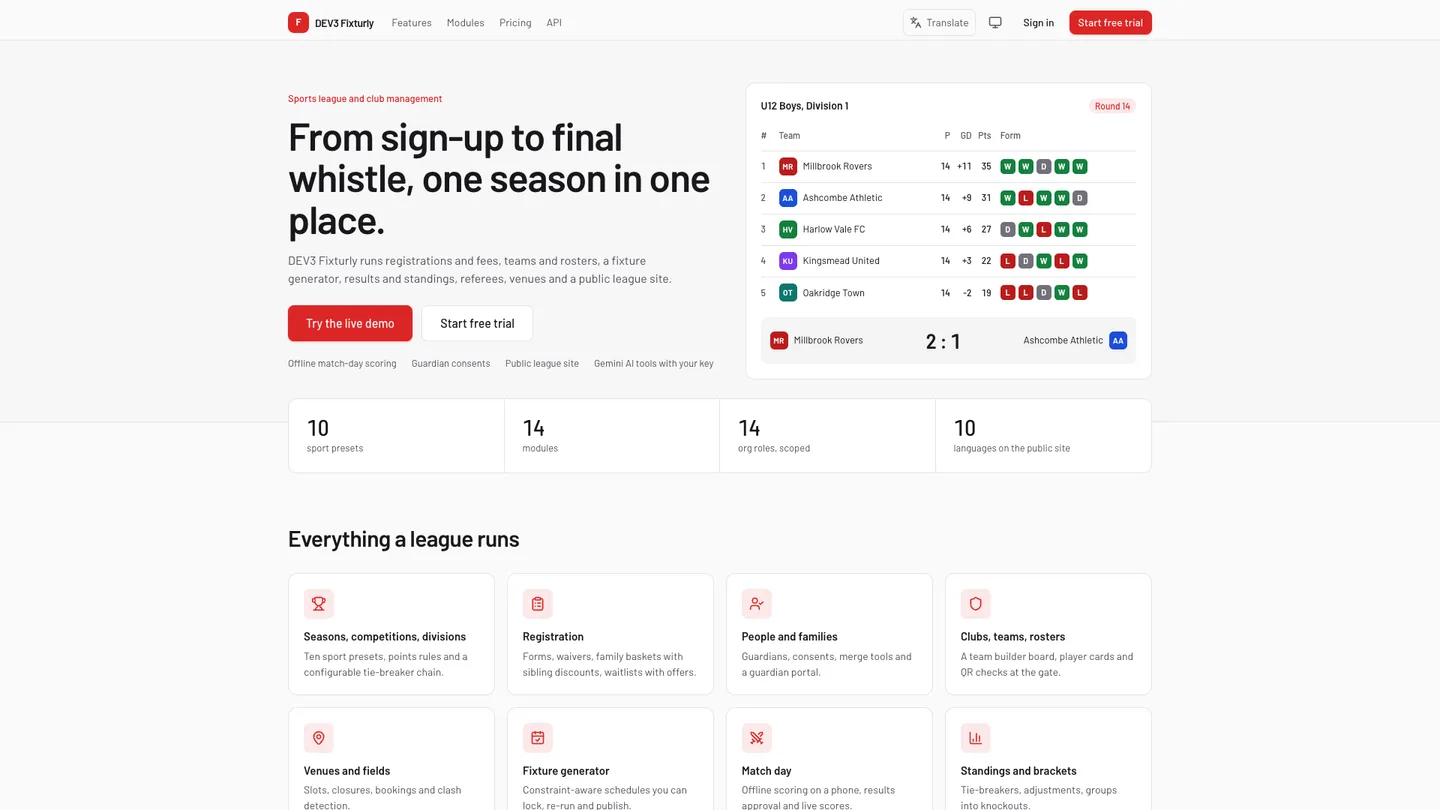
Features: Every module of a youth sports league from registration to the public site. Features — Every module of a youth sports league from registration to the public site.

Guides & articles

Practical guides and engineering write-ups for DEV3 Fixturly.

Sports league management software: 6 things to check before you pick one

Last updated
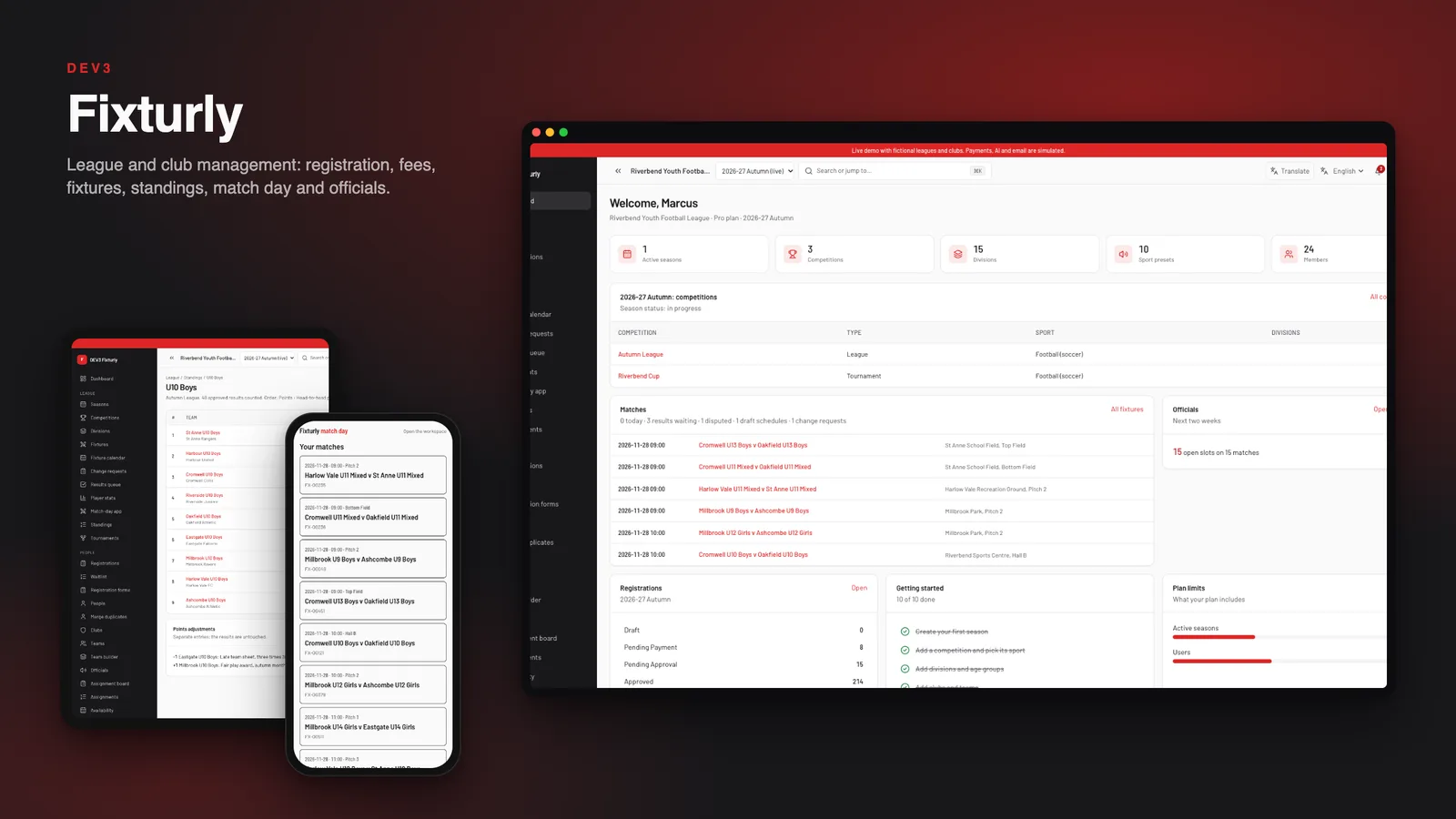
Sports league management software: 6 things to check before you pick one: DEV3 Fixturly

League software looks alike in a feature list until you ask the awkward questions: what happens when two schedulers publish the same division, how a tie on points is settled, and who can see a child's medical note. Here are six things to check, with DEV3 Fixturly as the worked example.
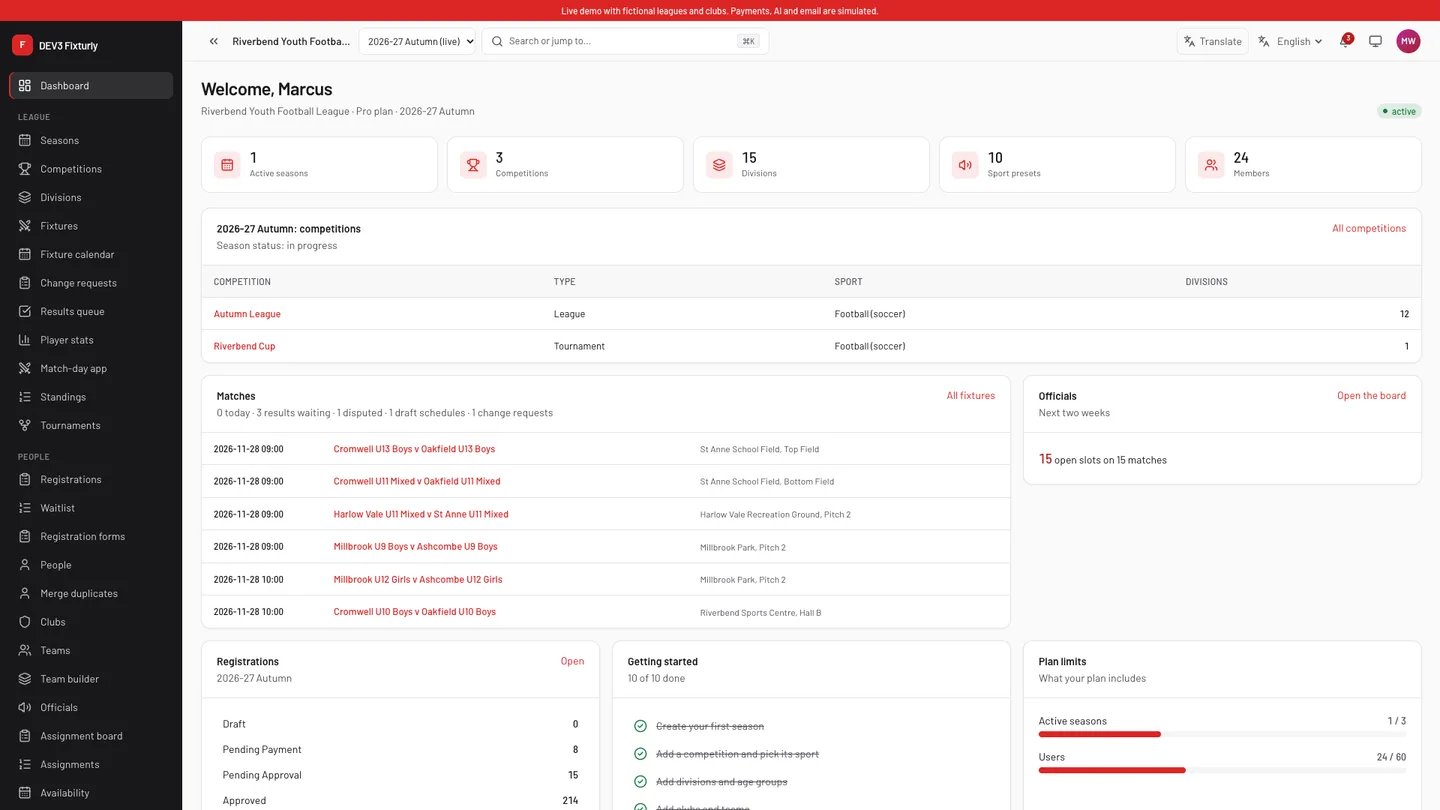
The league dashboard with registrations, fixtures and results to approve

A walk through registrations, the generator, results, standings, referees and the public site

1. Do fees cope with real families?

Sibling discounts, promo codes, hardship waivers and installments with retries decide whether the registrar keeps a spreadsheet. Fixturly prices a basket dearest first, holds the place for a time and offers a freed place to the waitlist in priority order.
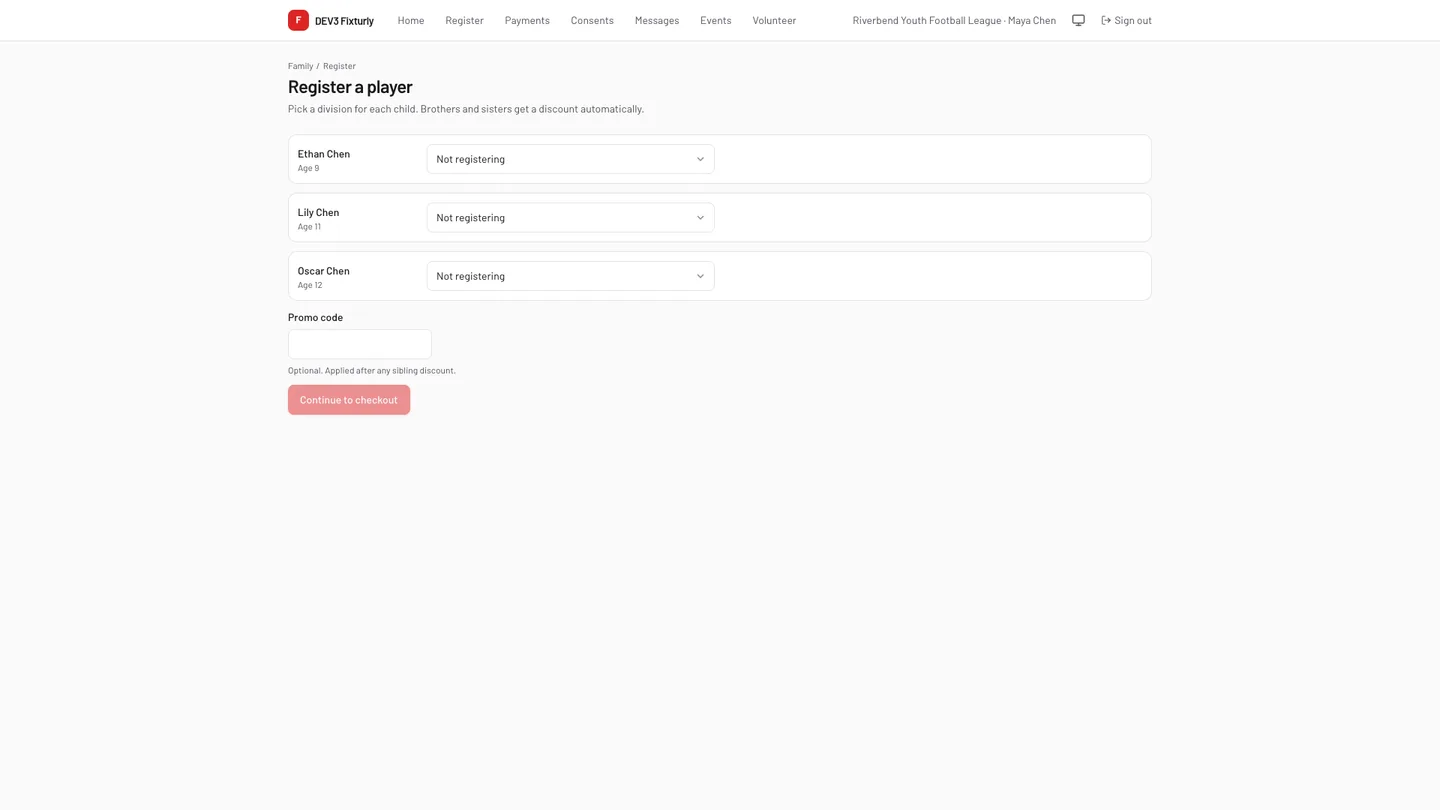
Family registration with a sibling discount

2. Does the fixture generator explain itself?

Look for blackout dates, rest days, shared coaches and field suitability, plus a way to lock a match and re-run. Fixturly returns the blockers for any match it cannot place and publishes through a clash guard.
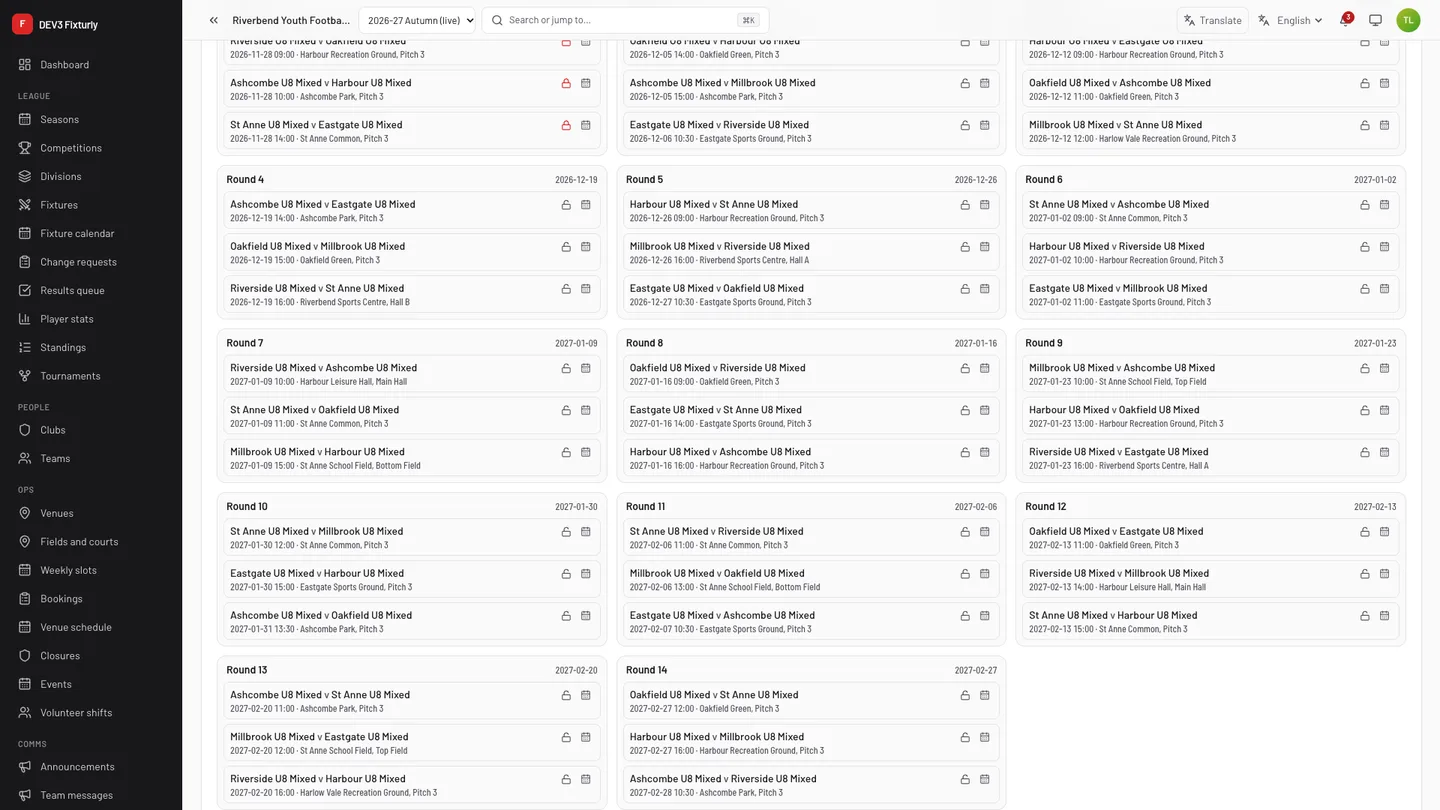
The draft schedule with locks and conflicts

3. Is the table order defensible?

Parents will check it. Look for a configurable tie-breaker chain, head-to-head and adjustments that carry a reason.
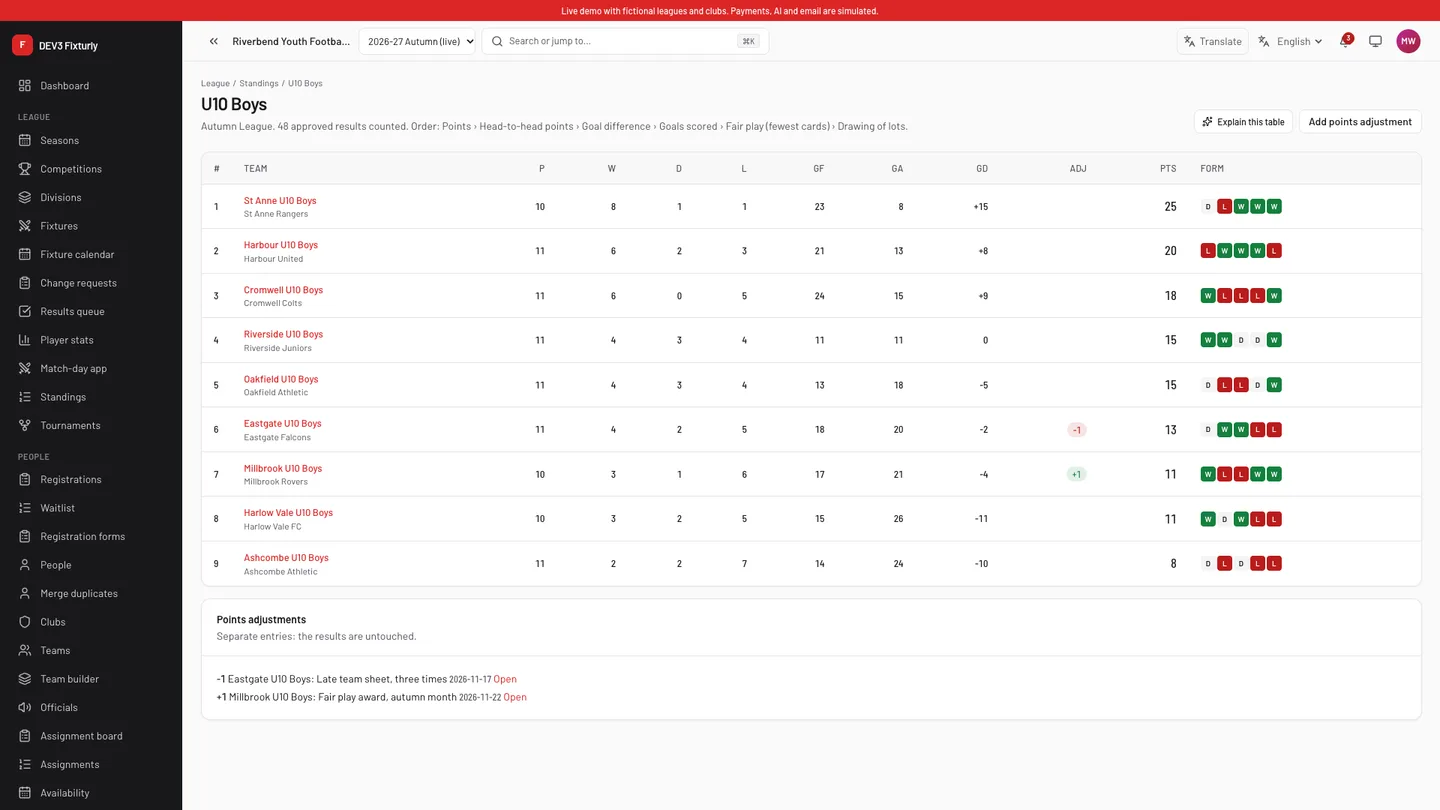
Standings with tie-breakers

4. Can referees be assigned without double-booking?

Availability, travel buffers and a board that suggests who is free matter more than a spreadsheet of names. Fixturly guards parallel accepts and keeps pay statements per run.
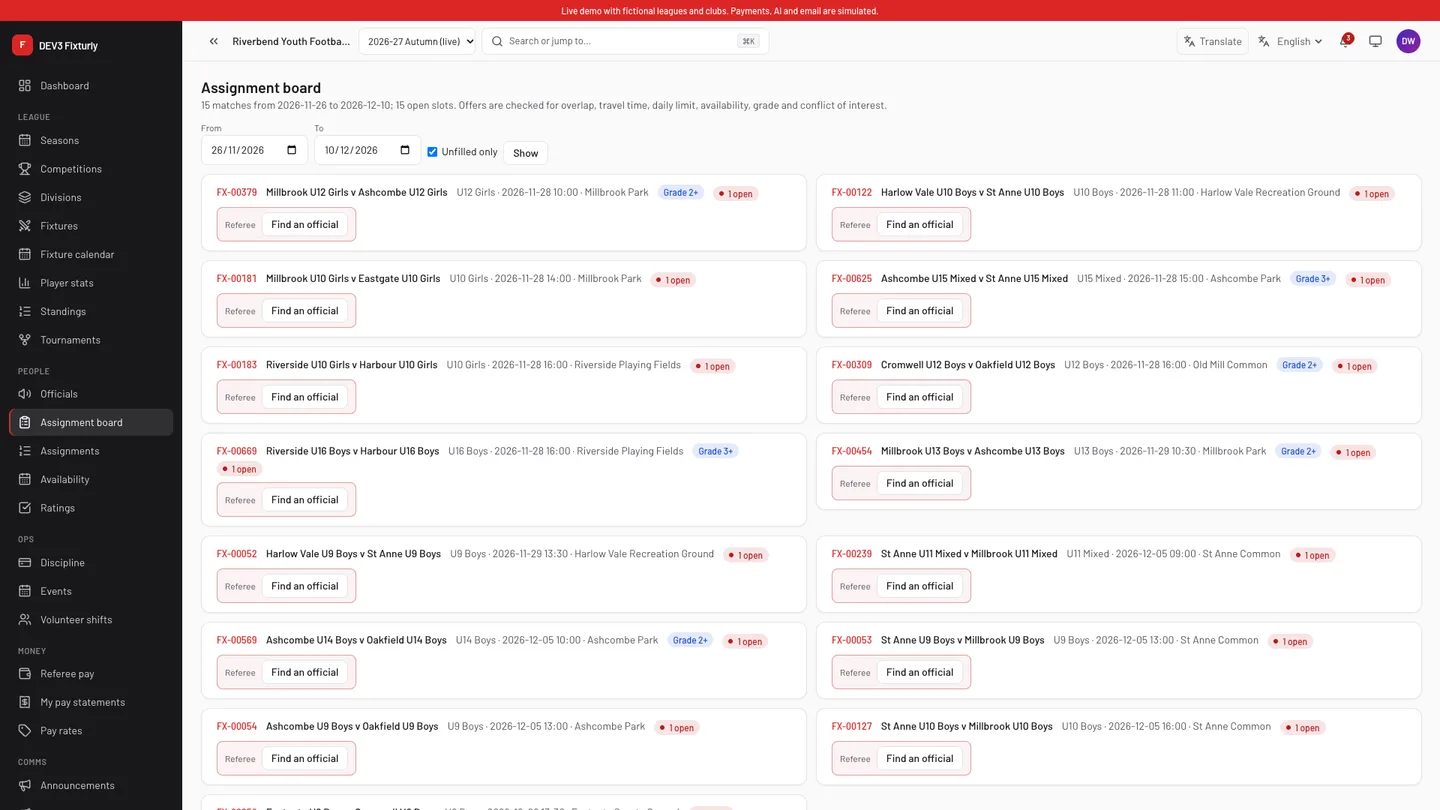
The assignment board

5. Are minors' records private?

Photo permission should hide a minor's surname on the public site, and erasure should keep the fee record while removing the person.

6. Can you own the data?

A self-hosted install on your own MongoDB with a REST API and CSV export on every list means your records stay yours.
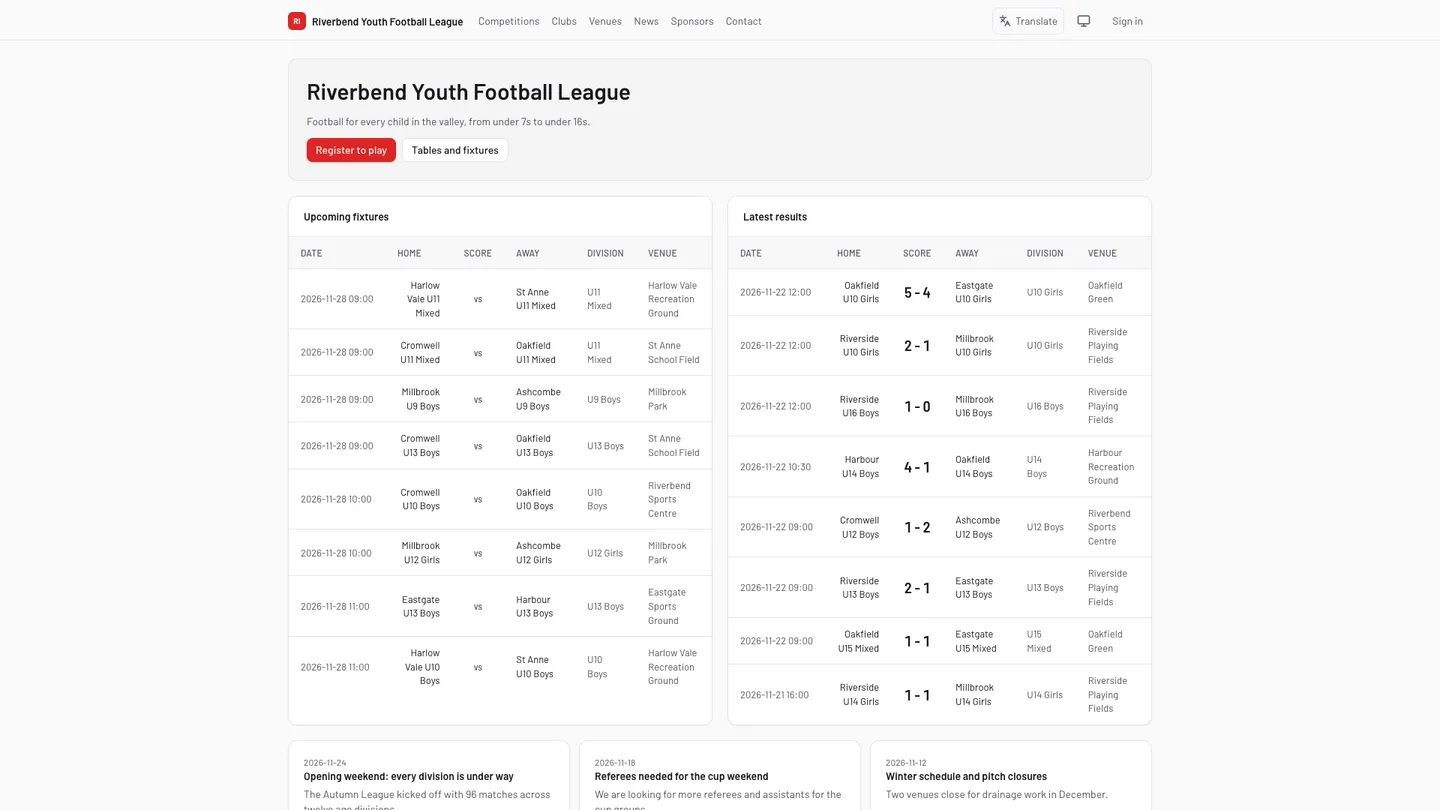
The public league site

Frequently asked questions

The complete source code (version 1.0.0) as a download from your account, with the setup and usage guides shown on this page. You can modify the code to suit your product.

Questions about this product (0)

Answers from the DEV3 team and the community.

Ask a question

No questions yet.

Wondering about setup, licensing or customisation? Ask, and the DEV3 team will help.

More from this author

View all

Related in Enterprise SaaS Starters

View all