Web Scripts & Software
DEV3 Chord Progression Generator & Player — Source Code (React + Tailwind)
from $20$29
Loading…
Design tool
Free, no sign-up. Runs in your browser; nothing is uploaded. Buy the source code: $29 Regular / $69 Extended
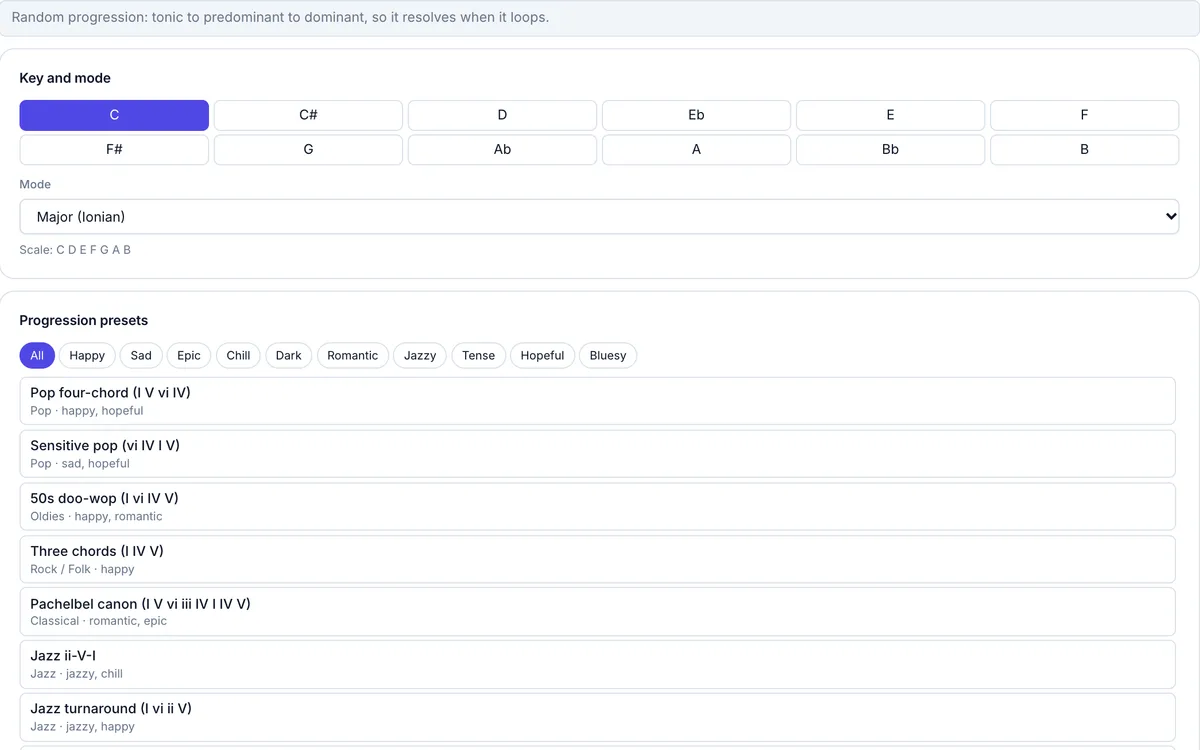
Scale: C D E F G A B
Follows tonic, predominant, dominant movement so the loop resolves.
| C      | G      | Am     | F      |
  I        V        vi       IV
Need Chord Progression Generator & Player as a complete website or app for your brand? We design and build it end to end. Built in about a week, from $99. Send your requirements or SOW; you get a fixed quote and a delivery date.
The chord progression generator & player stays free to use online. If you want the code to run, edit and ship in your own project, get the full source from the DEV3 Marketplace. Instant download, 6 months of support.
Launch the full site, not just the asset. Buy once, own the source, and try each one live first.
Web Scripts & Software
from $20$29
Enterprise SaaS Starters
from $69$99

Web Scripts & Software
from $69$99
Web Scripts & Software
from $20$29
Web Scripts & Software
from $20$29
Web Scripts & Software
from $20$29
Web Scripts & Software
from $20$29
Web Scripts & Software Mobile app
from $69$99
A chord progression is the harmonic loop under a song. Pick a key, choose a preset or generate one, press Play and tweak it until it fits your idea.
Each chord card shows the chord name, its roman numeral, its Nashville number, the notes, a piano diagram and a guitar chord box. The piano voicings are chosen so that each chord moves as little as possible from the last one, which is how pianists play progressions. You can change any chord's type from the menu, move it, duplicate it or remove it.
Choose piano, electric piano, organ, synth or a plucked guitar sound, and a pattern such as block chords, arpeggios, strum, off-beat stabs or a pop-piano eighth-note pulse. Tempo, beats per chord, bass and looping are all adjustable. The sounds are generated in your browser.
Chords are built by stacking thirds on each note of a scale. Major keys give major, minor, minor, major, major, minor, diminished (I ii iii IV V vi vii°). Natural minor shifts that pattern (i ii° III iv v VI VII). Modes such as Dorian or Mixolydian change one or two notes, which is why a bVII chord sounds so rock and roll.
I V vi IV, for example C G Am F in C major, is the best-known four-chord loop in pop and rock. I vi IV V (C Am F G) is the classic 50s version. Both are in the presets, and you can move them to any key with one click.
It uses functional harmony. Chords are grouped as tonic (home), predominant (moving away) and dominant (tension), and the generator moves tonic to predominant to dominant and back, never repeating a chord twice in a row. The last chord is chosen to pull back to the start, so it loops smoothly.
They describe a chord by its position in the key, not its letter name. In C major, I is C, IV is F and V is G. Capitals are major chords and lowercase are minor. A flat sign, as in bVII, lowers the root by a semitone relative to the major scale.
Yes. Type numerals in the box, such as ii7 V7 Imaj7 or i bVI bIII bVII, and press Enter. Add 7, maj7, 9, sus4, dim or the half-diminished sign to the numeral to change the chord type.
Download it and drag it into any music program or DAW. The chords and the optional bass are on separate tracks, with the tempo included, so you can swap in your own sounds or edit the notes.
No. The diagram shows the easiest voicing the tool found in standard tuning. Use the guitar chord finder linked on this page to see many other shapes for each chord.