Web Scripts & Software
DEV3 Guitar Chord & Scale Finder — Source Code (React + Tailwind)
from $20$29
Loading…
Everyday tool
Free, no sign-up. Runs in your browser; nothing is uploaded. Buy the source code: $29 Regular / $69 Extended
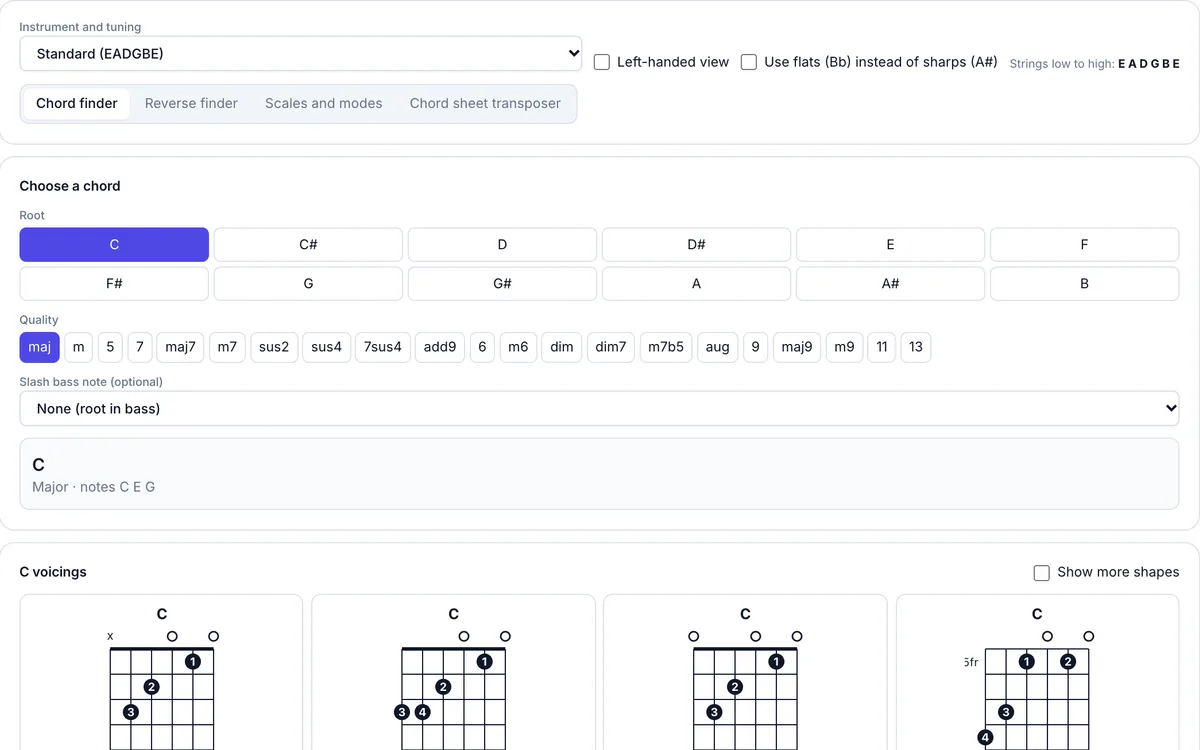
Strings low to high: E A D G B E
Shapes are generated from theory for this tuning, easiest first: x is a muted string, o an open string, numbers are fingers (1 = index). A black bar is a barre.
Need Guitar Chord & Scale Finder as a full mobile or web app? We build it in about a week. Built in about a week, from $99. Send your requirements or SOW; you get a fixed quote and a delivery date.
The guitar chord & scale finder stays free to use online. If you want the code to run, edit and ship in your own project, get the full source from the DEV3 Marketplace. Instant download, 6 months of support.
Get the full app behind this tool. Buy once, own the source, and try each one live first.
Web Scripts & Software
from $20$29
Web Scripts & Software Mobile app
from $69$99

Enterprise SaaS Starters
from $69$99

Enterprise SaaS Starters
from $69$99
Web Scripts & Software
from $69$99
Web Scripts & Software Mobile app
from $69$99
Web Scripts & Software Mobile app
from $69$99
Web Scripts & Software Mobile app
from $69$99
Use this tool as a quick lookup while you practise, write songs or prepare a chord sheet for a band.
Switch to Reverse finder, click the frets you are holding and read the name. If more than one name fits, the one with the root in the bass comes first.
The Scales tab maps a scale across the fretboard. Choose major, minor, the pentatonics, blues, harmonic or melodic minor, or any of the modes. Dots can show interval numbers (1, b3, 5...) or note names, and the root is highlighted so you can see the box patterns.
Paste a chord sheet and move it up or down by up to 12 semitones. The key is estimated from your chords. The capo helper lists positions that give the most beginner-friendly open shapes, and shows the shapes you would play with the capo on.
A chord is a stack of intervals above its root: a major triad is 0-4-7 semitones, a minor triad 0-3-7, a dominant seventh adds 10. The guitar is just a map from string and fret to pitch class, so the search simply asks which frets produce the notes you need.
They are not copied from a fixed chart. The tool works out the notes of the chord from music theory, then searches every fret combination on your chosen tuning for playable shapes: four-fret reach, no gaps between sounding strings, the right bass note, and no more than four fingers. The easiest shapes are listed first.
Open the Reverse finder tab, click the fret positions on each string (or mark a string muted) and the tool names the chord, including inversions and slash chords such as C/E.
Paste a chord sheet with chords above the lyrics, or ChordPro-style [Am] markers inside them. Pick the number of semitones to move up or down. Chords are rewritten and the spacing above the lyrics is kept. Choose sharps or flats to match the key you prefer.
A capo clamps across the neck and raises every open string by one semitone per fret. It lets you play easy open shapes in a harder key. The tool lists the capo positions that turn your chord sheet into the most open chords such as G, C, D, Em and Am.
Yes. Choose standard, drop D, DADGAD, open G, open D, half step down, ukulele (GCEA, with the re-entrant high G string) or four-string bass. Diagrams, scales and the reverse finder all follow the tuning. A left-handed view mirrors every diagram.
Each diagram downloads as SVG or PNG, and a print button lays out the chord sheet and the diagrams of the chords you used. Nothing is uploaded; everything runs in your browser.