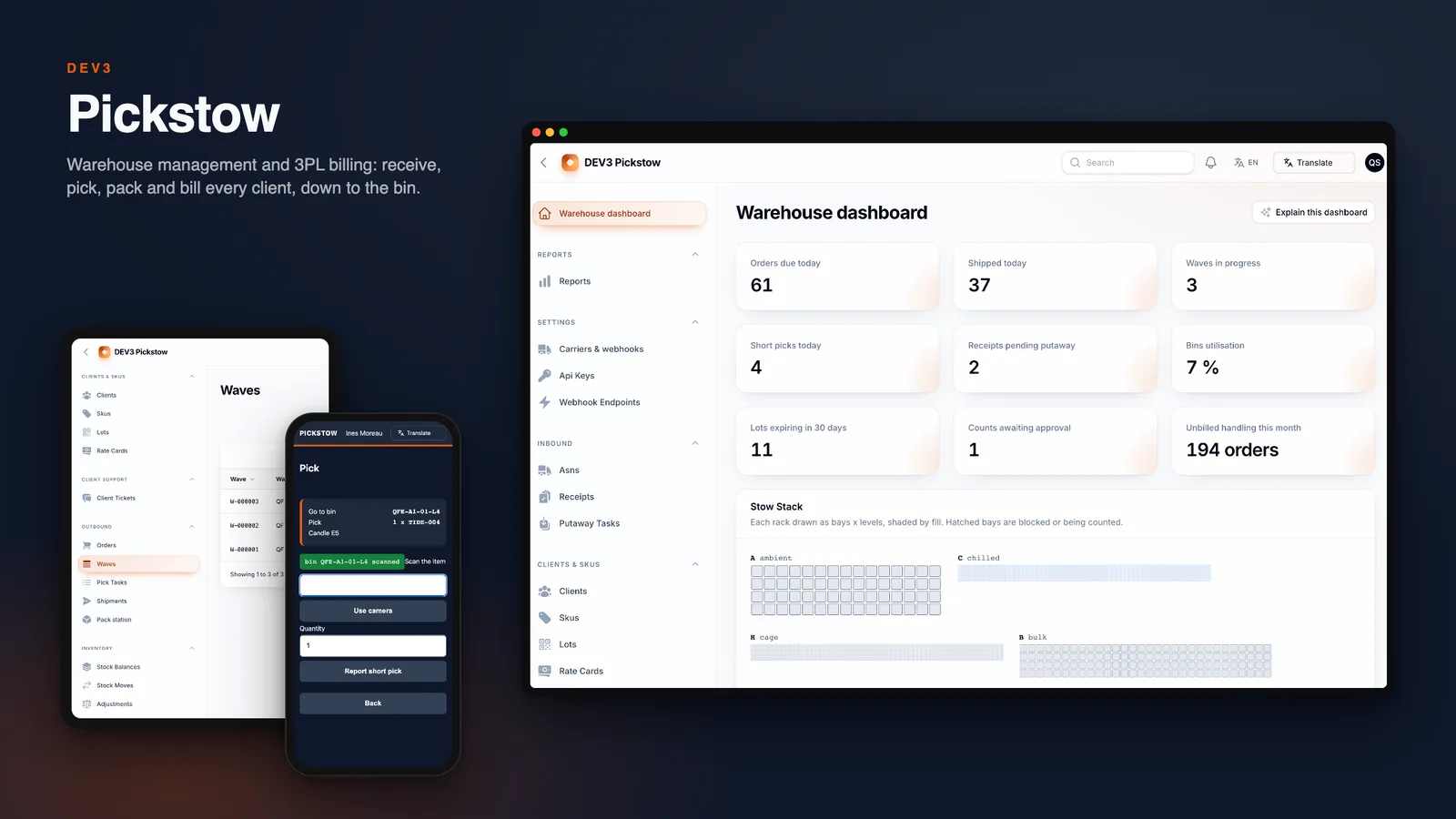
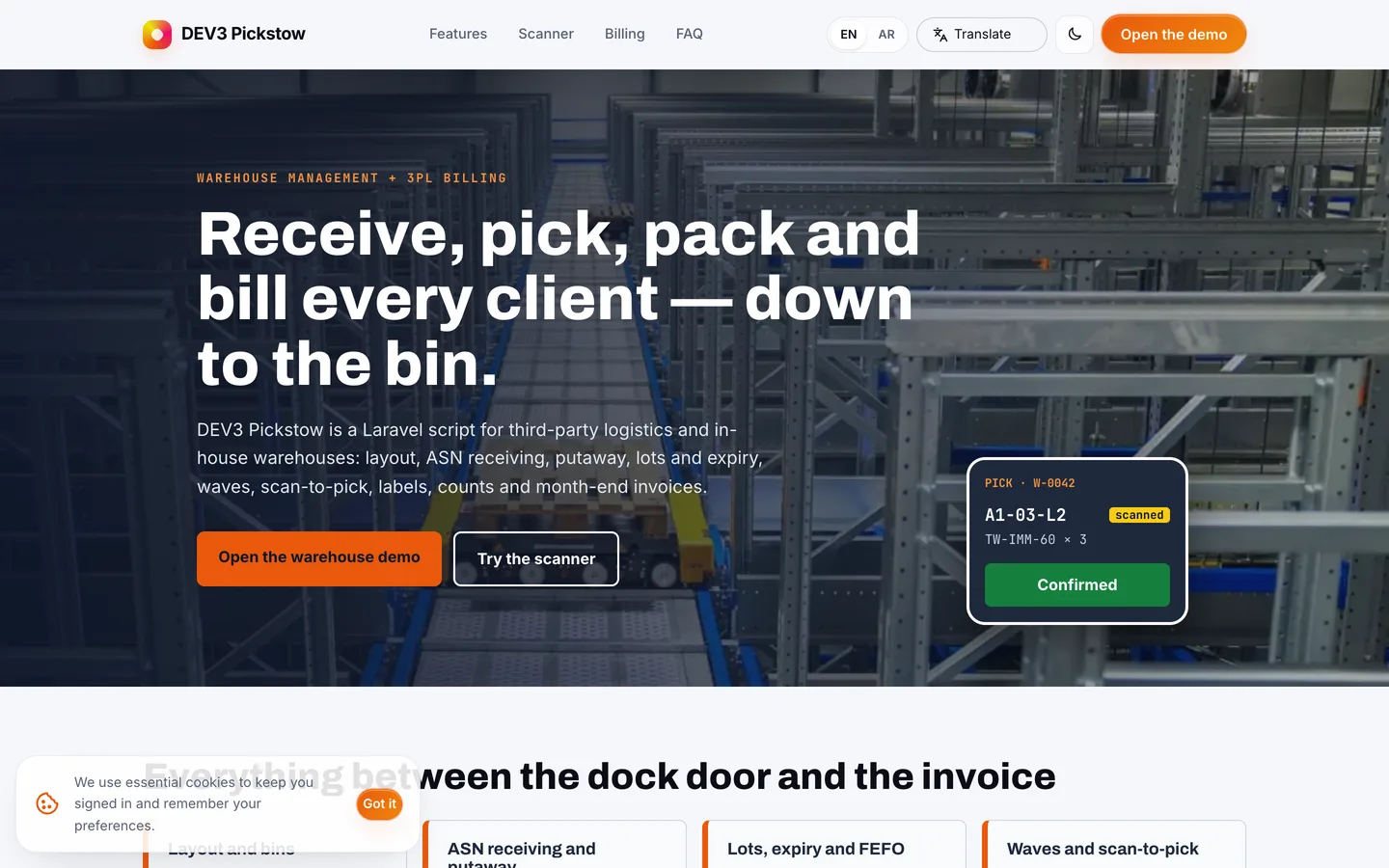
Pickstow is the software for running a warehouse that stores and ships for other companies, or your own. Receive against an ASN with lot, expiry and serial capture, put stock away to a suggested bin, allocate by FEFO or FIFO, release waves, pick and pack by scanning on a phone, print a carrier label, count and replenish, and bill each client for storage and handling at month end. Every client logs in to their own portal. It is built by DEV3 Technologies on Laravel 12 and Filament 4, with a scanner web app (PWA) for the floor. There is no Flutter app in this release.
What it does
- Layout and bins. Warehouses, zones, aisles and bins with capacity in units, volume and pallets, bin labels as ZPL, and a "Stow Stack" picture of every rack on the dashboard.
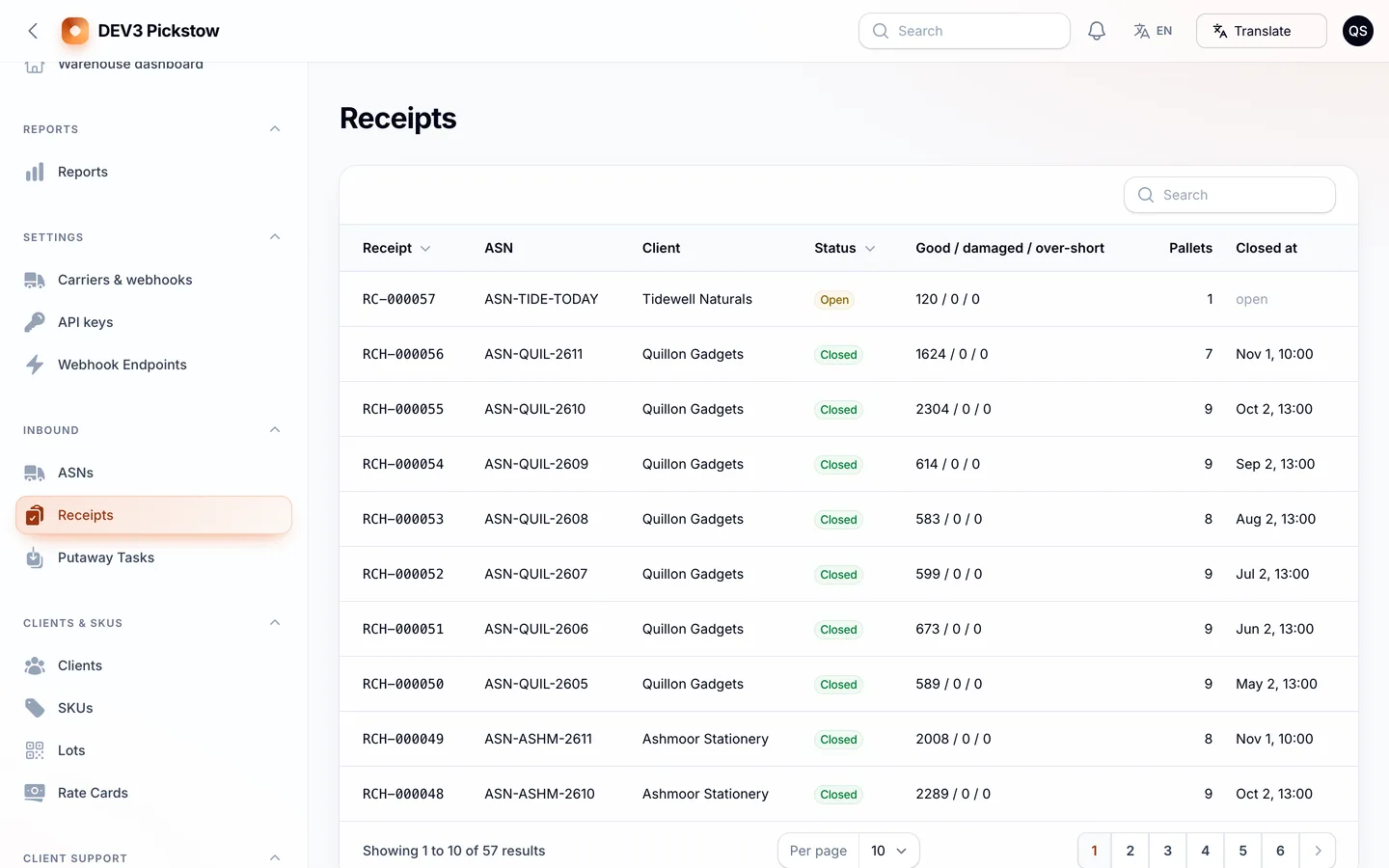
- Receiving and putaway. ASNs created by staff or by the client, receiving with a tolerance, lot, expiry and serial capture, damages to a quarantine bin, and a suggested putaway bin that respects capacity.
- Allocation that cannot oversell. FEFO or FIFO per client with minimum shelf life; quarantined, expired, blocked and counting bins are never allocated. Short picks reallocate automatically.
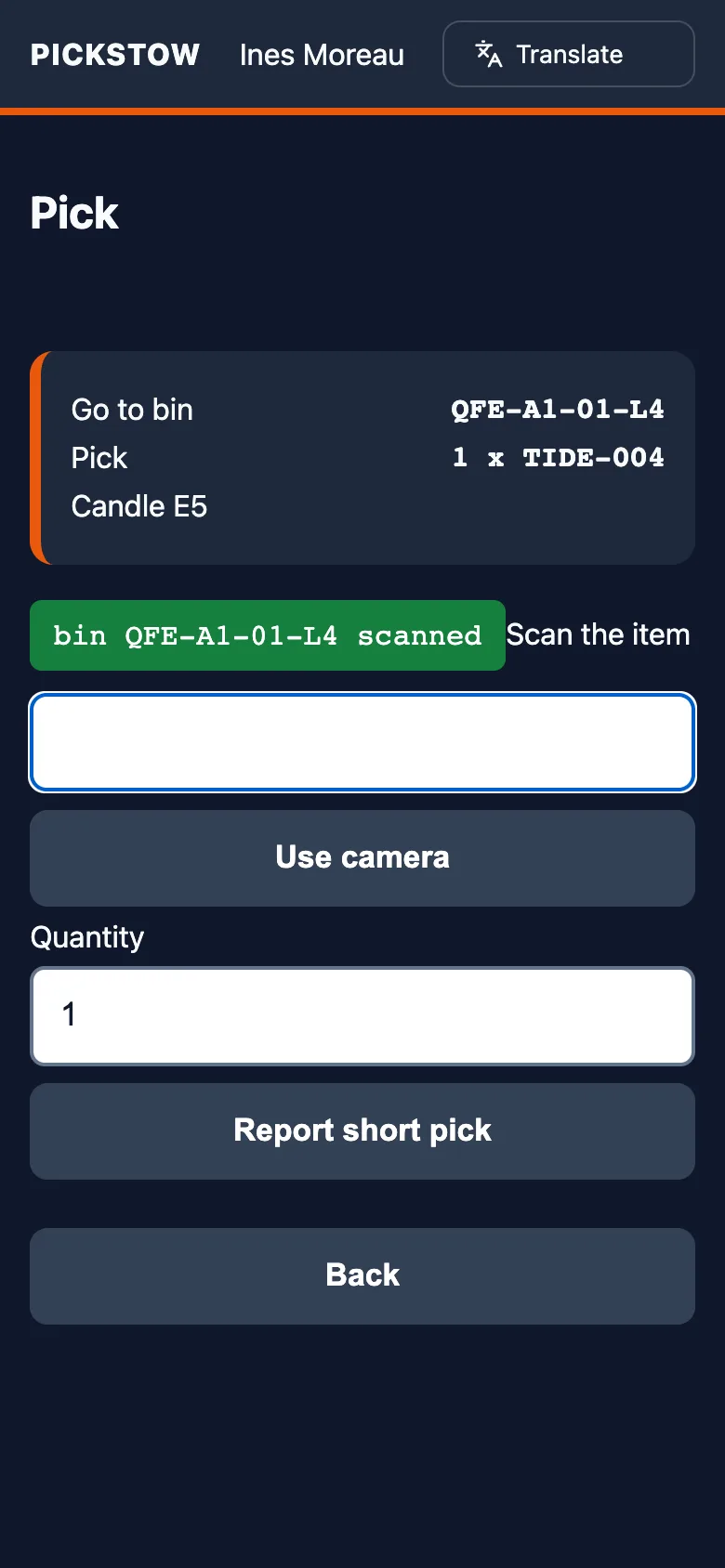
- Waves, pick paths and packing. Waves release pick tasks in a serpentine path; pickers scan bin, then item; the pack station fills cartons by scan, weighs them and prints a label.
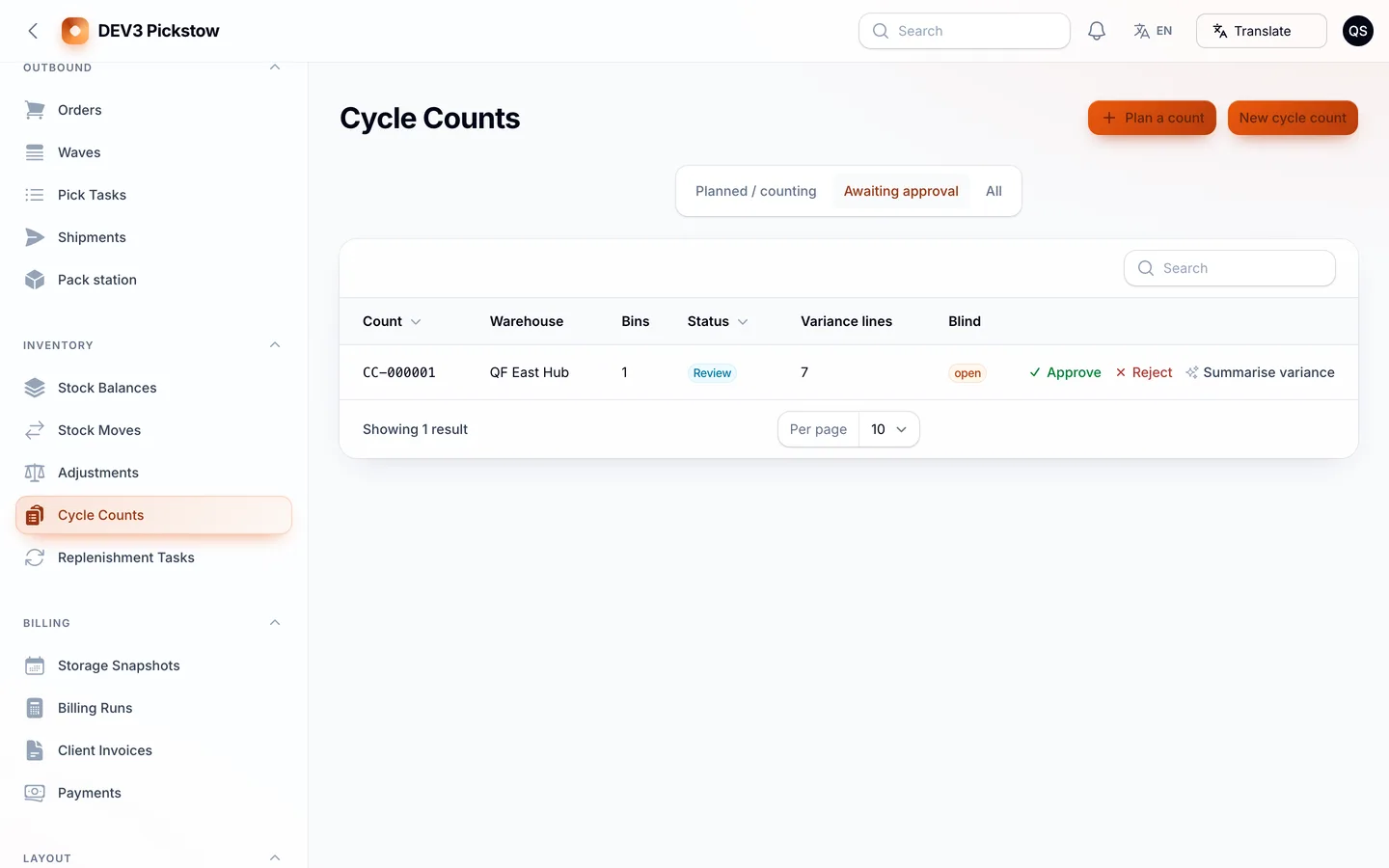
- Counts, adjustments and replenishment. Blind cycle counts that lock the bin, auto-approve within your limits, approvals above them, adjustments with reason codes, and replenishment from storage to pick faces.
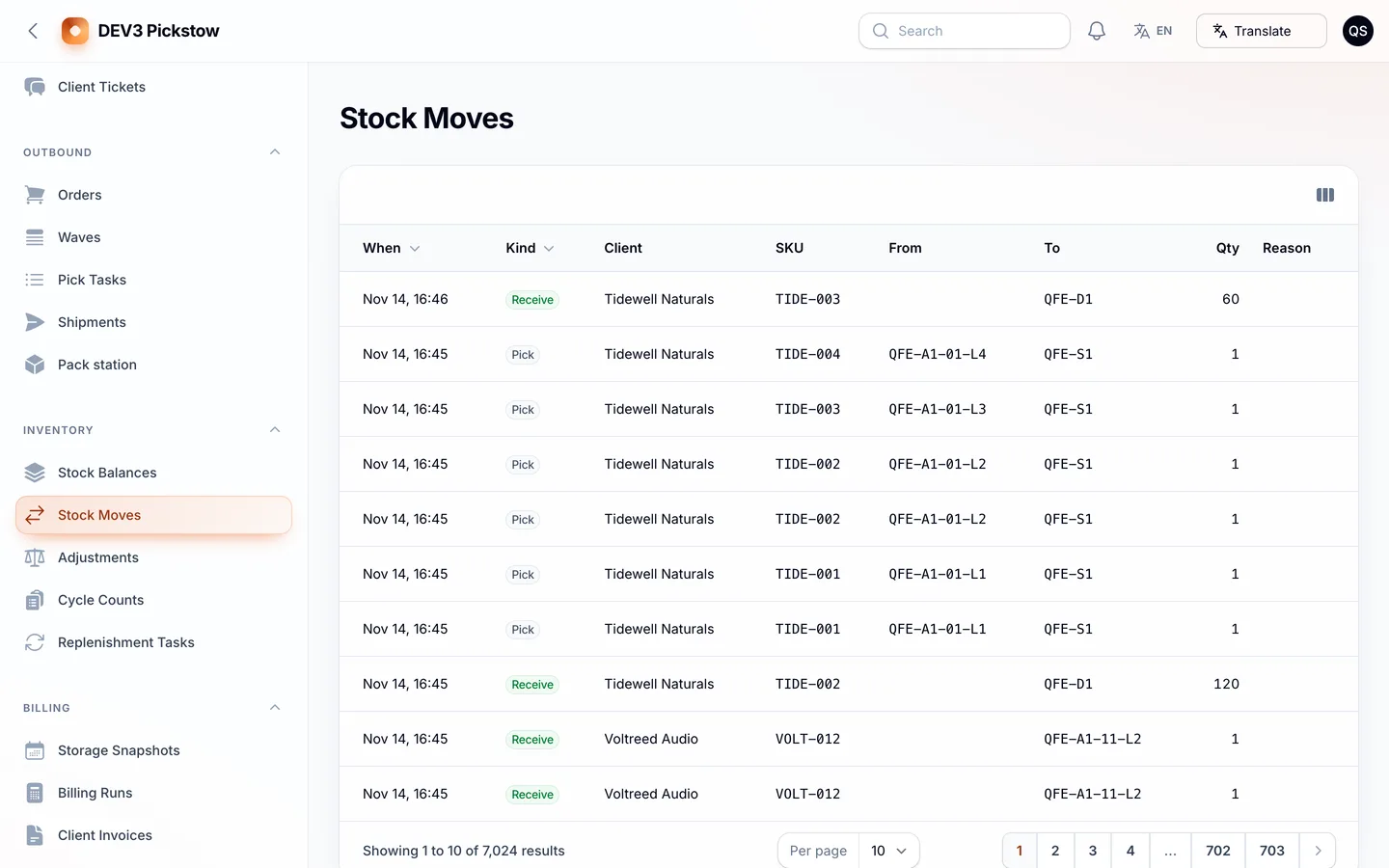
- An immutable stock ledger. Stock only changes through ledger moves; balances are maintained in the same transaction and a command proves the two agree.
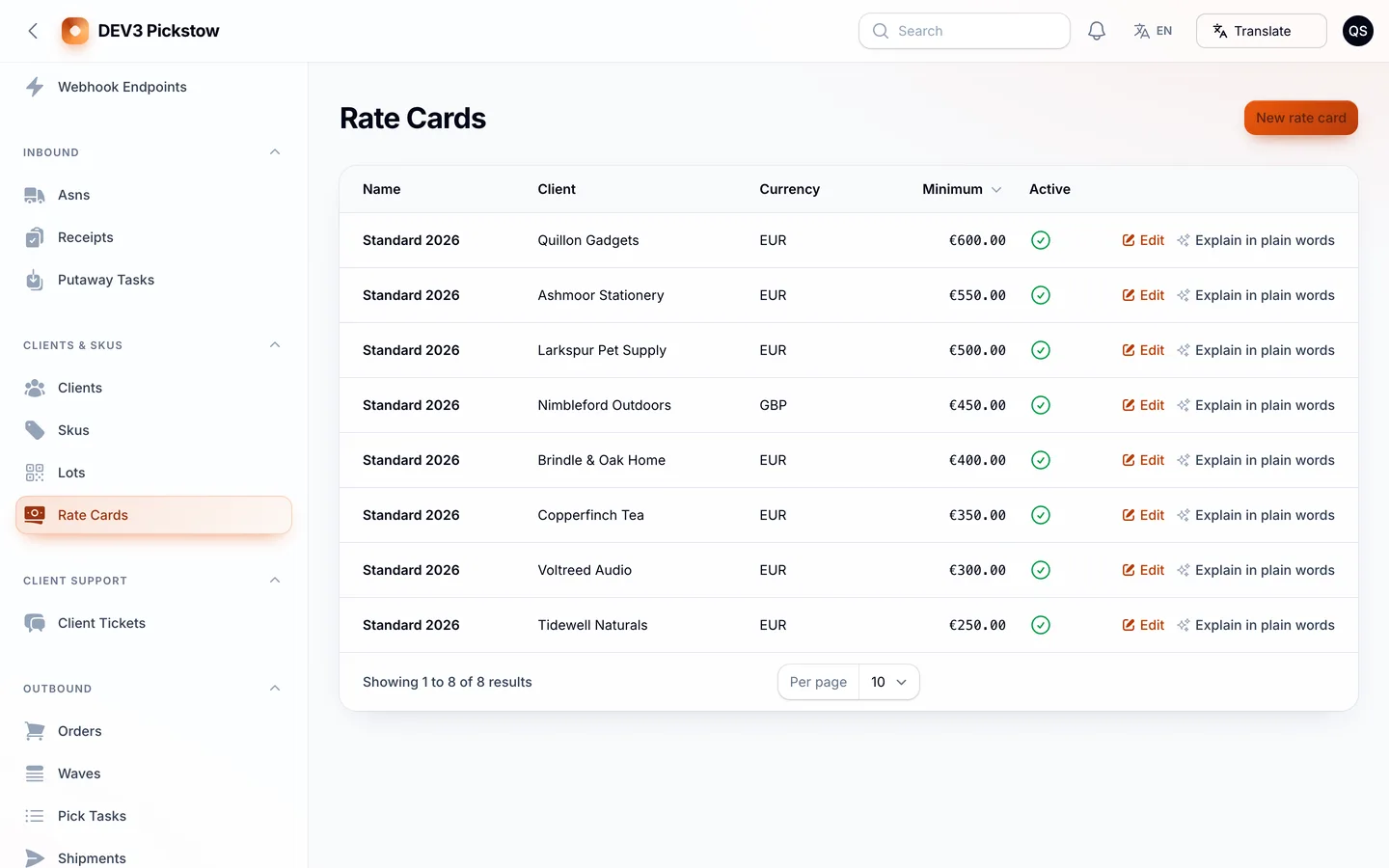
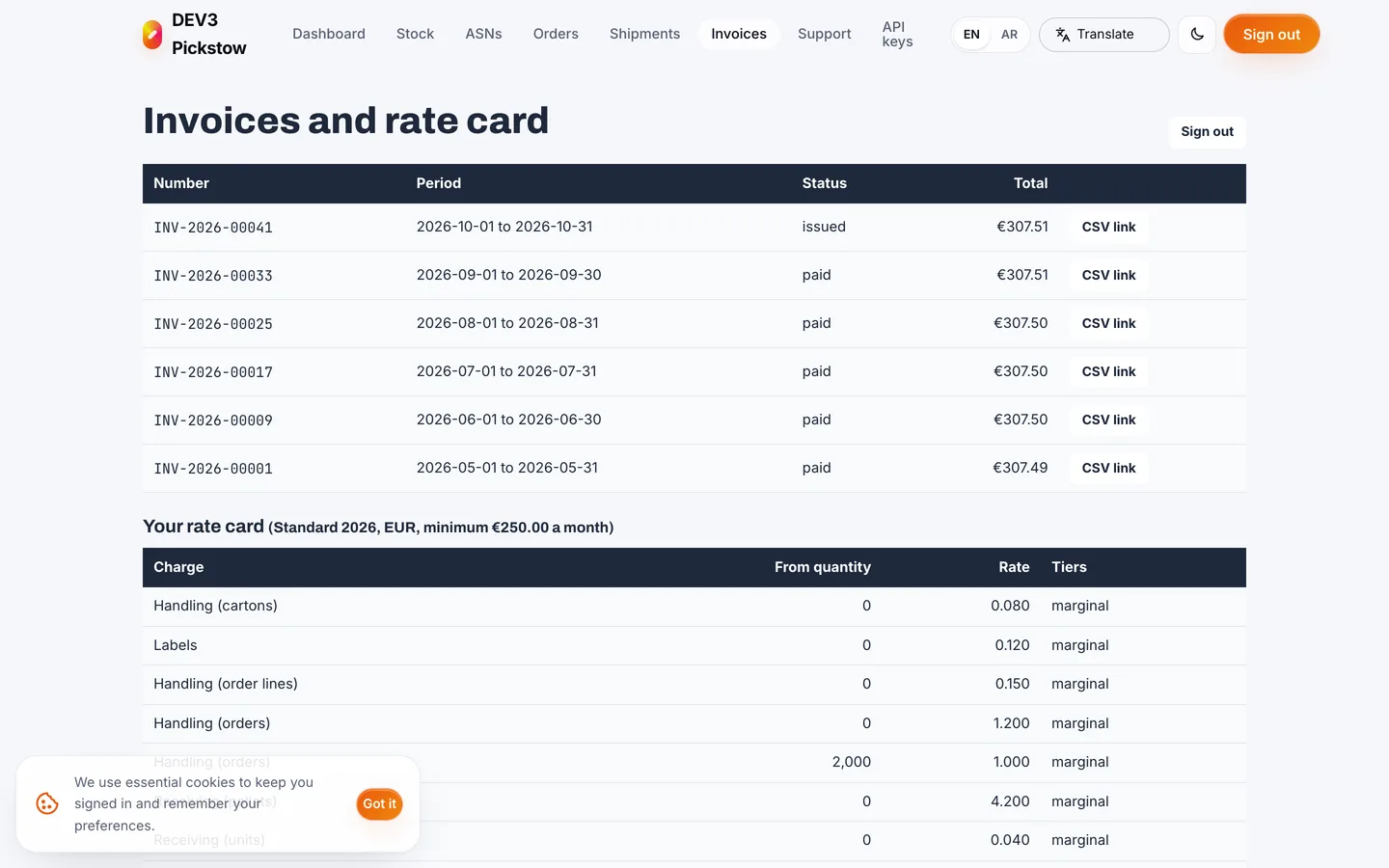
- 3PL billing. Daily storage snapshots, rate cards with marginal or all-units tiers and a monthly minimum, VAT per line, billing runs that make invoices, credit notes and statements. Issued invoices are immutable.
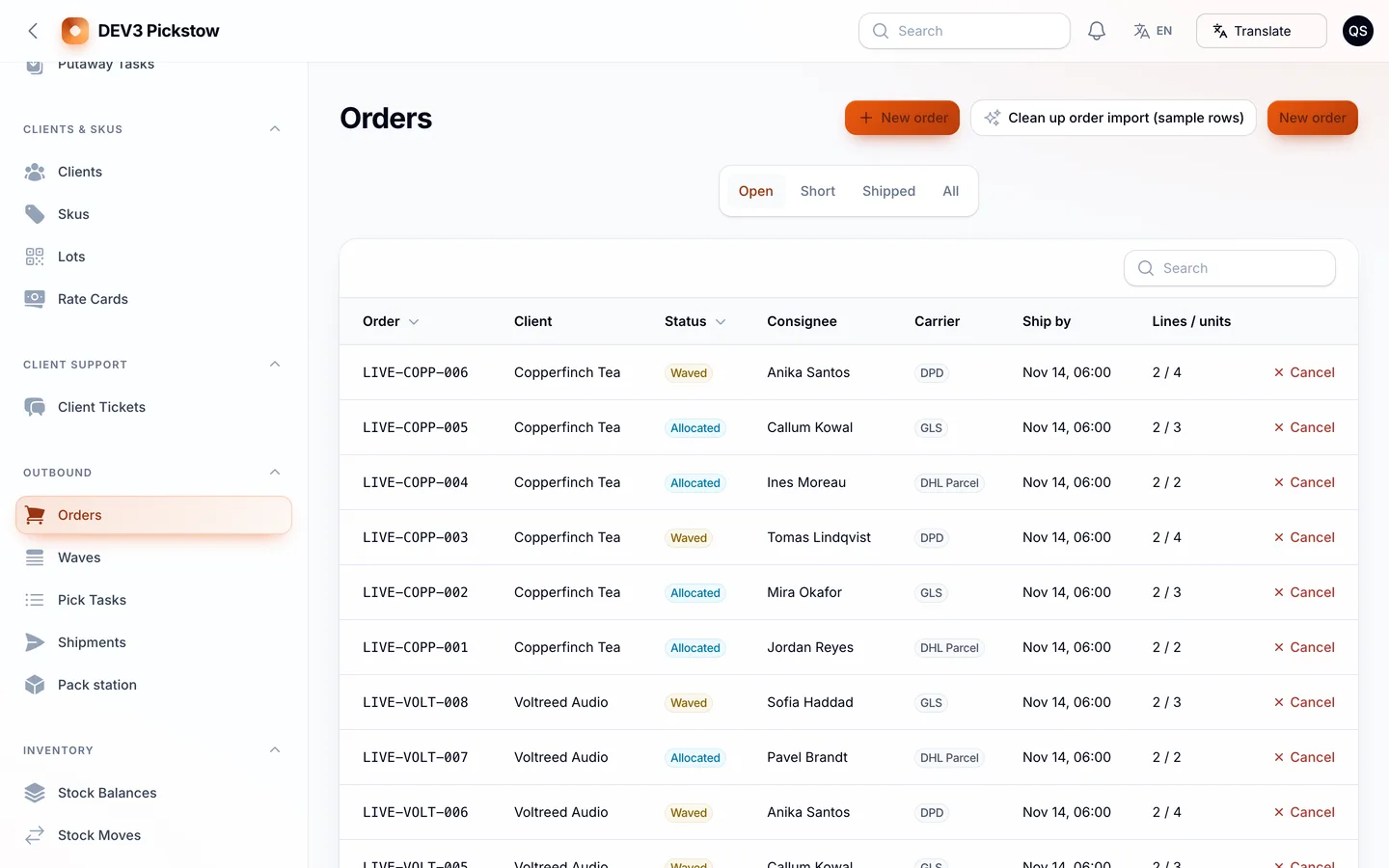
- Client portal. Each client sees only its own stock by SKU, lot and expiry, creates ASNs and orders (one by one or by CSV), follows shipments, reads invoices and its rate card, opens tickets, manages its own API keys and issues expiring export links.
- Scanner web app. Installable PWA with large buttons for receive, putaway, pick, pack, count and lookup; the camera opens only after a tap (a vendored fallback decoder covers browsers without BarcodeDetector), a keyboard-wedge scanner works as well, and counts queue offline.
- API and webhooks. A key-based REST API with an OpenAPI document and signed webhooks for received ASNs, shipped orders, issued invoices and low stock.
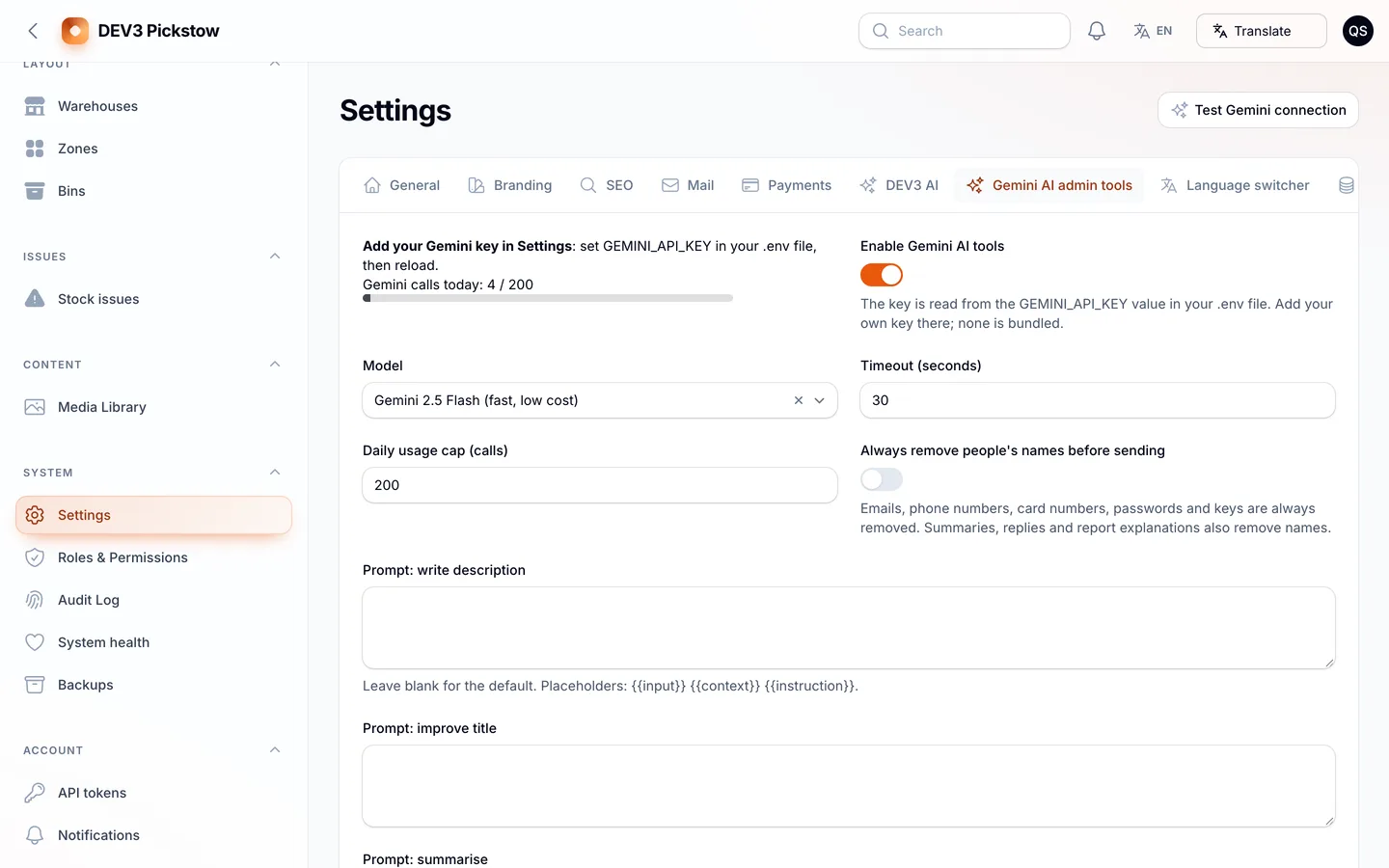
Gemini AI admin tools
Optional, bring your own key: add your own Gemini key after purchase (Google bills your account); with no key the AI buttons say "Add your Gemini key in Settings". Every result is an editable draft; nothing is saved, adjusted, allocated or invoiced automatically.
- Dashboard and reports: explain the numbers and flag risks such as shrinkage, slow movers or near-expiry concentration.
- SKUs and rate cards: write a SKU description and tags, and explain a rate card in plain words.
- Imports: clean up an ASN or order CSV before you confirm it.
- Stock search: type "Tidewell lots expiring in 60 days in zone C"; the query is turned into allow-listed filters, never run as raw text.
- Counts, exceptions and waves: summarise a count variance, suggest the next action on an exception and explain a wave plan.
- Support and billing: draft a ticket reply, explain an invoice and flag billing anomalies.
- A Google Translate language switcher (English, Spanish, German, French, Polish, Arabic) in the public header, the admin bar, the client portal and the scanner.
Consignee names, addresses, phone numbers and emails are replaced before any call, and API keys, export links and carrier credentials are never sent. There is no AI in the scanner or the client portal. You remain responsible for your own privacy notices and your agreement with Google.
Quality checks
The release passed seven gates on the final code: Larastan level 6 with 0 errors, a Pest suite of 420 tests including 44 money vectors checked against an independent calculation, a build with a 22 KB page budget and no 3D, migrations and the full demo seed on MySQL 8 and SQLite, a headless smoke test with 58 checks including MySQL race checks (the last five units ordered twice, putaway into a full bin, a count against a pick, an offline batch sent twice, a snapshot run in two processes, a label made twice), the web installer driven from the zip, and a secret scan. A consistency command (pickstow:check) proves balances, ledger, allocations, snapshots and invoices agree on the demo data.
What you should know before buying
- The carrier and label driver is simulated in the demo. It makes fake tracking numbers and local ZPL and PDF labels, and it refuses to run on a live site. Connect your own carrier through the generic REST adapter (off by default, fixture-tested) and the signed HTTP webhook driver. There are no live carrier integrations and no EDI.
- Billing follows the primary warehouse's timezone. Storage snapshots and billing days use that calendar.
- Weight at the pack station is typed in. There is no scale adapter in v1; a scale that types like a keyboard works in the weight field.
- Rate cards are not effective-dated. An edit applies from the next billing snapshot onward, and issued invoices never change; fix them with a credit note.
- Export links cannot be revoked in bulk. They are signed, expire after 72 hours and are bound to one client; links of an ended client stop working.
- The Gemini key is your own. No key and no usage are included, and the AI buttons stay inactive without one.
- Translate privacy. The language switcher uses Google Website Translator and loads from Google. Private areas (invoices, rate cards, consignee data, the stock ledger, billing snapshots, API keys, bin and SKU codes) are marked not to be translated.
- Camera scanning quality depends on the phone; only counts work offline. Not a tax-filing product. Use MySQL or MariaDB for a live site; the concurrency checks were run on MySQL 8. One cron entry every minute is required.
Included
Source code, the web installer, a buyer guide, demo data for a fictional 3PL (2 warehouses, 3,046 bins, 240 SKUs, 8 clients, about 2,800 orders, 7,000 ledger moves, 48 client invoices) and six months of support.
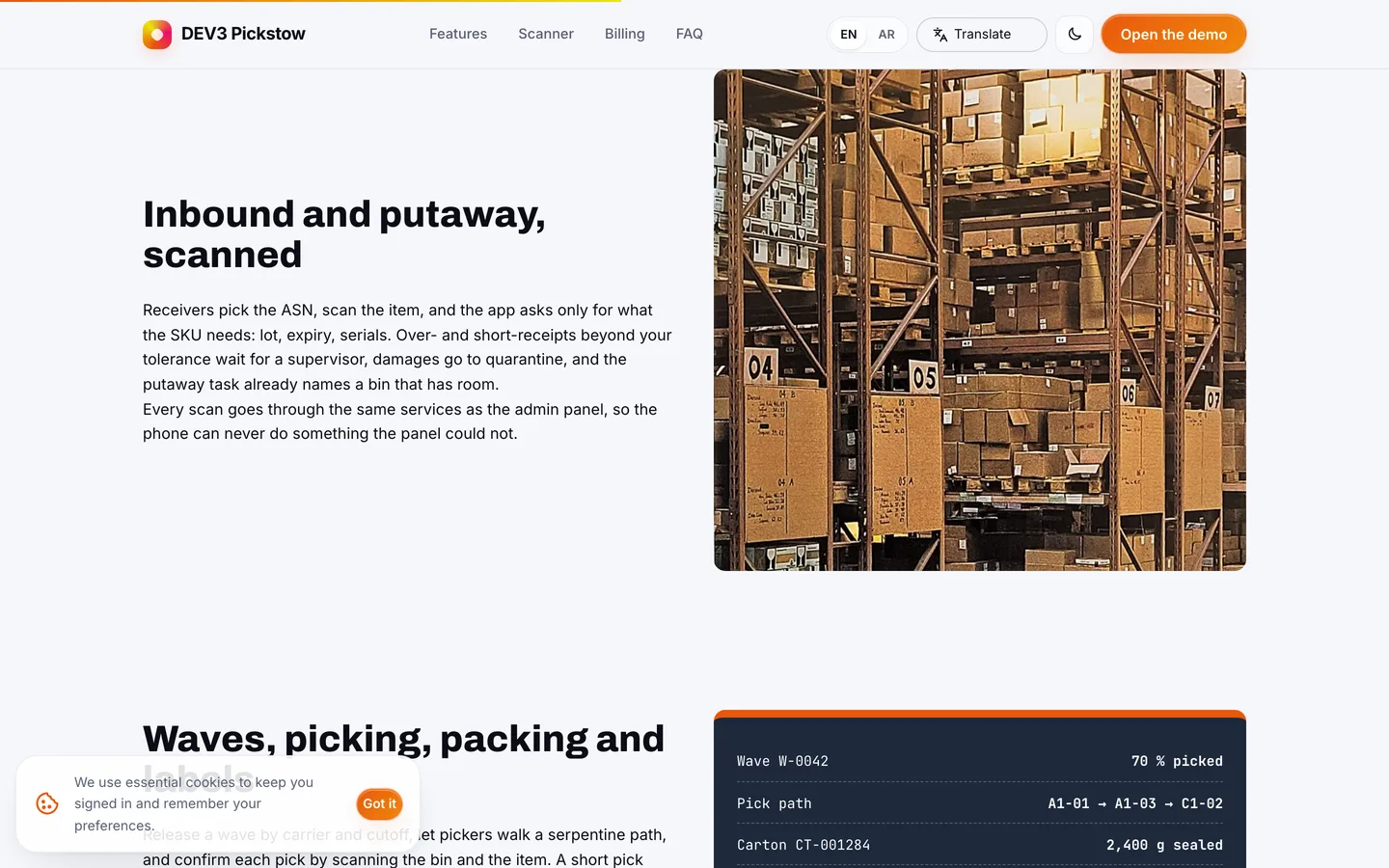 Inbound and putaway — ASN receiving with lot and expiry, then a suggested bin.