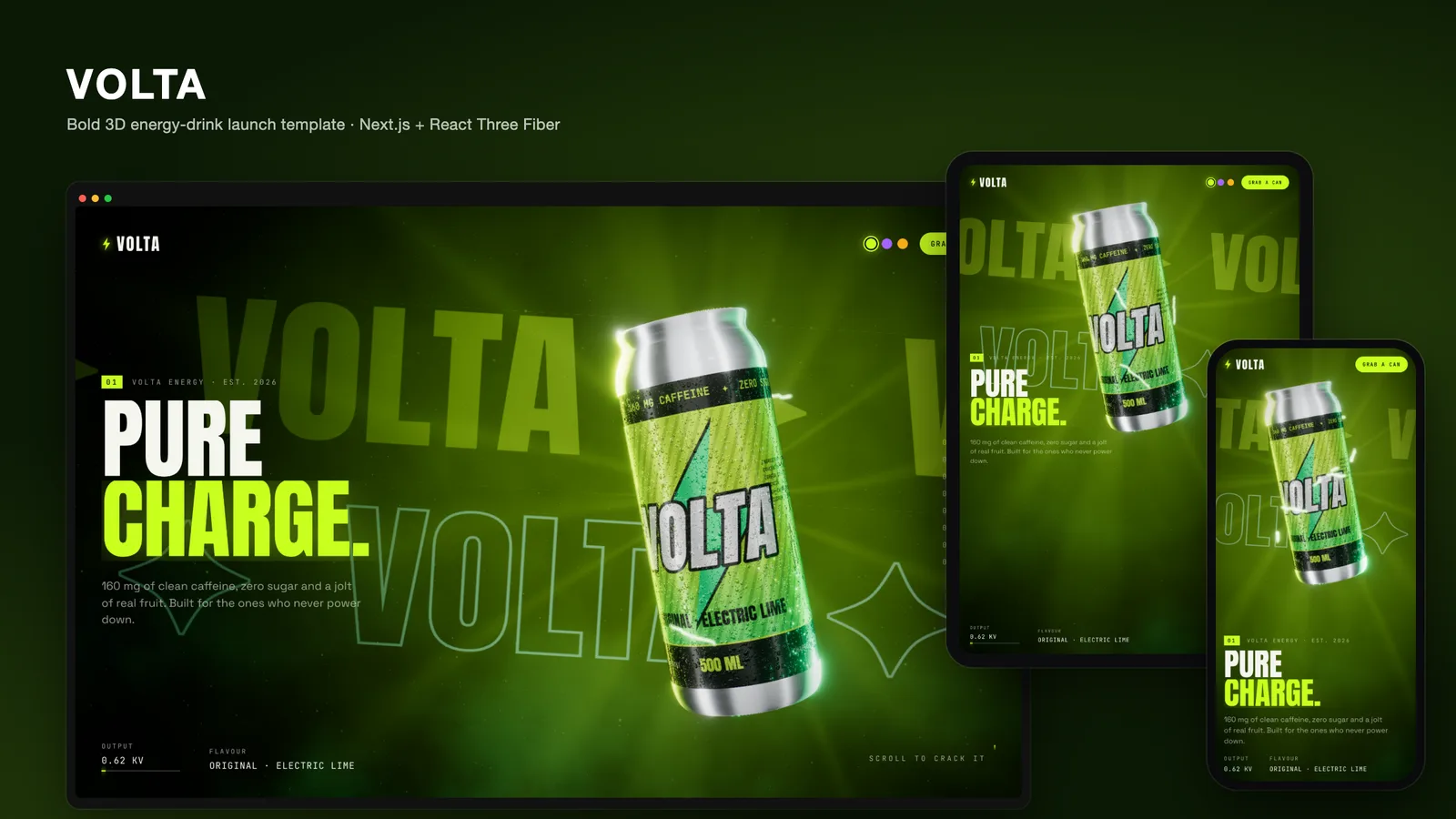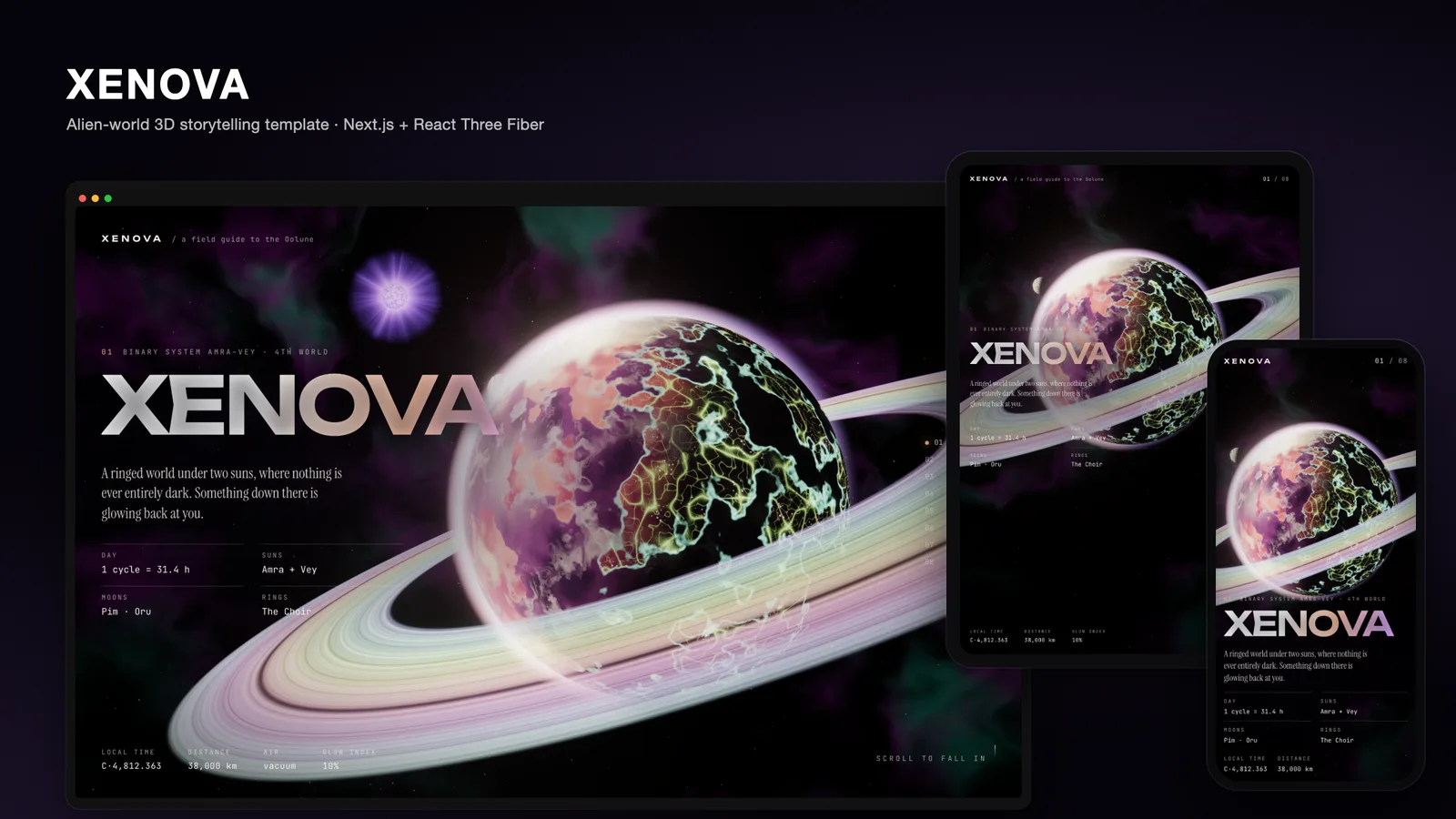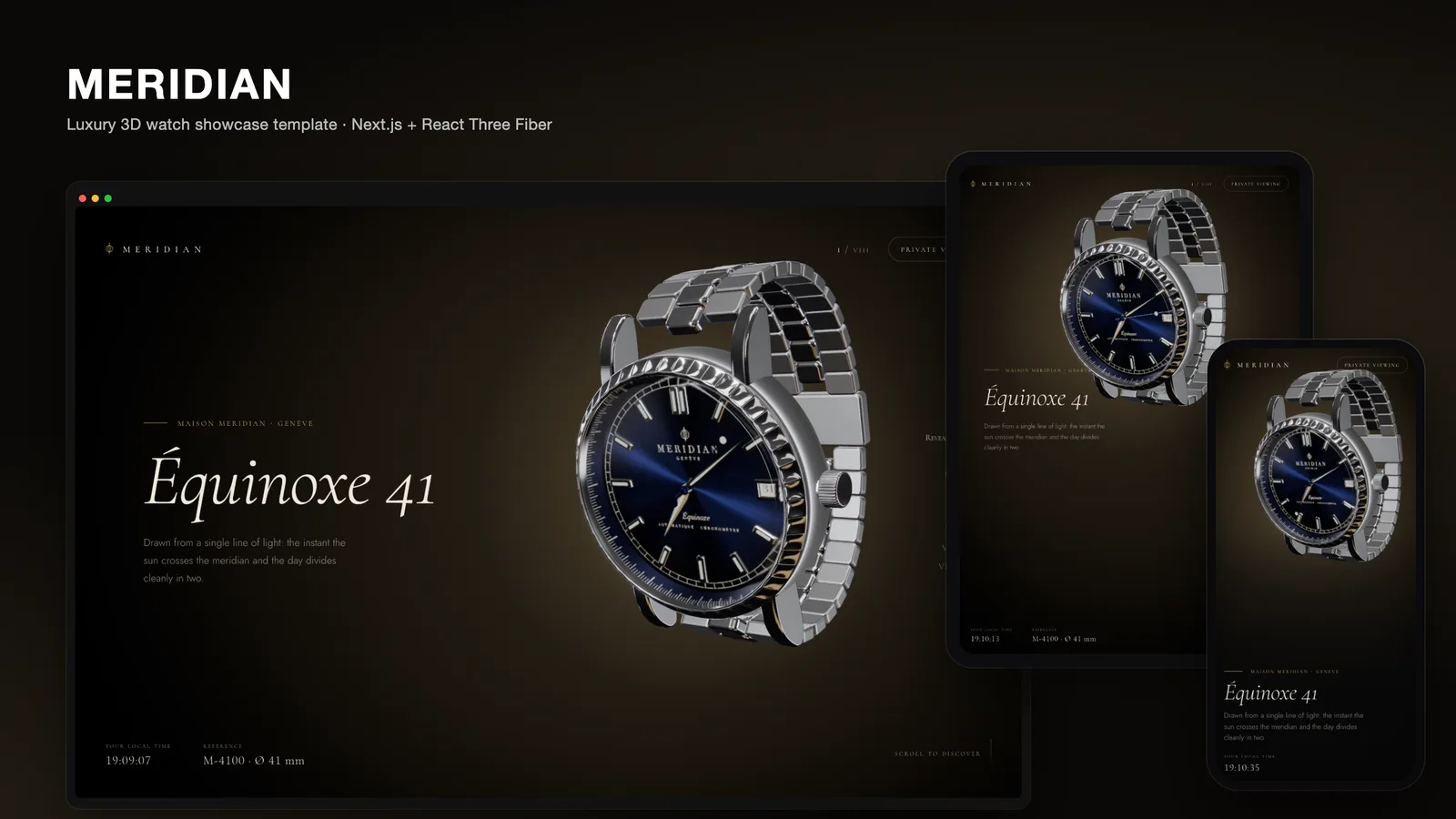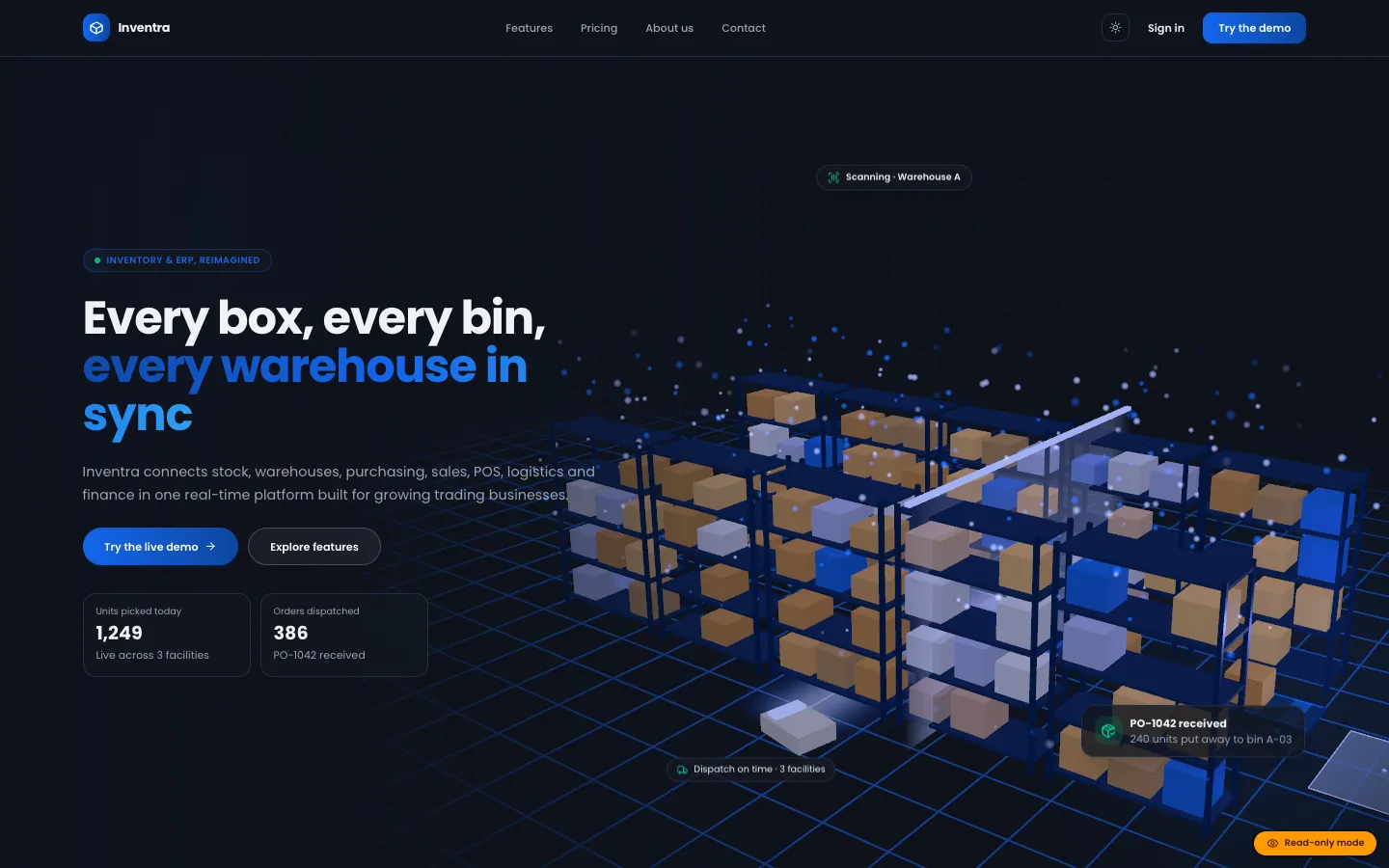
HELIOS – Immersive 3D Solar System Landing Page Template (Next.js, React Three Fiber)

A scroll-driven three.js landing page template: fly from the Sun past every planet to Neptune in 11 snapping chapters. Procedural GLSL planets, bloom and film effects, live distance readouts and a responsive editorial layout, built with Next.js 16, React Three Fiber and Lenis.

by DEV3 TechnologiesVerified Author(0) 0 sales 6 viewsUpdated 31 Oct 2026

HELIOS is an immersive 3D landing page template built with Next.js 16, React Three Fiber and three.js. The whole page is one scroll-driven WebGL journey: the visitor starts on an overview of the solar system, then scrolls to fly from the Sun past every planet out to Neptune, and finishes on a pull-back from beyond the planets. Big headlines, live stats and a chapter rail sit over the scene in a clean, editorial layout.

Try the live demo or watch the video tour at the top of this page. Use it as a space, science or education site, an astronomy event or product launch, or as a starting point for any brand story told in chapters.

The scroll story: 11 chapters

  1. Overview – the glowing Sun, every orbit and the asteroid belt, with the "The Solar System" headline.
  2. The Sun – a churning granulated surface and a soft corona fill the screen.
  3. Mercury to Neptune – one chapter per planet (Mercury, Venus, Earth with its Moon, Mars, Jupiter, Saturn, Uranus, Neptune). The camera flies to a three-quarter-lit portrait of each body, framed off-centre so the copy has room, with diameter, day, year and moon figures.
  4. Beyond – the camera pulls back to see the whole system from far out, with a button that flies the visitor back to the Sun.

Scrolling is smoothed with Lenis and snaps to the nearest chapter when the visitor stops, so a planet is always framed. The chapter rail and a "back to the Sun" button jump between chapters with a long, eased flight.

Shaders and effects

  • Everything is procedural GLSL. Sun granulation with limb darkening and a billboarded corona, Earth with oceans, clouds and city lights on the night side, gas-giant bands with storms, Mars with a polar cap, Saturn's rings with the planet's shadow cast across them, and atmosphere shells on the lit limb. No textures or models are downloaded.
  • Starfield, Milky Way band, asteroid belt and drifting dust as GPU point clouds from a seeded generator, so the sky is the same on every load and dust gives parallax while flying.
  • Camera rig on a centripetal Catmull-Rom path with one stop per chapter, eased legs that linger on each body, damping and a subtle pointer parallax. The orbit of the planet in focus brightens as the camera settles.
  • Post-processing: bloom, ACES filmic tone mapping, film grain, vignette, and chromatic aberration that grows with scroll velocity.
  • Interface: a loader that holds at 99% until every shader has compiled (so the first scroll never hitches), scramble-text reveals, a chapter rail, and live distance from the Sun and sunlight travel time readouts interpolated while flying.

Performance, motion and responsive layout

  • The 3D scene is loaded on the client only, after the page shell, and all shaders are compiled up front.
  • React only re-renders when the chapter changes; scroll position, velocity and pointer live in a mutable store read every frame, so scrolling never re-renders the tree.
  • Device pixel ratio is capped at 1.75, and the canvas uses no MSAA at the WebGL level (anti-aliasing happens in the effect composer).
  • On portrait screens the camera stops are rebuilt: each planet is framed higher and further away so the copy fits underneath. The layout is tuned for desktop, portrait tablet and 390 px phones.
  • With prefers-reduced-motion the interface reveal animations (stats, taglines, scroll hint) are switched off; the camera only travels when the visitor scrolls.
  • The layout is artistic, not to scale; the figures in the stats panels are real.

Tech stack

  • Next.js 16 (App Router) and React 19, TypeScript
  • React Three Fiber 9 and three.js 0.187
  • @react-three/postprocessing 3 and postprocessing 6
  • Lenis 1.3 smooth scrolling
  • Space Grotesk and JetBrains Mono through next/font

Make it yours

  • Copy and data – every body's name, kicker, tagline and stats are in one file (lib/bodies.ts); the intro and outro text is in the overlay component.
  • Colours – each body has a three-colour palette plus atmosphere colour in the same file; the page colours (background, text, accent) are CSS variables at the top of app/globals.css.
  • Fonts – swap the two next/font imports in the root layout.
  • Chapters – add, remove or reorder bodies and the camera path, chapter rail and scroll length follow automatically.
  • Effects – bloom, grain, vignette and aberration strength are a few props in one component.

What's in the download

  • The complete Next.js source (app, components, lib with the shaders, journey store and body data)
  • scripts/ with the screenshot capture script used for visual checks
  • Documentation/index.html (rendered from the README) and START-HERE.txt
  • No third-party 3D models, textures or images; the noise function in the shaders is the MIT-licensed Ashima simplex noise, credited in the source

Requirements

  • Node.js 20.9 or newer and npm
  • A browser with WebGL 2 (all current desktop and mobile browsers)
  • Deploys as a normal Next.js app (for example on Vercel) or as a static export

All copy is sample content for a fictional brand. See how we built HELIOS for the design decisions behind the journey.

Frequently asked questions

The complete source code (version 1.0.0) as a download from your account, with the setup and usage guides shown on this page. You can modify the code to suit your product.

Buying guides: Immersive 3D website templates in Next.js

More from this author

View all

Related in Immersive 3D Websites

View all