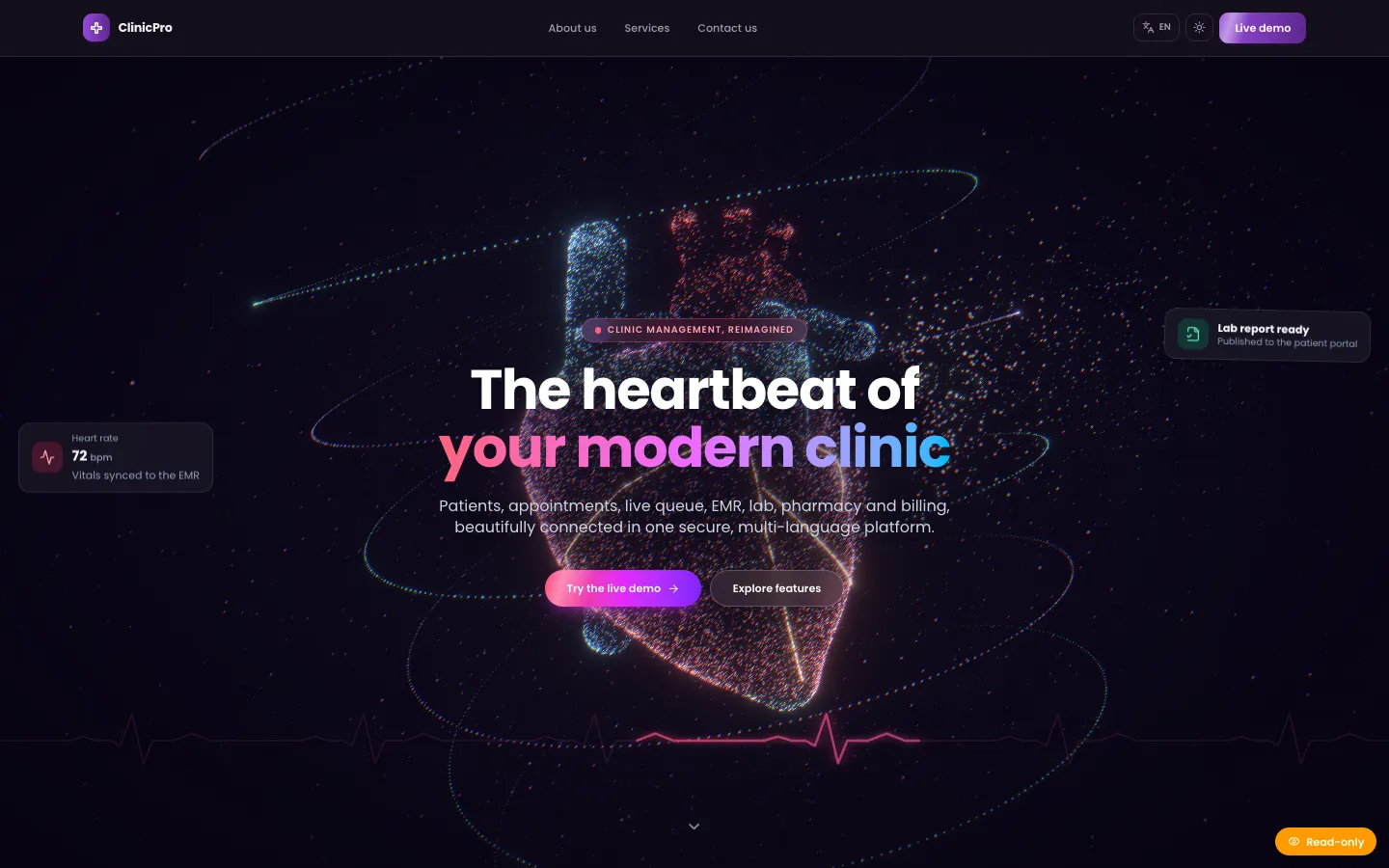
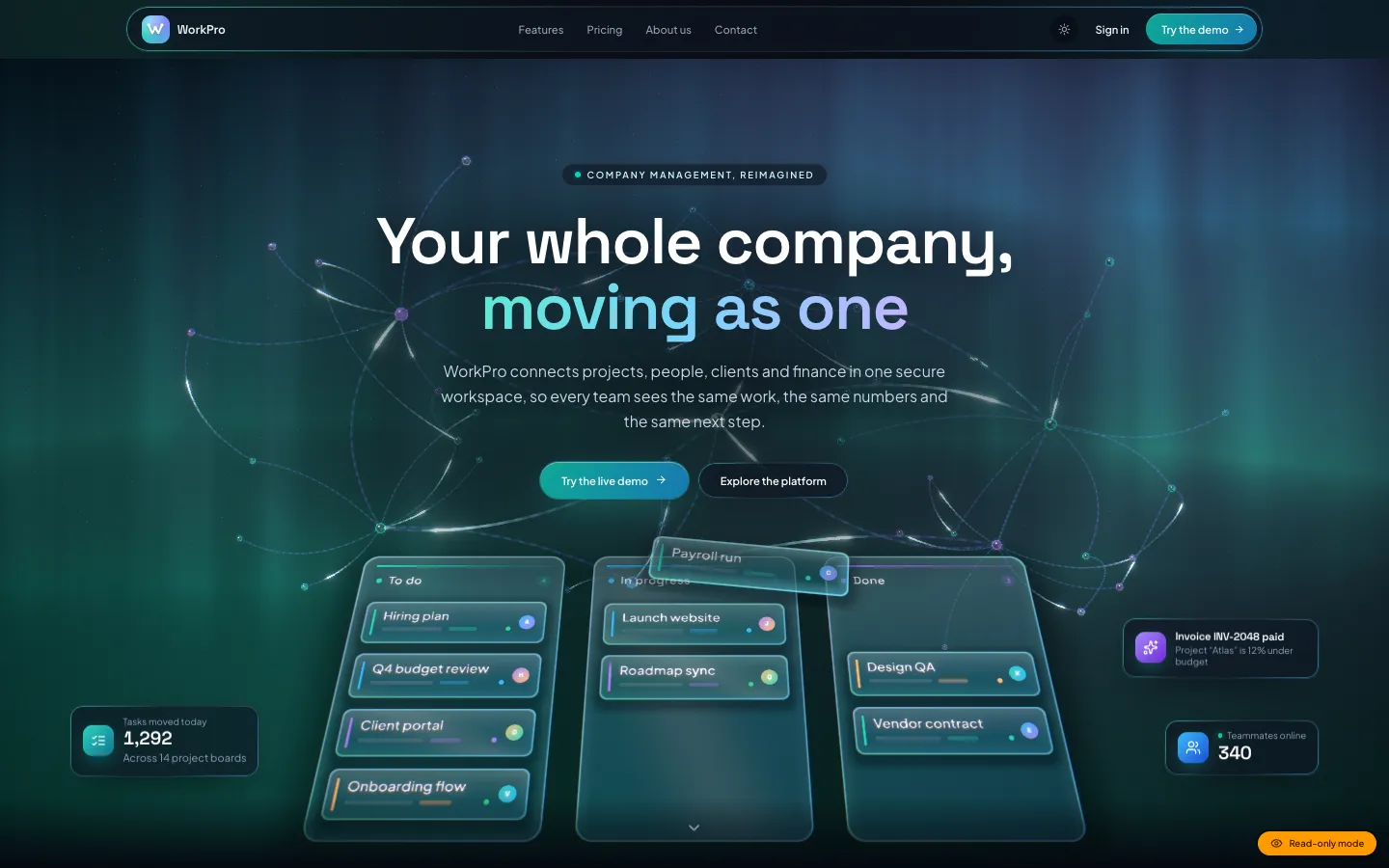
WorkPro – Multi-tenant Company Management Platform: Projects, HR, CRM & Finance (Next.js)

One workspace for projects, people, clients and finance: Kanban and Gantt, HRIS and attendance, CRM and client portal, invoicing, recruitment and email — with roles each organisation designs itself.
by DEV3 TechnologiesVerified Author(0) 0 sales 0 viewsUpdated 22 Oct 2026
WorkPro – Multi-tenant Company Management Platform: Projects, HR, CRM & Finance (Next.js) — preview 1
1 / 7

WorkPro is a multi-tenant company management platform built by DEV3 Technologies on Next.js 15 and MongoDB. One deployment hosts many organisations, each in its own workspace with projects, people, clients and finance — and with security roles that each organisation designs itself.

Try it: the live demo is read-only and has one-click logins for the Organization Admin, Department Manager, Sales Associate, Standard Staff, an External Client and the Super Admin.

Modules

  • Projects – Board, List, Gantt (drag bars, dependencies, critical path), Calendar, Milestones, Team and Time views, My Tasks and timesheet approvals.
  • HRIS – employee records and document vault, org chart, clock-in restricted by IP range and geofence, rosters and shift swaps, leave policies with accruals and carry-over, onboarding and offboarding checklists.
  • CRM & client portal – client 360°, lead pipeline with scoring and conversion, CSV/API lead import, quotes, support tickets, an inquiry inbox fed by a hosted form, and a portal where clients see their projects, invoices and tickets.
  • Finance – invoices with PDF, email and tracking links, recurring billing, overdue reminders, expense claims with receipt scanning, and P&L, project profitability, AR ageing, forecast and tax reports. Money is held in integer minor units with exchange rates.
  • Recruitment – public careers boards and apply flow, requisitions with approval, a candidate pipeline Kanban, interviews and scorecards.
  • Communications – SMTP or Gmail accounts with encrypted stored passwords, sender identities, HTML templates fired by 14 catalogued events and a delivery log.
  • Website & CMS, Access (users, roles, departments, teams, password policy, lockout, invitations, device sessions) and Platform (⌘K omni-search, field-level audit trail, Super Admin console, translations, backups).

Access control that customers design

  • 6 personas decide where a user lives (admin console, workspace or client portal).
  • Per-organisation security roles are built in a matrix editor: 22 resources × 7 actions give 104 permissions, each scoped Own, Team, Department or All.
  • The scope becomes a MongoDB filter on every list, search and record read, so lists, search and detail pages share one rule.
  • Grants from several roles merge by widest scope; admins cannot lock themselves out; every role change is audited.
  • Tenant isolation is enforced in the data layer: any query without an organisation filter throws before it reaches MongoDB.

Also included

  • Optional AI assistants in each module (document and photo import of 10 record types, daily briefing, writing help); every suggestion is reviewed before it is applied, and the AI controls hide when no key is configured.
  • 4 languages (English, Arabic, Hebrew, Spanish) with full right-to-left layouts, light and dark themes.
  • 5 idempotent cron jobs (recurring invoices, reminders, leave accrual, task due dates, email retry).

What's in the package

  • Full TypeScript source (105 pages, 63 route handlers, 62 Mongoose models), .env.example and README.
  • 19 Vitest test files with 260 automated test cases, run against a real MongoDB.
  • Dockerfile, Docker Compose and PM2 configuration, Vercel cron configuration and a read-only demo mode.

Requirements

  • Node.js 20.9 or newer and npm
  • MongoDB running as a replica set (Docker Compose uses mongo:7)
  • Optional: Cloudinary, SMTP/Gmail, Upstash Redis and an AI API key

More from this author

View all

Related in Enterprise SaaS Starters

View all