DEV3 Technologies home

DEV3 Formstead – Form and Survey Builder SaaS Laravel Script with Logic, Calculations, Payments, Quizzes & Analytics

A multi-tenant form and survey builder SaaS on Laravel 12 and Filament 4: 33 field types, conditional logic, live calculations, card payments with payouts, quizzes, NPS, uploads, embeds, webhooks, analytics and an API. Web installer and demo data included. No mobile apps.
by DEV3 TechnologiesVerified Author(0) 0 sales 0 viewsUpdated 08 Nov 2026

Launch Offer: up to 50% off

This item is 50% off: $24.50 instead of $49

Ends in
--
Days
--
Hrs
--
Min
--
Sec

Video tour. Pick a section below to browse 108 screenshots in 9 sections.

App & phone tours

Tap play to watch each app. Nothing downloads until you do.

  • Mobile web1:21

Formstead is a form and survey builder that you run as a multi-tenant SaaS, built by DEV3 Technologies on Laravel 12 and Filament 4. Workspaces build forms, quizzes and surveys in a visual builder, publish them at a public address or embed them on any page, take payments with them and read the answers in an inbox with analytics. Respondents need no account. You sell plans, and every workspace is isolated from the others.

What it does

  • A visual builder. Pages, a palette of 33 field types, 24 starting templates, drag and drop ordering, a live preview for desktop and phone, themes, and versions: publishing creates a numbered version and every response stays pinned to the version it started on.
  • Conditional logic. Show, hide, require, skip a page or set a value from rules with all and any groups. Cycles are caught while you build, and hidden answers are dropped on the server, so what the browser shows is what is stored.
  • Calculations. A safe formula language (no code evaluation) with fields, functions and currency rounding, shown live to the respondent and recomputed on the server. A division by zero is reported, never silently charged.
  • Payments. A payment field charges the server-side total, with optional tax, through the operator's payment gateway. The response completes only when the payment succeeds; late or duplicate payments are refunded automatically. Workspaces see a takings wallet, refunds (the owner within a window, operator finance any time) and weekly payout batches. The operator earns a configurable fee per payment.
  • Quizzes and surveys. Scored questions, pass marks, a result page, NPS, CSAT, rating, scale, ranking and matrix questions.
  • Uploads and signatures. Size and type limits, a scan step that flags infected files and signed, short-lived download links; hand-drawn signatures are checked for ink.
  • Save and continue, resume links, conversational mode (one question at a time), right-to-left forms in Arabic and a version of every form that works without JavaScript.
  • Embeds. An iframe loader that resizes itself, with optional lists of allowed parent sites per form.
  • Responses. Inbox with tabs and filters, response detail with computed values, files and payment panel, notes, tags, a timeline, PDF per response and CSV export.
  • Analytics. The Response River (completes, partials and abandoned by day), per-question charts, NPS and CSAT cards, a matrix heat table, histograms, drop-off per page and a version filter.
  • Webhooks and API. Signed webhooks with a delivery log, retries and automatic disabling after repeated failures; scoped API keys, a REST API and an OpenAPI document.
  • Protection. Honeypot, speed, link and repeat checks, a simulated captcha for the grey zone, abuse reports and a block list in the operator panel.
  • SaaS layer. Plans with limits (forms, monthly responses, uploads, members) and feature gates, trials, a billing page, team roles (owner, editor, analyst), an operator panel with a payments ledger, refunds, payout batches, a fees report and an audit log.

Install and demo data

A web installer checks the server, writes the configuration, migrates and loads either demo data or an empty install, then creates the operator account. The demo has 20 fictional workspaces (a community garden, a dental practice, a workshop studio, a school), about 140 forms, 63,000 responses, 2,600 paid payments with refunds and partial payments, and thousands of webhook deliveries. Every demo password is password. Node.js is not needed because compiled assets are included.

Good to know before you buy

  • You are the merchant of record. Respondents pay through your payment gateway. Workspaces do not connect their own Stripe account: they receive a takings balance and payout batches, and tax, invoices and refunds are your responsibility.
  • Drivers are simulated until you configure them. The payment gateway, the captcha, the file scanner and mail are simulated out of the box. The scanner recognises the standard test string only; to scan real uploads you connect your own scanner. The built-in captcha is a stand-in: a real challenge needs your own verifier and keys. Mail goes to the log until you set SMTP. Stripe, Razorpay and PayPal drivers are present and need your keys.
  • Sign-in required forms use an emailed one-use link and a first-party cookie, so they do not work inside another site's embed.
  • A partial refund keeps the response complete; the payment row shows the refund.
  • Web only. There are no mobile apps.
  • Name: Formstead is a working name checked by a web search only, not a trademark clearance. Check it before launching under it.
  • No hosted demo. The brands, people and places in the screenshots are fictional.

Quality checks

Formstead 1.0.0 passed the seven release gates of the DEV3 Laravel suite on the final code: static analysis (Larastan level 6), the Pest suite (293 tests), a front-end size budget, migrations and seeding on MySQL 8 and SQLite, a headless-browser pass over 81 pages and 34 happy paths with MySQL race checks (last place on a limited form, the plan quota edge, parallel card payments, payment against expiry, parallel page submits and parallel webhook runs), an installer test from the package and a secret scan.

How it's built

Architecture, stack, key decisions and the quality gates DEV3 Formstead passed before release.

The engineering behind Formstead: forms that stay pinned to the version a respondent started on, one logic and calculation engine shared by PHP and the browser, payments that complete a response only when the money arrives, and locks that keep limits exact.

The problem it solves

A form is edited while people are filling it in. Answers must stay valid across versions, the browser and the server must agree on every hidden field and total, a payment that arrives late must never be lost or kept twice, and a response limit or plan quota must hold when many people submit at once.

Architecture and approach

Formstead is a Laravel 12 application with Filament 4 panels for workspaces and the operator, a server-rendered respondent surface with a small script on top, a visual builder, a JSON API and signed webhooks. It builds on the shared DEV3 core for settings, roles, wallets and audit.

Versions that never break an answer

Publishing freezes the schema as a numbered version. A response keeps the version it started on, field keys cannot change meaning, and analytics merge answers across versions by key and type.

One engine, two runtimes

Conditional logic and calculations are written once as vector files with hundreds of cases and run by both a PHP engine and a JavaScript engine. The formula language is a parser and evaluator, never code evaluation, with exact decimals and half-up rounding. The server always recomputes totals and drops hidden answers.

Pay, then complete

A response with a payment waits in a payment state. It completes when the payment succeeds. Late, duplicate or expired payments become durable refund records that a worker retries, and fees and refunds post to the ledger under idempotency keys.

Limits under lock

The response limit of a form and the monthly quota of a plan are checked under row locks in a fixed order, and checkouts that are still waiting count toward the quota. Six MySQL race checks run against a live server in the test suite.

A tenant guard that fails closed

Every tenant model is scoped by workspace and a guard throws if one is loaded without a tenant. Uploads are served through short-lived signed links, and a generated test requests other workspaces' records and expects 404.

Quality gates and results

Formstead 1.0.0 passed the seven release gates on the final code, including Larastan level 6, 293 Pest tests, a headless-browser pass over 81 pages and 34 happy paths, shared logic, calculation, payment and quiz vectors run through both engines, and MySQL race checks on six groups: the last place on a limited form, the plan quota edge, parallel card payments, payment against expiry, parallel page submits and parallel webhook runs.

Tech stack

Area Technologies
Application Laravel 12, Filament 4, Blade, REST API
Forms engine Own formula parser, PHP and JavaScript logic engines, Exact decimal math, Versioned schemas
Money Pay-then-complete, Idempotent ledger, Payout batches
Quality Pest, Larastan level 6, Playwright, MySQL race checks

Inside the build

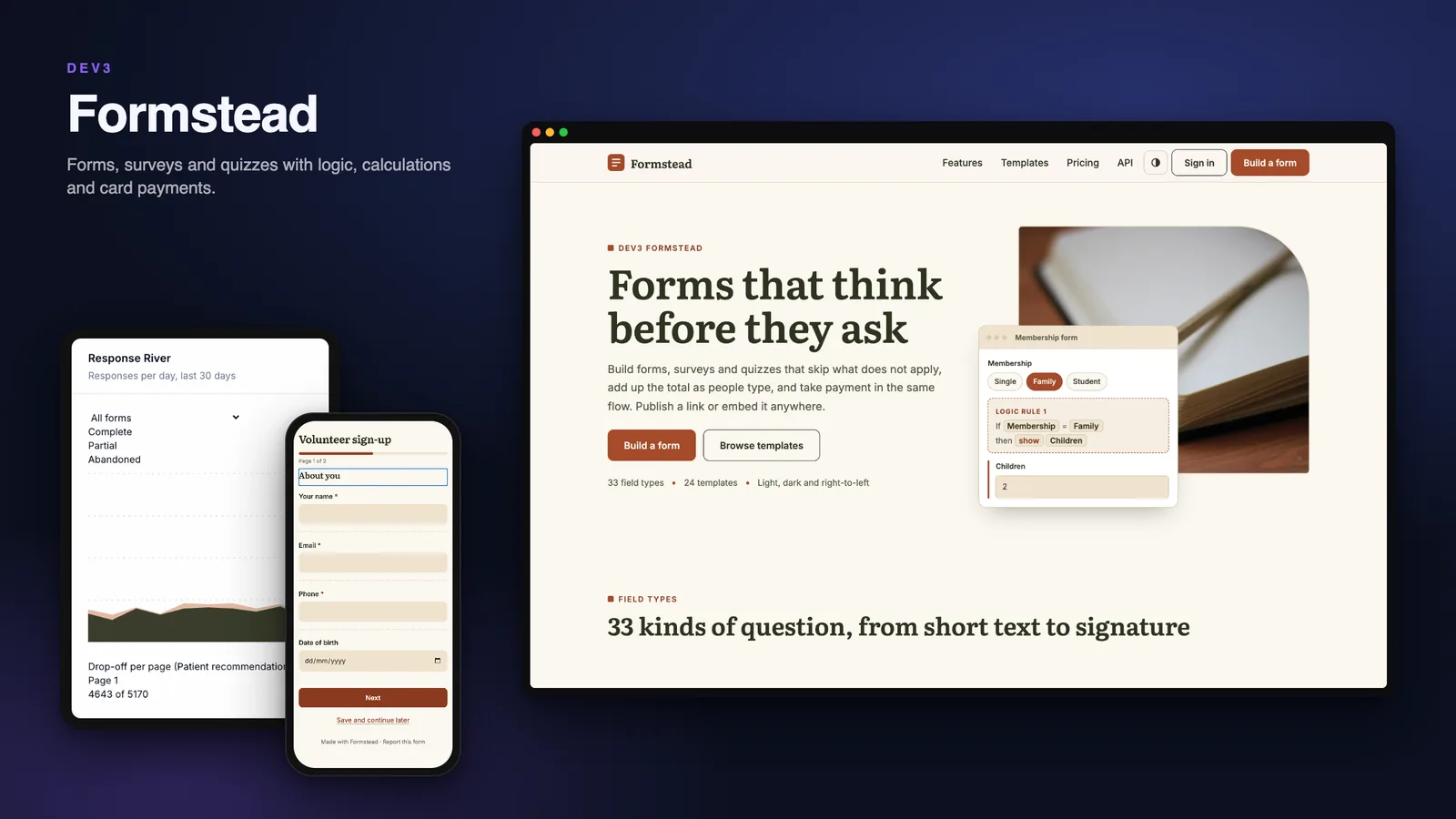
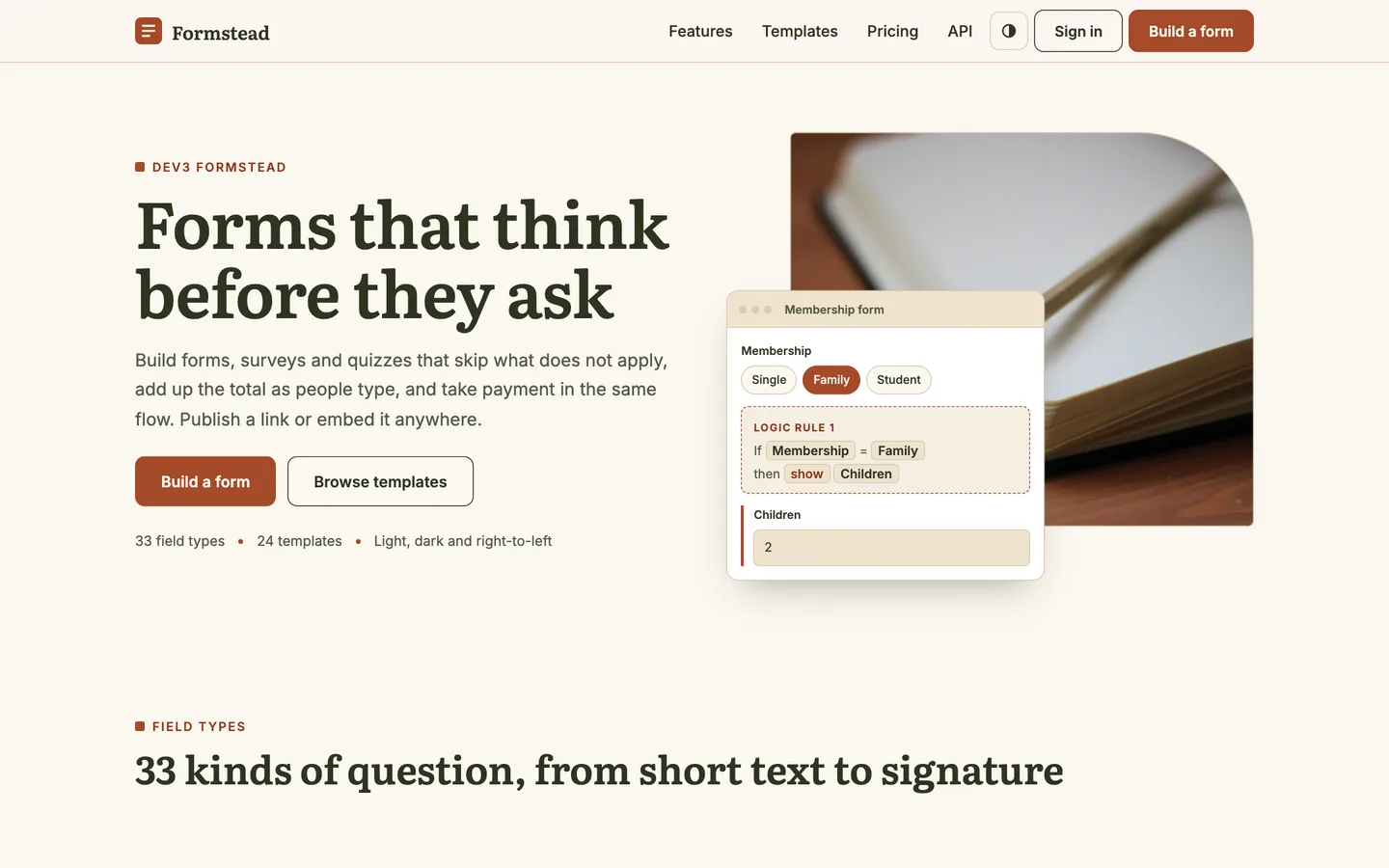
Hero: A notebook photo beside the headline, the build button and the trust points on a warm paper page, with a small builder card showing a logic rule. Hero — A notebook photo beside the headline, the build button and the trust points on a warm paper page, with a small builder card showing a logic rule.

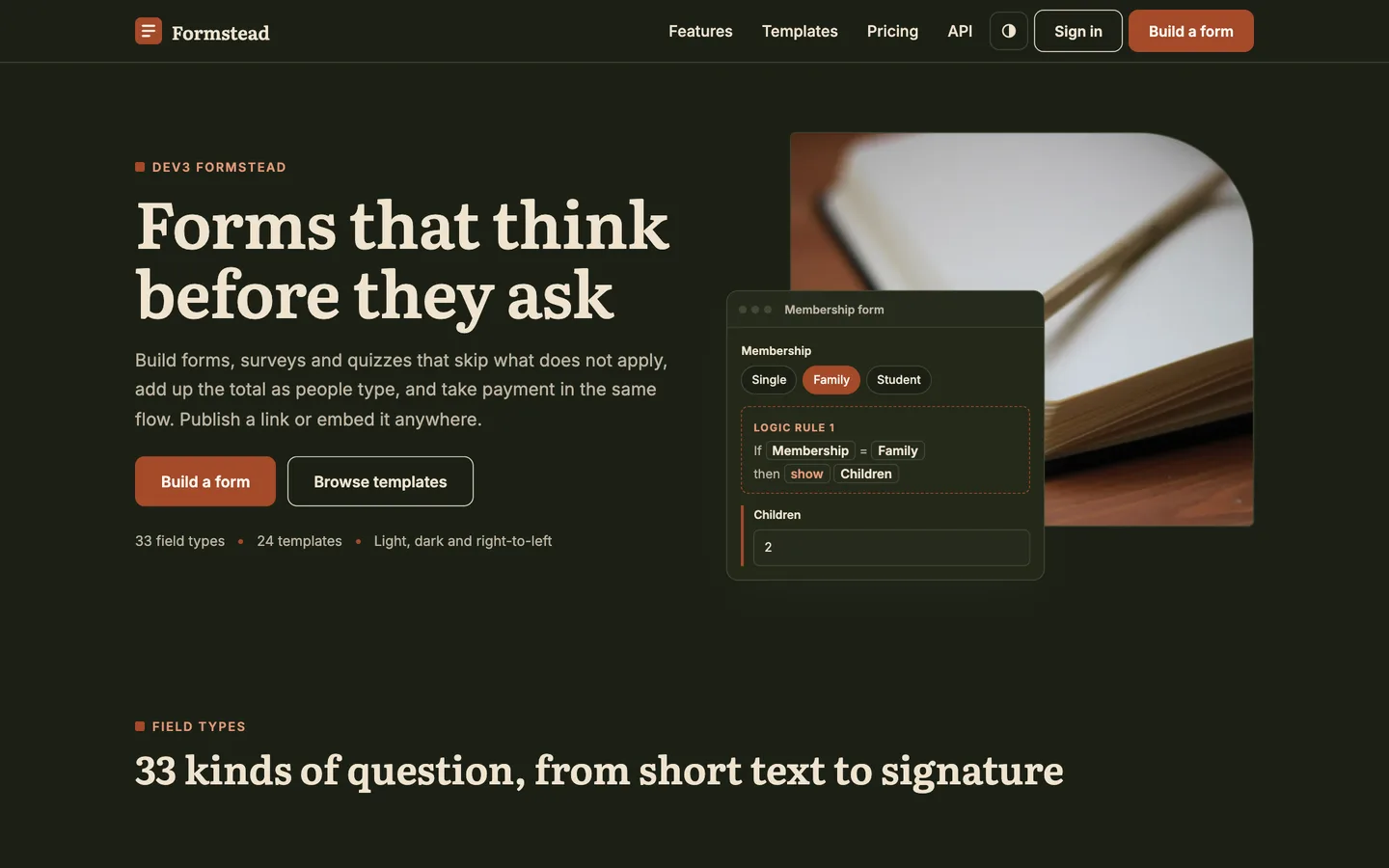
Hero in the dark: The same opening screen in the dark theme, with the photo, headline and builder card kept readable. Hero in the dark — The same opening screen in the dark theme, with the photo, headline and builder card kept readable.

Guides & articles

Practical guides and engineering write-ups for DEV3 Formstead.

Form builder SaaS: 7 things to check before you pick one

Last updated
Form builder SaaS: 7 things to check before you pick one: DEV3 Formstead

A form is not finished when you publish it. People fill it in while you edit it, pay through it, upload files to it and expect it to stop at a limit. Here are seven things to check in a form and survey builder, with DEV3 Formstead as the worked example.
Video tour — building a form with logic and a calculation, publishing it, paying, and reading the inbox and analytics

Formstead home page: the builder, a live conditional form and the plan cards

1. What happens to answers when you edit a live form?

Look for numbered versions. Each response should stay tied to the version it started on, field keys should keep their meaning, and analytics should merge answers across versions. Formstead publishes a version and pins every response to it.

2. Is conditional logic checked on the server?

Showing and hiding fields in the browser is easy. The question is whether the server drops hidden answers and re-checks every visible page. Formstead runs the same rule vectors through a PHP engine and a JavaScript engine, and catches rule cycles while you build.
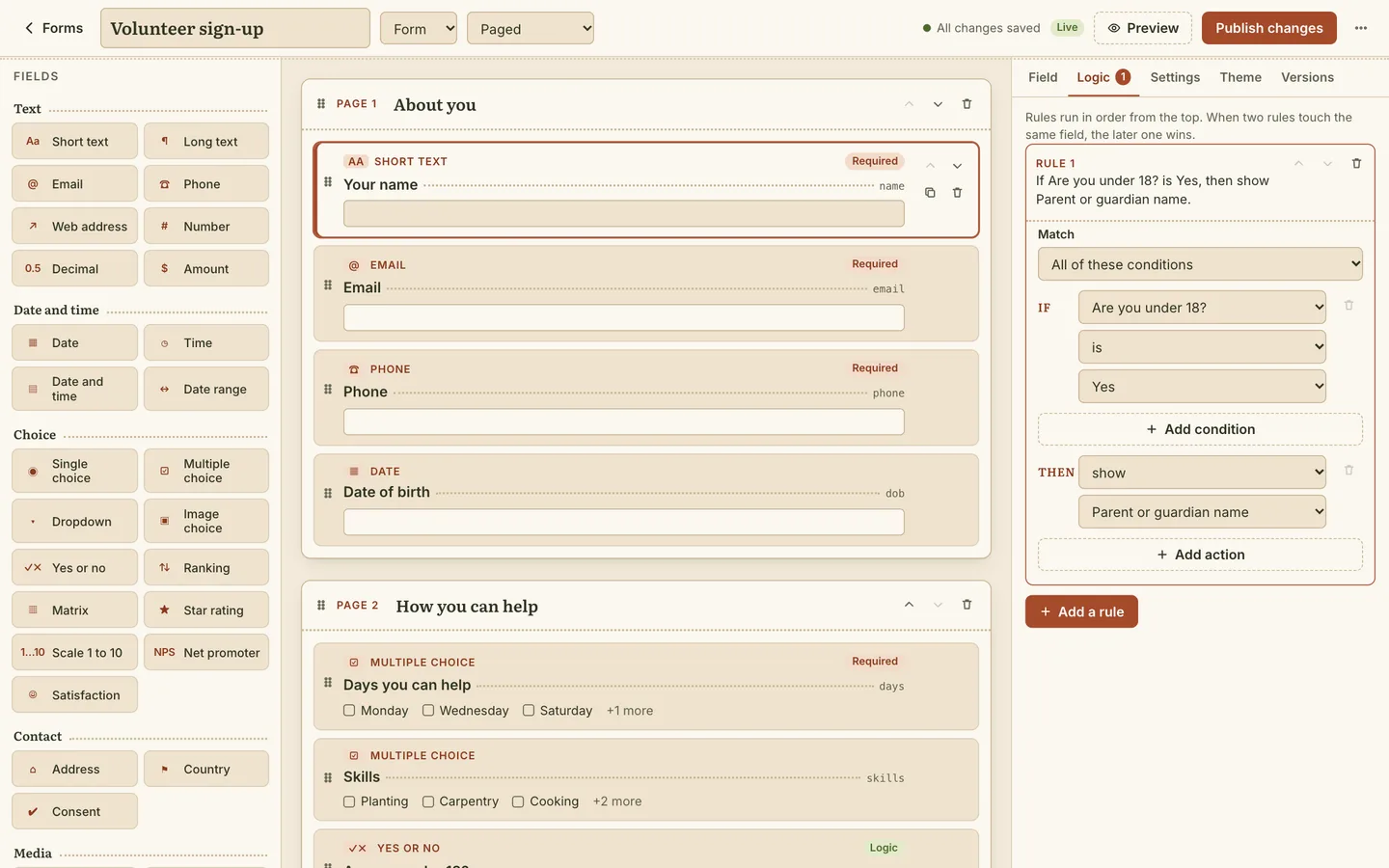
The logic rule editor with an all and any group and a show action

3. Are totals calculated safely?

A formula that feeds a payment must never be evaluated as code. Check for a real parser, exact decimals, rounding rules and a clear error for a division by zero. Formstead recomputes every total on the server and ignores the amount the browser sends.
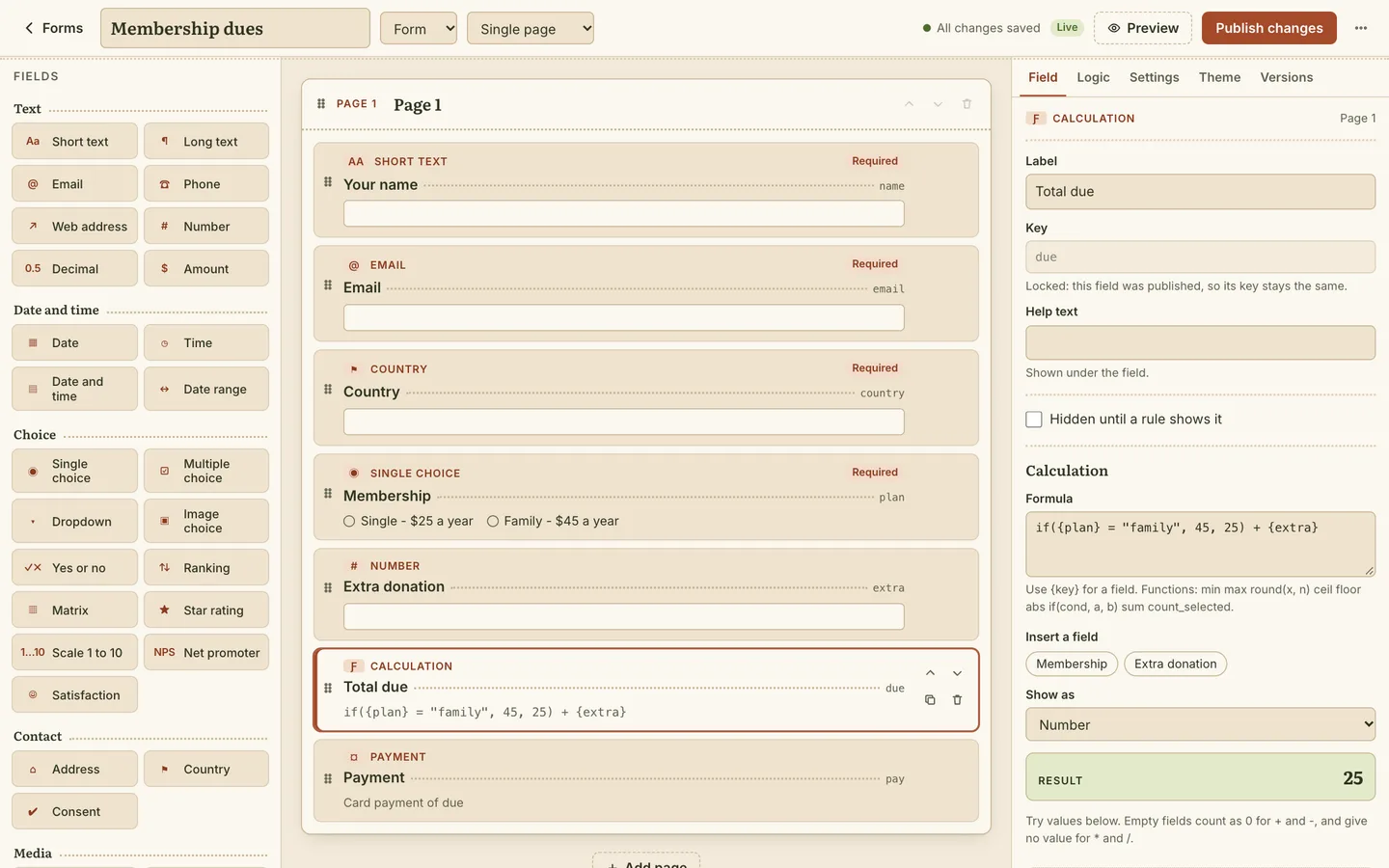
The calculation editor with a live result for a payment field

4. Does a payment complete the response only when the money arrives?

Look for a pay-then-complete flow, automatic refunds for late or duplicate payments, a fee you can set, refunds with the fee returned in proportion, and payout batches. Formstead keeps a takings balance per workspace and posts every movement to an idempotent ledger.
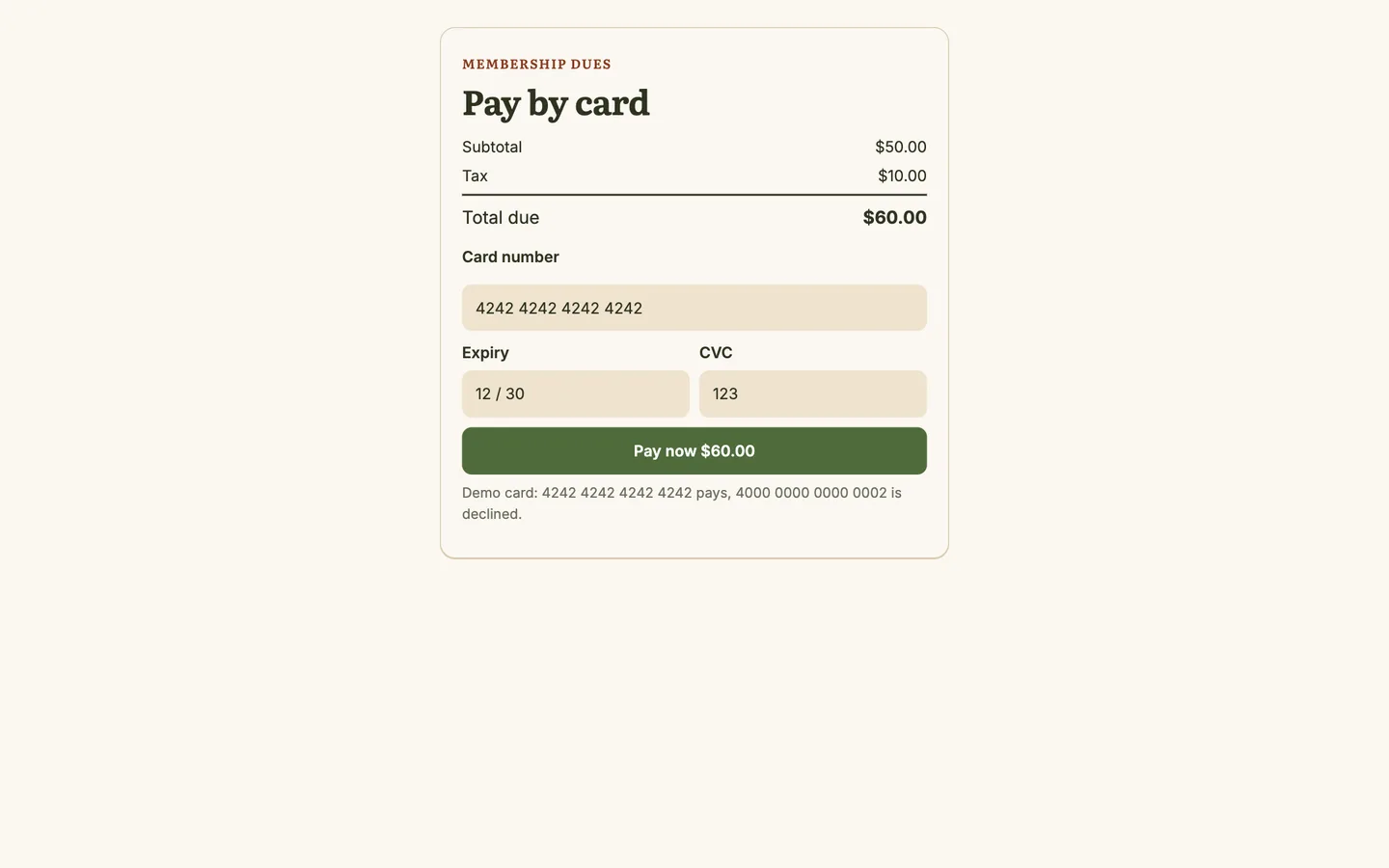
The payment summary a respondent sees before paying by card

5. Are uploads and abuse handled?

Check size and type limits, a scan step, signed download links, and layered spam checks that do not punish real people. Formstead flags infected files, shows the scan status on the response and has abuse reports with a block list for the operator.

6. Do limits hold under load?

A form limited to 100 responses must stop at 100 when two people submit at once, and a plan quota must not be passed by parallel payments. Formstead checks both under row locks and runs six MySQL race checks against a live server.

7. Can you read the answers and send them on?

An inbox with filters, a response page, PDF and CSV export, analytics that show where people drop off, signed webhooks with a delivery log and a REST API cover most integrations.
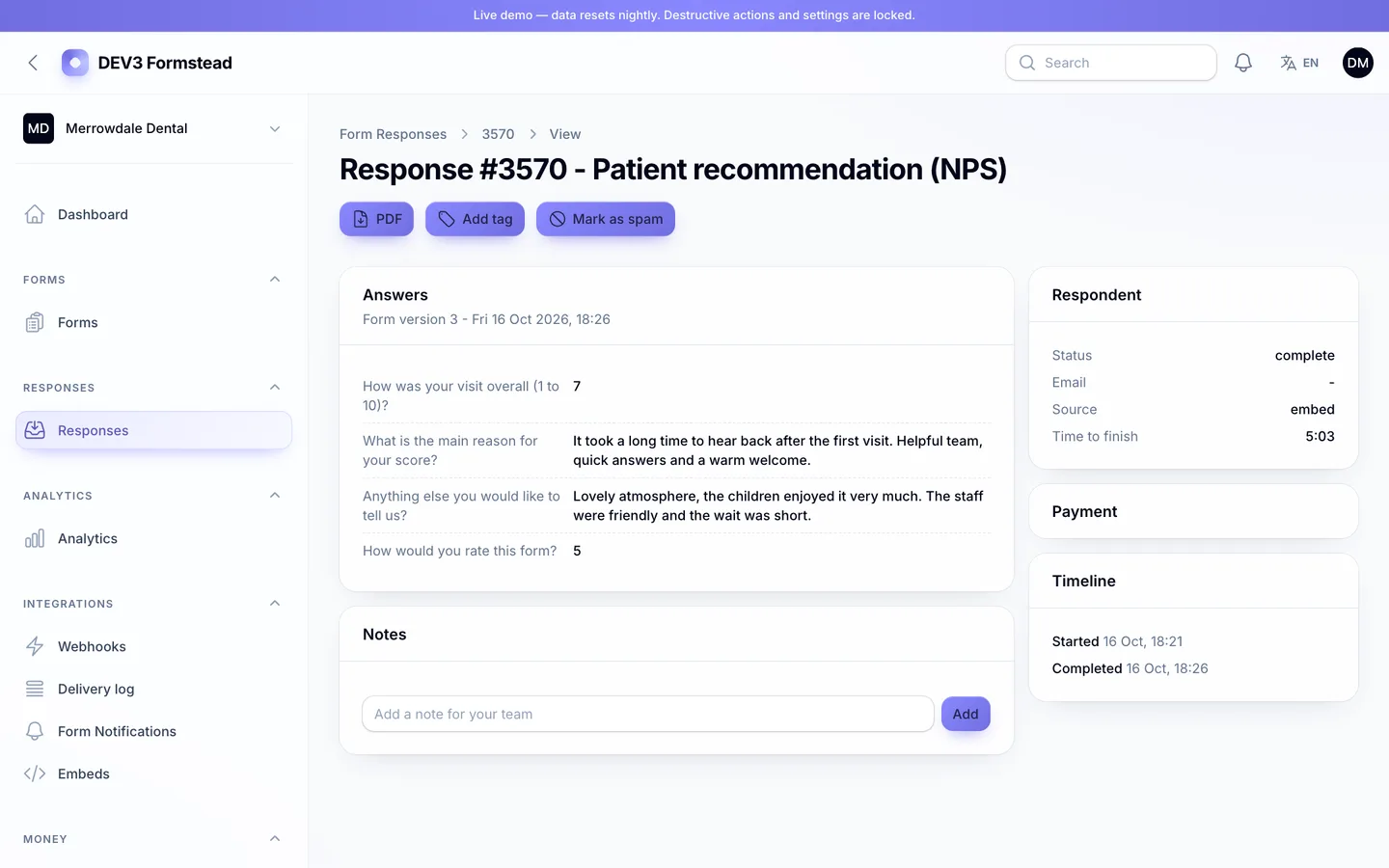
A response with its computed values, files and payment panel

If you want to run this as your own product, Formstead is a multi-tenant SaaS with plans, a billing page and an operator panel. It ships with a web installer and demo data.


Frequently asked questions

The complete source code (version 1.0.0) as a download from your account, with the setup and usage guides shown on this page. You can modify the code to suit your product.

Buying guides: Laravel scripts with Filament panels and a web installer · Next.js or Laravel for a SaaS script?

Free snippets from this product

Questions about this product (7)

Answers from the DEV3 team and the community.

Ask a question

More from this author

View all

Related in Web Scripts & Software

View all