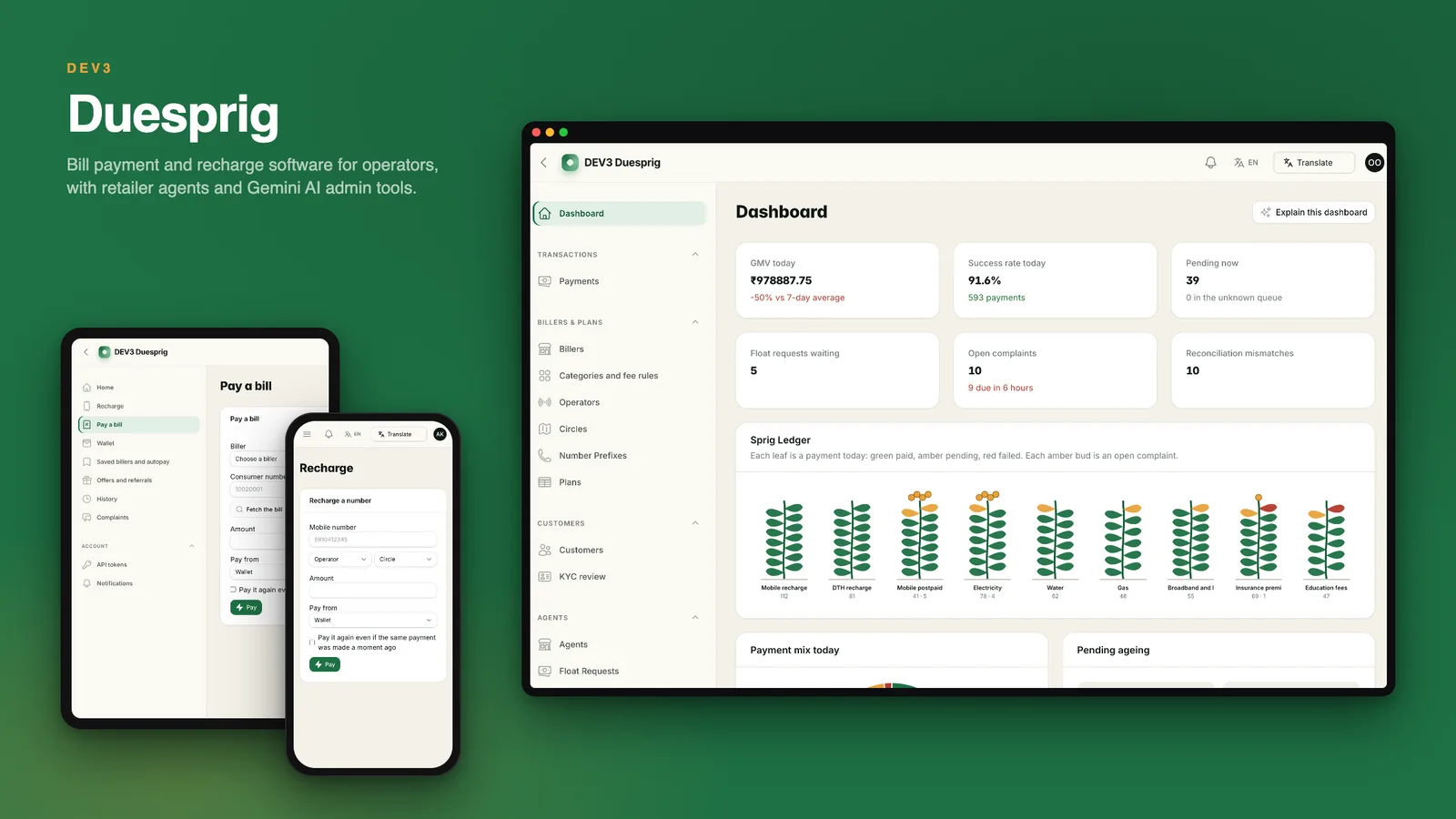
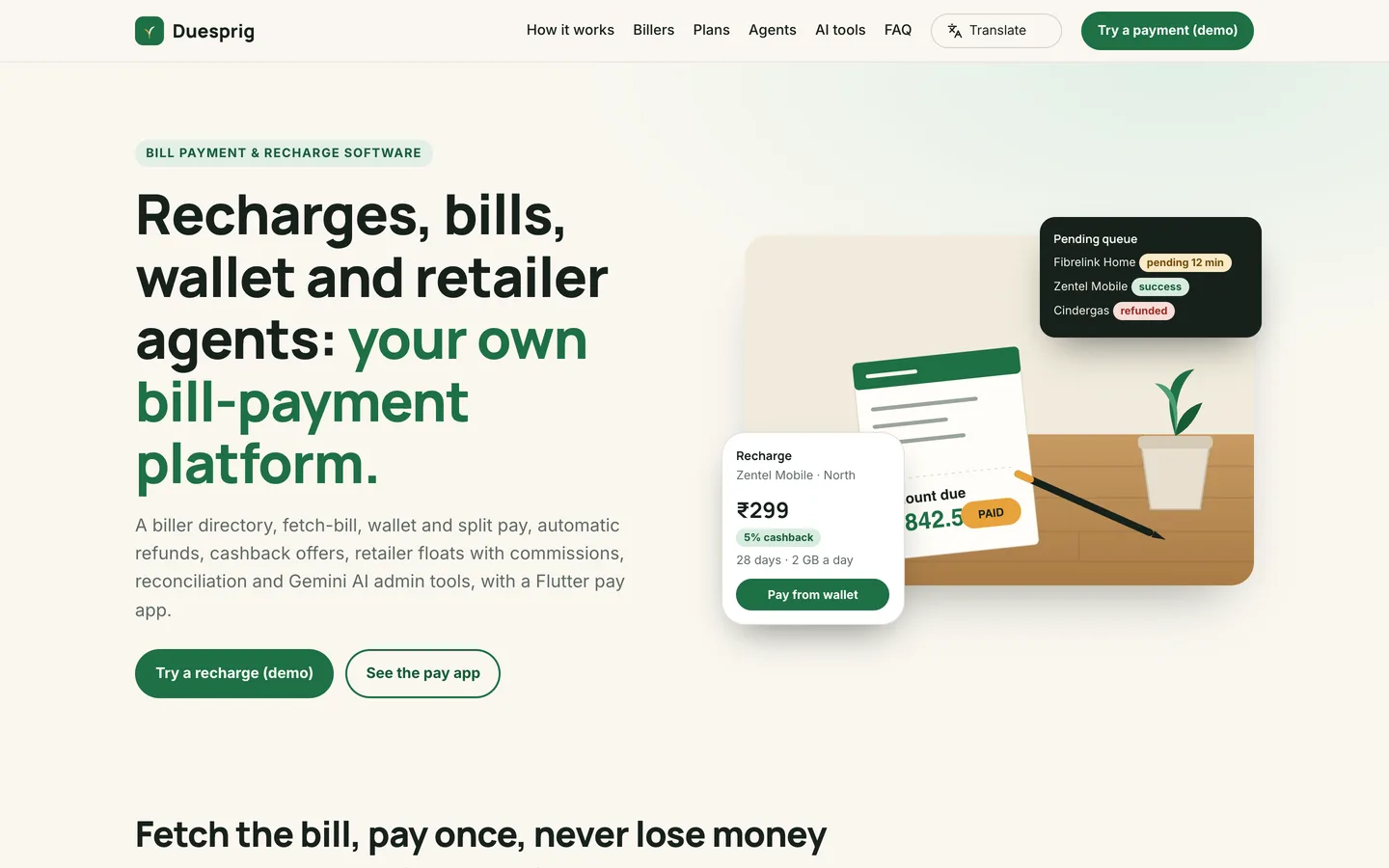
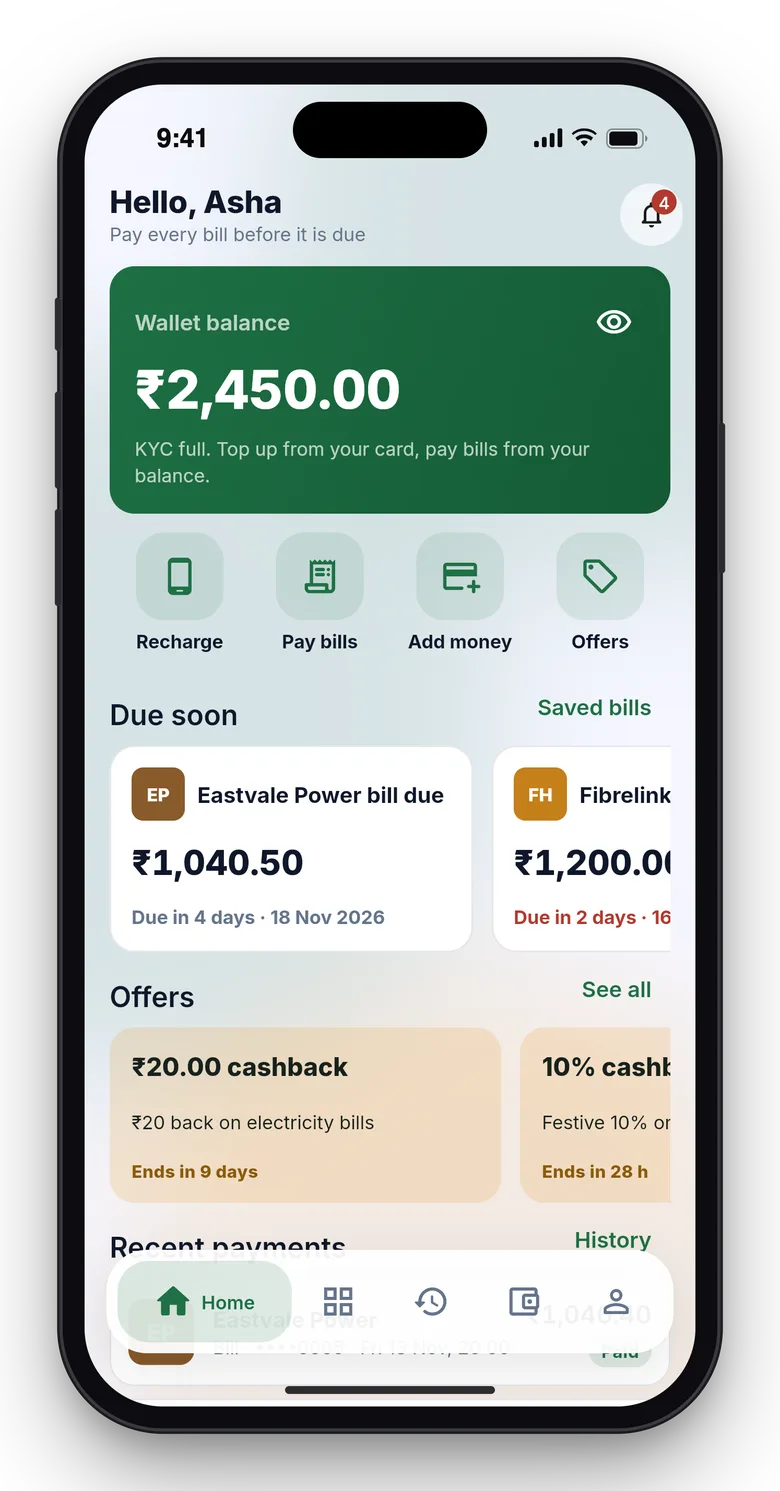
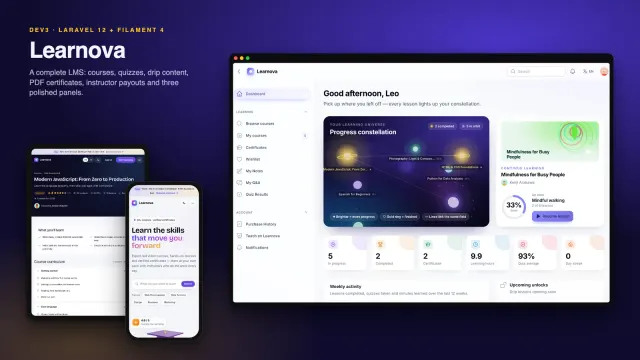
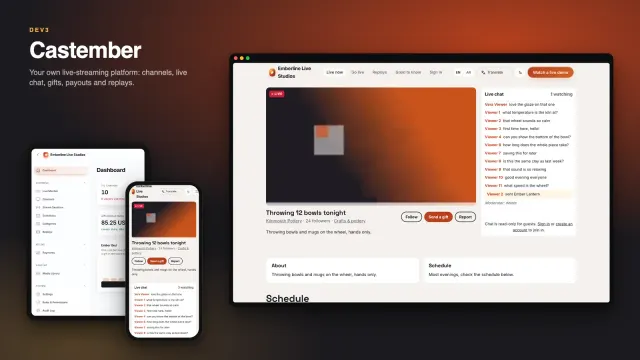
Duesprig is the software for running your own bill-payment and mobile-recharge service. Customers recharge prepaid mobiles and DTH, pay electricity, water, gas, broadband, landline, insurance and school-fee bills, and keep a wallet. Retail agents sell the same payments to walk-in customers from a float you top up. It is built by DEV3 Technologies on Laravel 12 and Filament 4, with one Flutter app (customer and retailer modes) whose source is included.
What it does
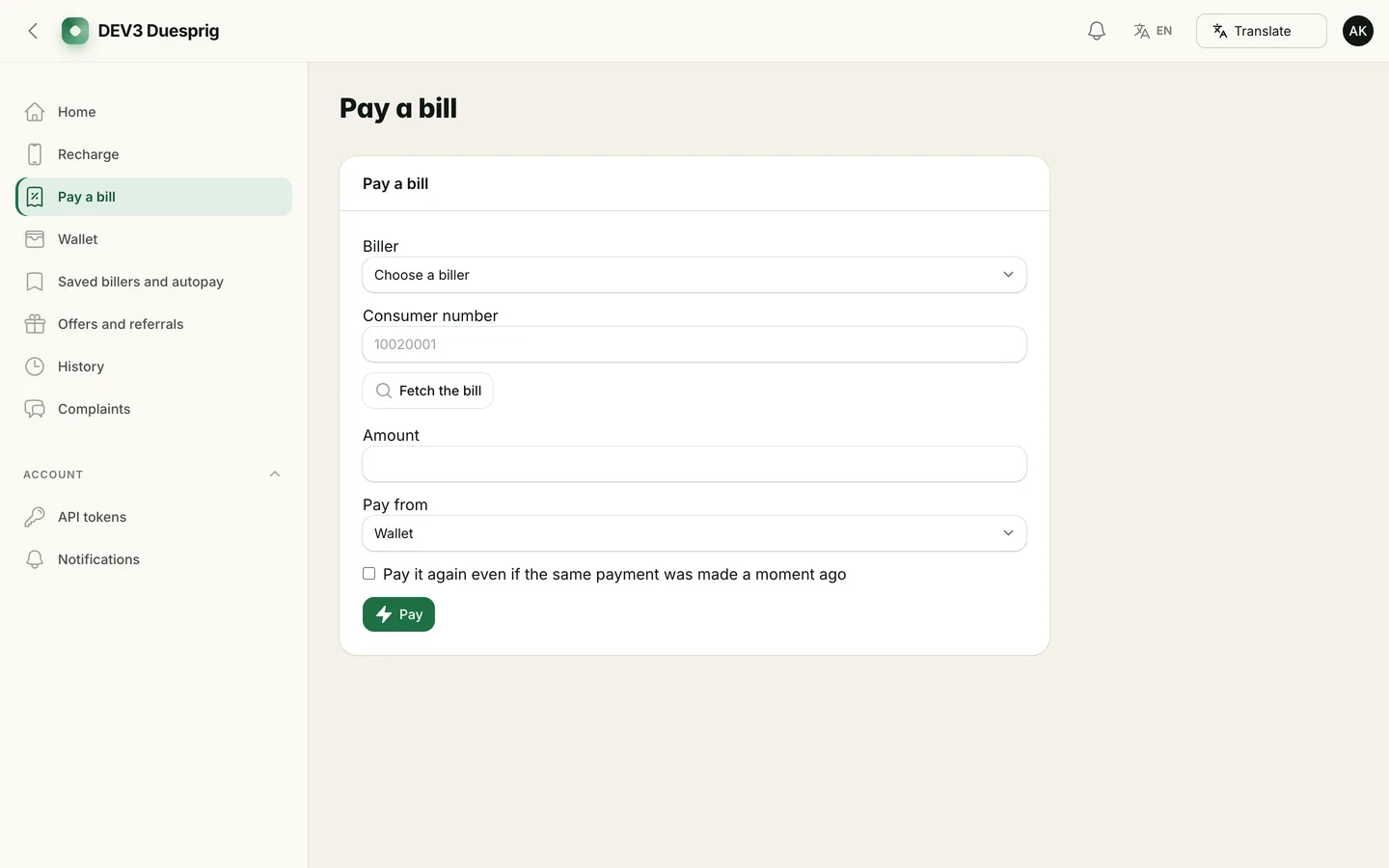
- Biller directory and fetch-bill. Billers by category and region, with a fetch step (consumer number, amount due, due date, masked customer name) and then pay. The demo has 42 billers in 9 categories, 5 mobile and DTH operators and 18 circles.
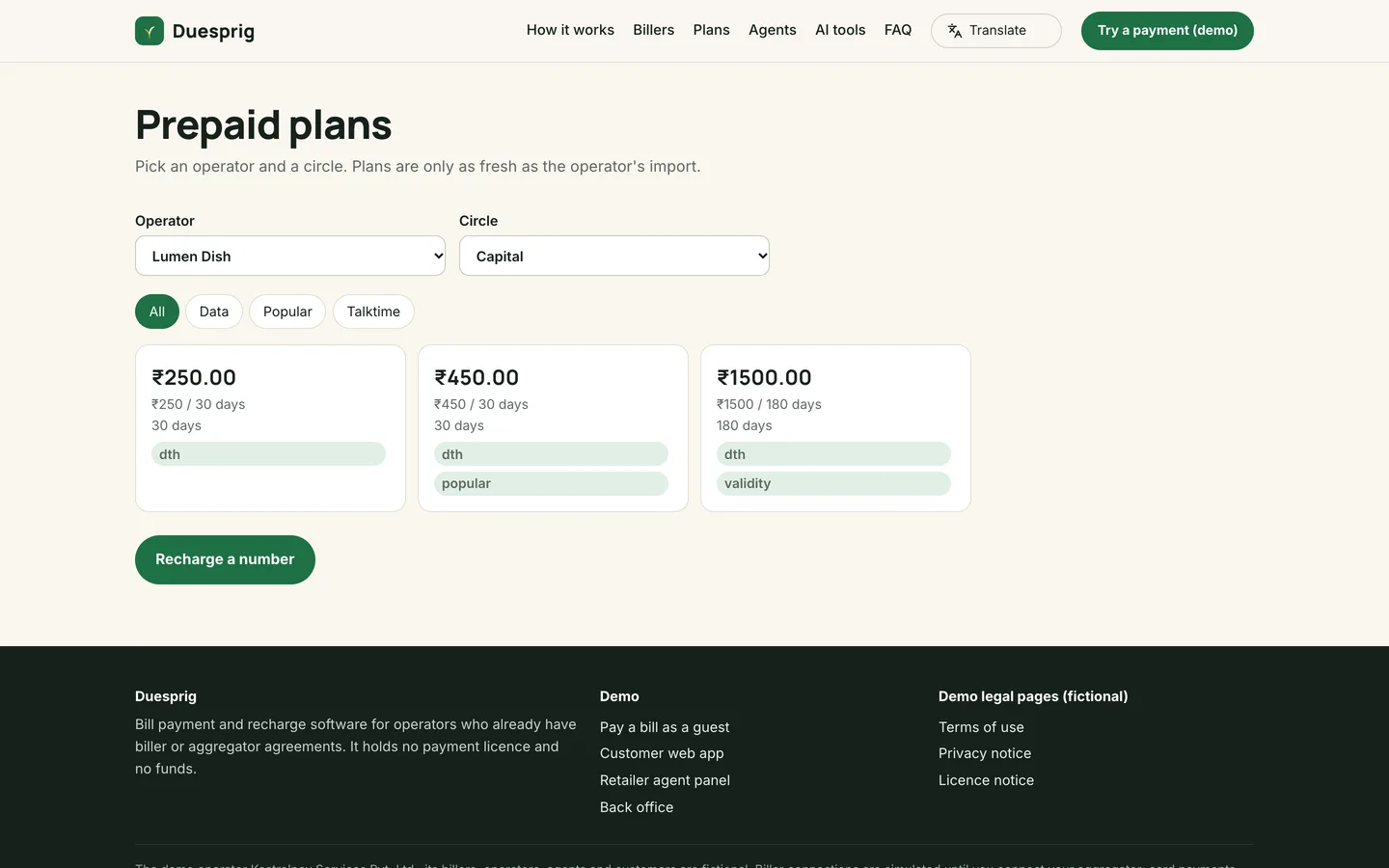
- Prepaid recharge. The operator and circle are detected from the number prefix, and a plans browser filters by data, validity and popularity. A plan's price is locked for ten minutes by plan version.
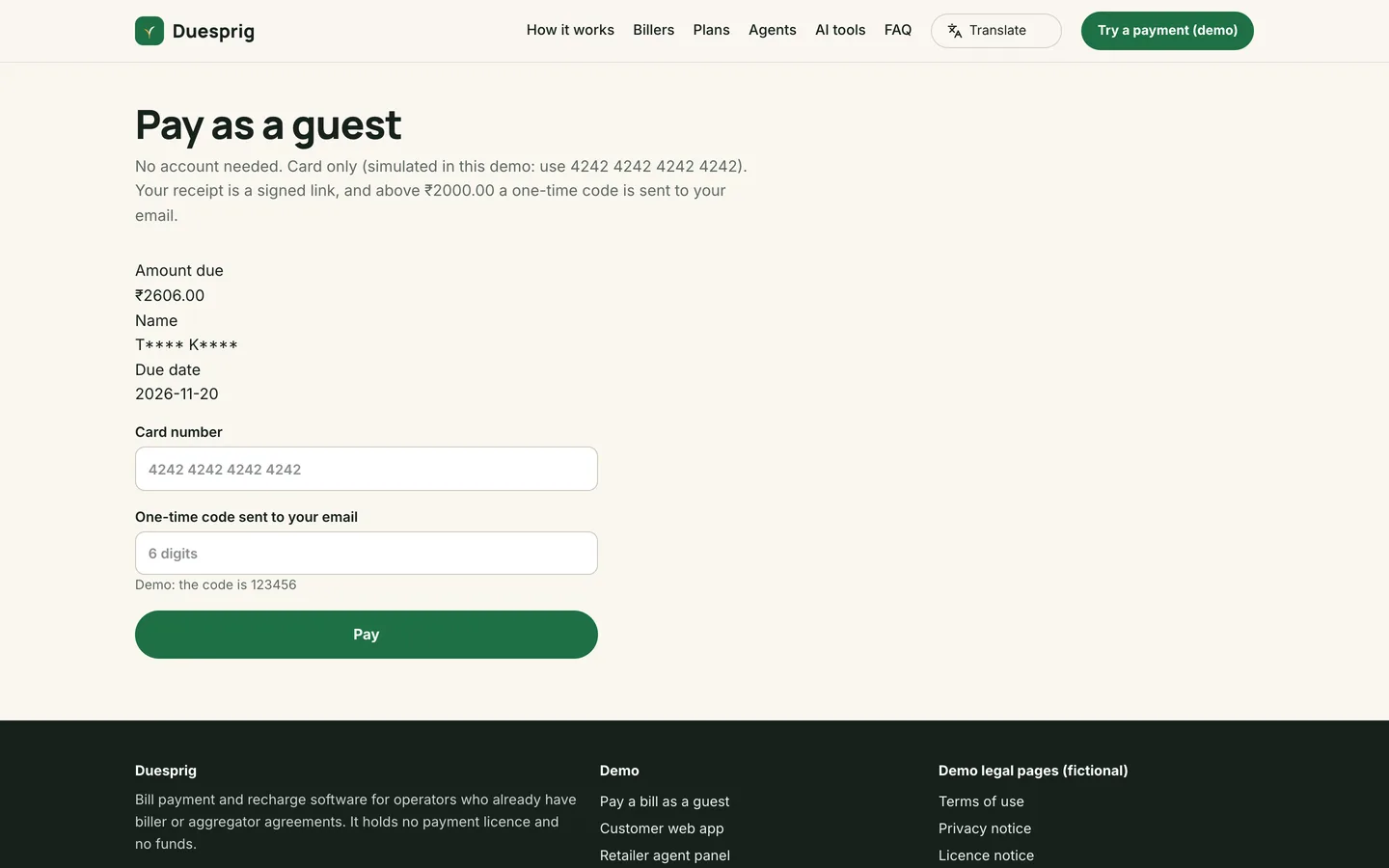
- Wallet, card and split pay. Pay from the wallet, from a card, or split the two. The wallet is a closed-loop convenience balance with KYC tiers and limits; fees carry tax on the fee and are shown before every payment.
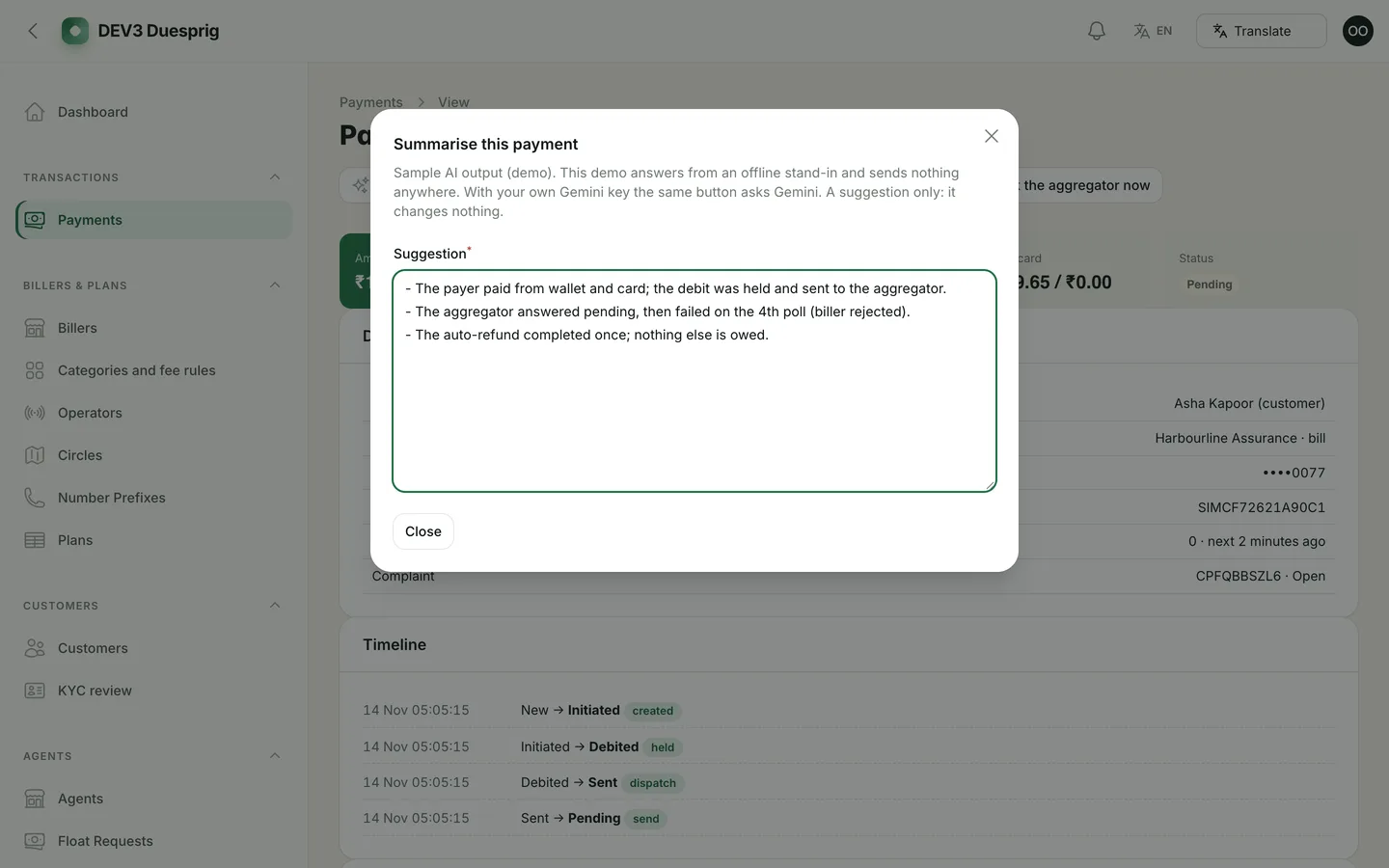
- Pending, status polling and automatic refunds. A payment moves through initiated, debited, sent and then success, failed or pending. Pending ones are polled until they settle; a failure is refunded automatically; a late success is reconciled. Every transition is recorded on a timeline the customer can see, and one request key can never pay twice.
- Cashback, autopay and referrals. Cashback offers with rules and monthly caps credited after settlement, reminders and autopay mandates, receipts with signed share links, and a refer-a-friend bonus.
- Retailer agents. A float balance topped up by requests you approve, commission slabs per category, daily statements, and a low-float stop so a sale never overdraws.
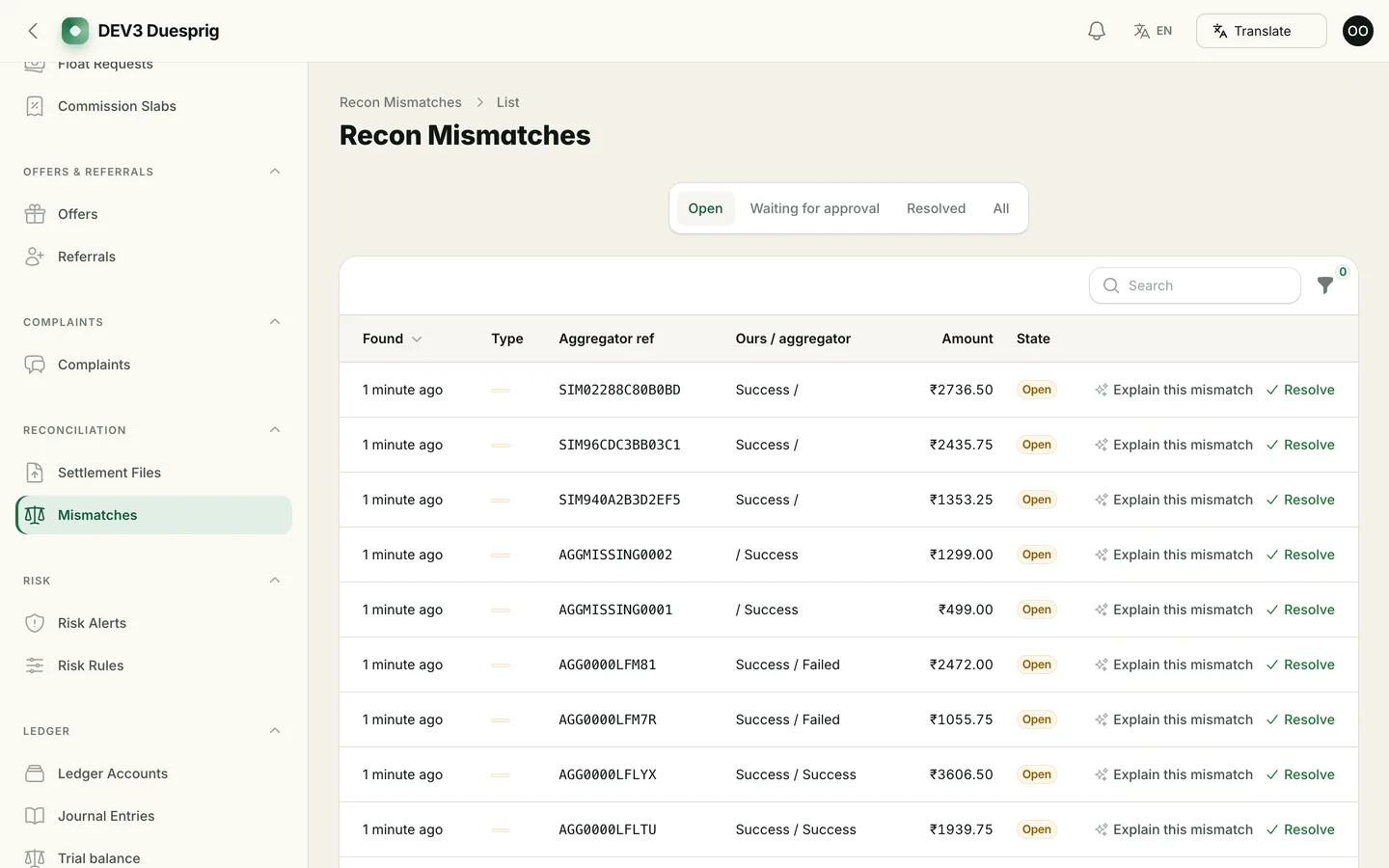
- Back office. Payments and the unknown queue with five audited actions, biller health, plans import, KYC review, agents and float requests, offers, complaints with SLA timers, daily settlement-file reconciliation with four mismatch types, risk rules and alerts, a double-entry ledger with a trial balance, and reports.
- PIN and device safety in the app. A 4 to 6 digit PIN on the app's own keypad, a proof that works once per payment, device binding with a cooling-off limit on a new phone, and idempotency keys on every money call.
- API. A key-based partner REST API with scopes and webhooks, a public API for the signed-out site, an OpenAPI document and the app API used by the Flutter app.
- Twelve languages. A Google Translate language switcher on the public site and the admin; the app has its own in-app language picker.
The Flutter app
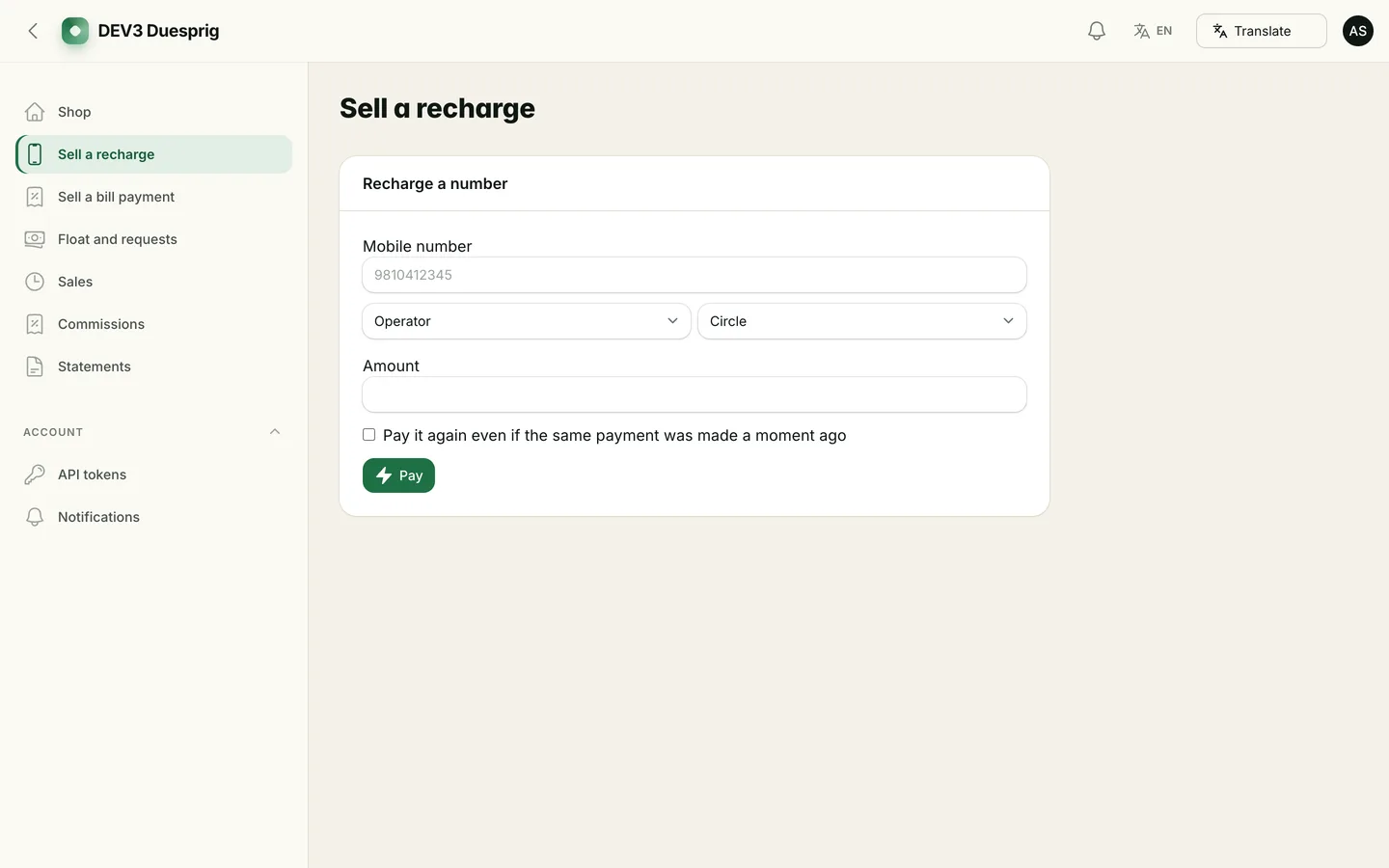
The pay app (apps/pay) is one login with two modes. In customer mode: wallet and due-soon home, recharge with plan browser, billers, fetch and pay, confirm with PIN, a status screen that polls, receipts, wallet and top-up, saved bills and autopay, offers, complaints and referrals. In retailer mode: float, sell a recharge or a bill, sales, commissions and statements, and float requests. It starts in demo mode and has a store-publishing guide in docs/STORE-PUBLISHING.md.
Gemini AI admin tools
Optional, bring your own key: add your own Gemini key after purchase in Settings > AI (Google bills your account); with no key the AI buttons say "Add your Gemini key in Settings". Every result is a draft you preview and edit; nothing is saved, refunded, sent or applied automatically, and every applied suggestion is audited.
- Dashboard and reports: explain the dashboard, any report and the trial-balance movement.
- Transactions: summarise a payment timeline, "Ask in plain words" filters, and a next-best-action hint for pending and unknown payments.
- Billers and plans: write descriptions, improve titles, suggest tags and clean up a plans import.
- Agents and offers: flag a float anomaly, draft a reply to a float request, write offer copy and suggest a cap from history.
- Complaints, reconciliation and risk: summarise a thread, draft a reply, tag root causes, explain a mismatch with a suggested resolution and explain a risk alert.
Names, phones, emails, consumer numbers, card, UPI and bank references, aggregator references and device ids are replaced by tokens before any call; PINs, OTPs, card data and KYC documents are never sent.
Quality checks
The release passed seven gates on the final code: Larastan level 6 with 0 errors, a Pest suite of 351 tests, a build with a small JavaScript budget and no 3D, migrations and the full demo seed on MySQL 8 and SQLite, a headless smoke test over the public site and every panel plus ten MySQL race groups (two devices paying at once, a failure racing a success callback, agent float, the last budget unit, wallet double spend, PIN lock, float approval twice, scheduler double poll), the web installer driven from the zip, and a secret scan. A consistency command (duesprig:check) proves the ledger, wallets, floats, refunds and settlements agree on the demo data. The Flutter app passed analysis, its tests and simulator builds, and ran once against the live API.
What you should know before buying
- This is software for an operator who already has biller or aggregator agreements. It holds no payment licence and no funds. Bill-pay and recharge providers are simulated in the demo; you connect your own aggregator (a generic REST adapter with field mapping is included) and complete any country certification, such as BBPS, yourself.
- Payments need a real gateway in production. Card, UPI and bank payments are simulated until you add your own gateway, and the simulated card leg refuses to run on a live site.
- The wallet is a closed-loop convenience balance under your own licence or partner rules; cashback is a configurable promotion, not interest. Retailer agents need float top-ups you approve.
- Gemini AI admin tools need your own Google Gemini API key (Settings > AI); no key or AI usage is included. Without a key the AI buttons stay disabled.
- A Google Translate language switcher is on the public site and admin; it needs Google's widget to load in the visitor's browser. Private pages (wallet, statements, consumer numbers, receipts, complaints, customer and agent pages, admin payment views and Settings > AI) are marked so the switcher does not send them to Google.
- One Flutter app (customer and retailer modes) with source and a store-publishing guide. Building, publishing and store approval are your step; financial-app store rules apply.
- Use MySQL or MariaDB for a live site; the concurrency checks were run on MySQL 8. One cron entry every minute is required.
Included
Source code, the web installer, the Flutter app source with a store-publishing guide, a buyer guide and demo data for a fictional operator (about 64,000 customers, about 1,900 retailer agents, about 250,000 payments, about 3,200 complaints, 365 settlement files, about 9,800 risk alerts and 22 offers) and six months of support.
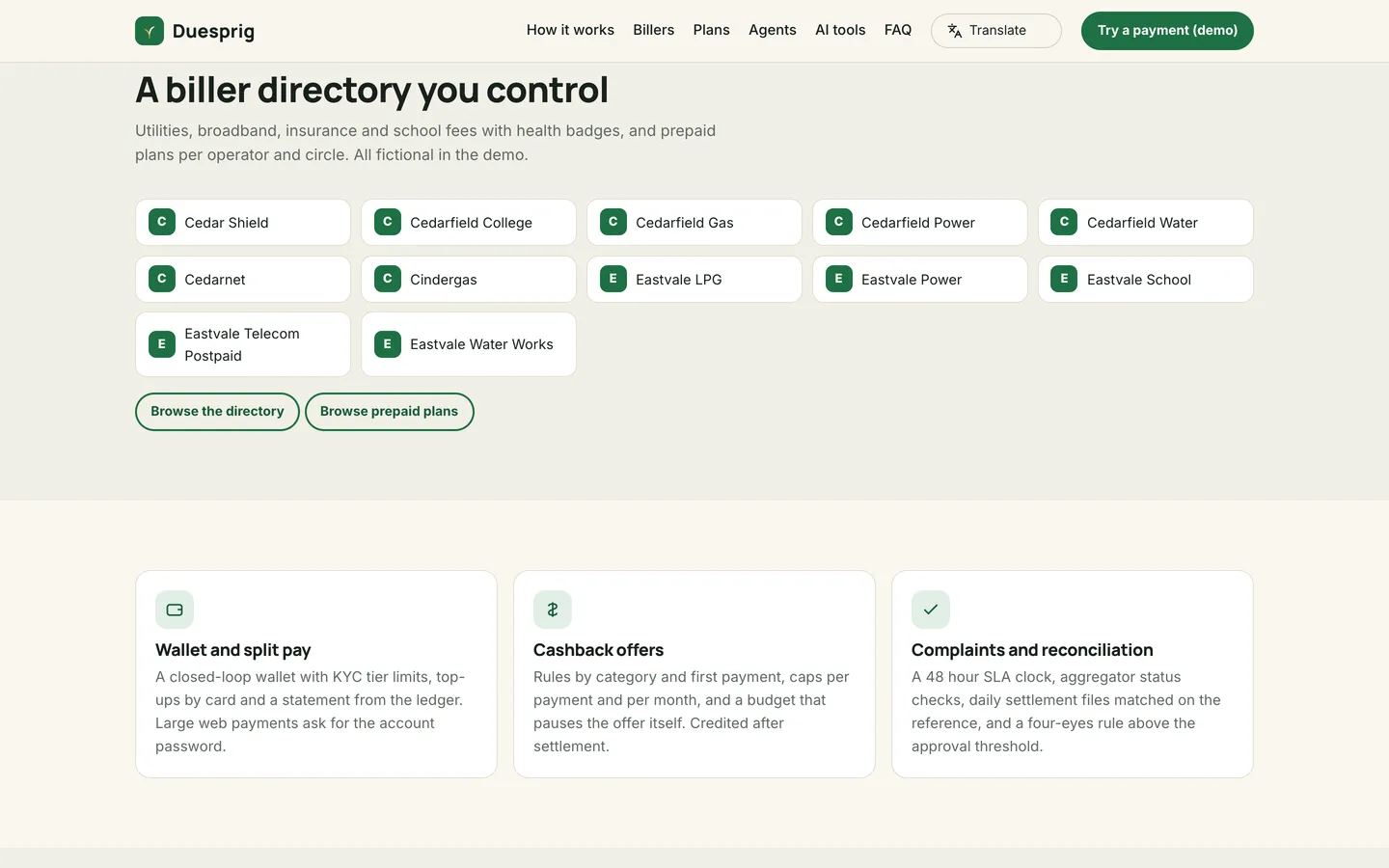 Biller directory — utilities, broadband, insurance and school fees with health badges.