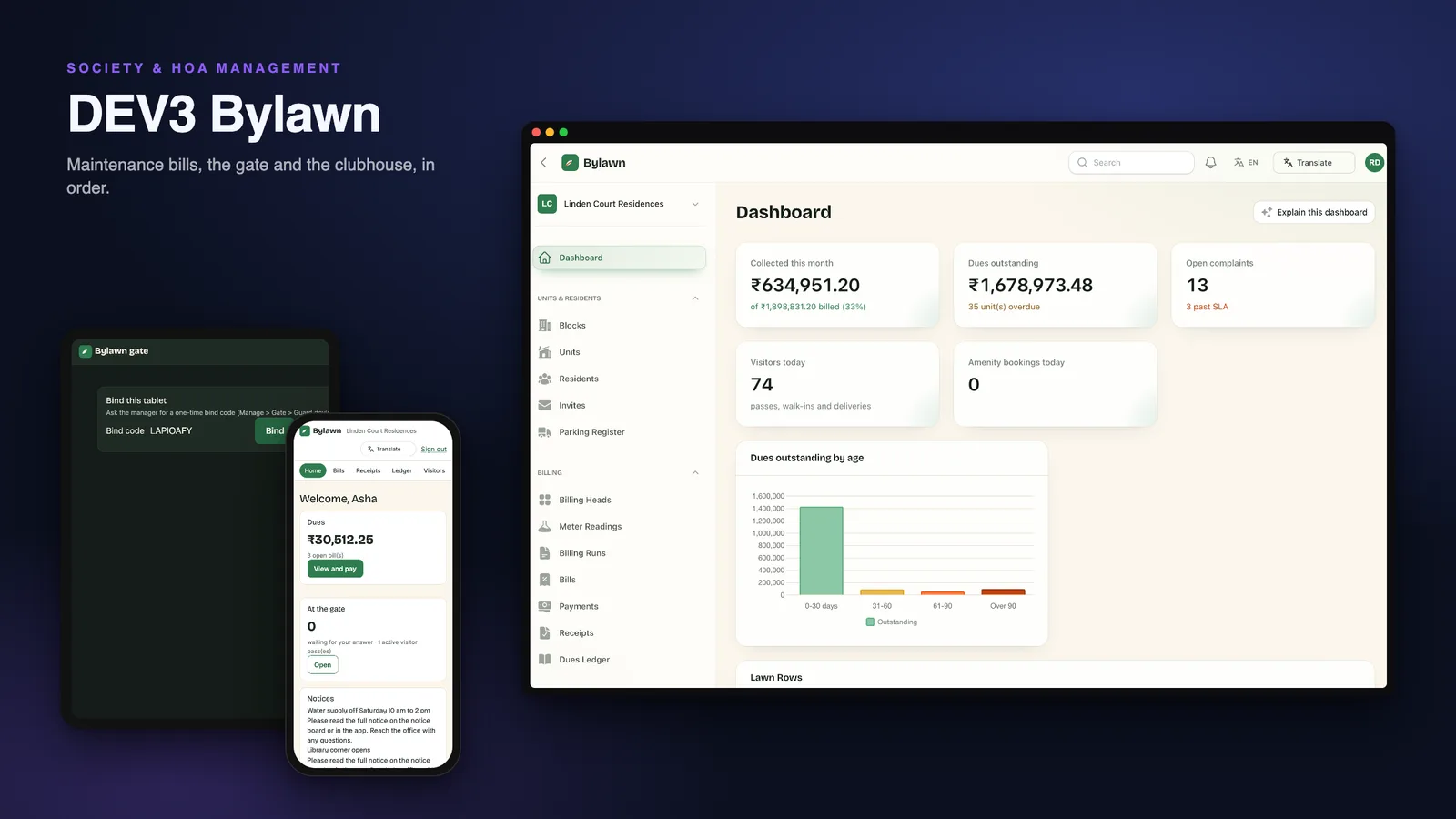
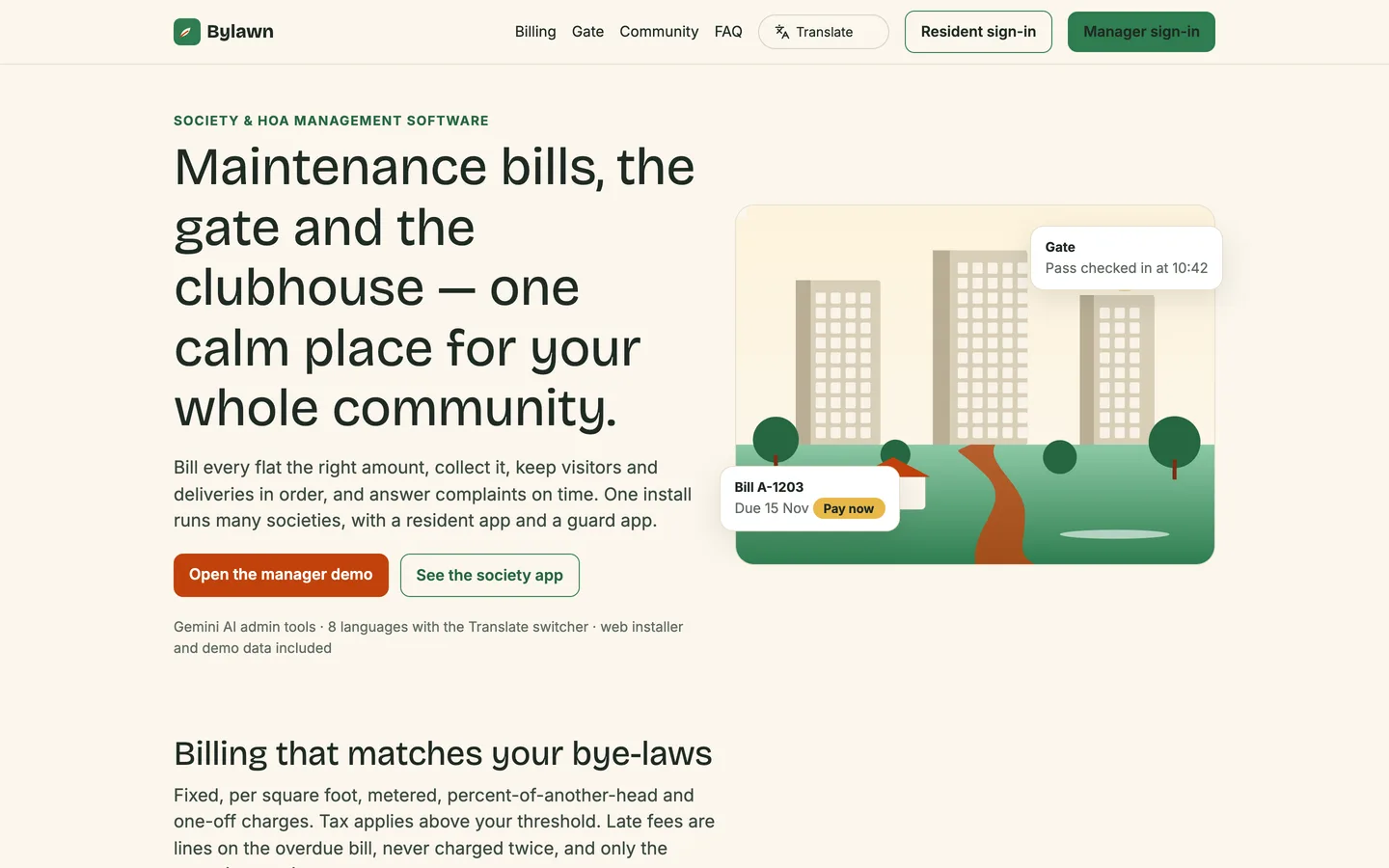
Bylawn is the software for running apartment societies, residents' associations and gated communities. The committee issues maintenance bills from configurable heads, residents pay and see where every rupee goes, guards admit visitors with signed one-time passes, and the same install runs many societies, each with its own committee. It is built by DEV3 Technologies on Laravel 12 and Filament 4, with one Flutter app (resident and guard modes) whose source is included.
What it does
- Many societies, one install. Each society or association is its own workspace with its own units, committee, settings and data. A platform panel lists societies, plans and platform reports.
- Units, owners, tenants and residents. Blocks, towers and villas, owner and tenant records, invites, a parking register and an opt-in directory. Ownership can be transferred mid-period.
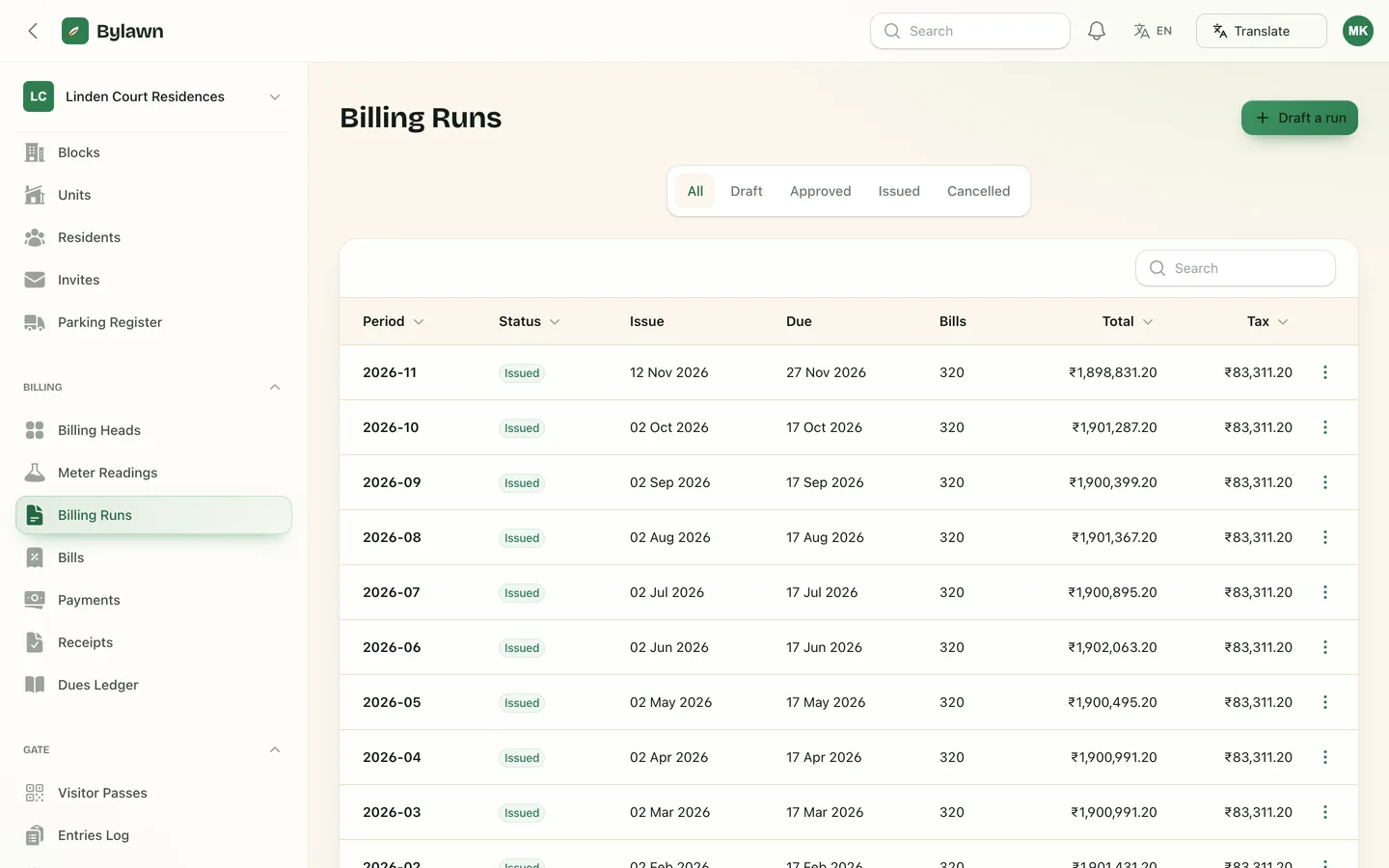
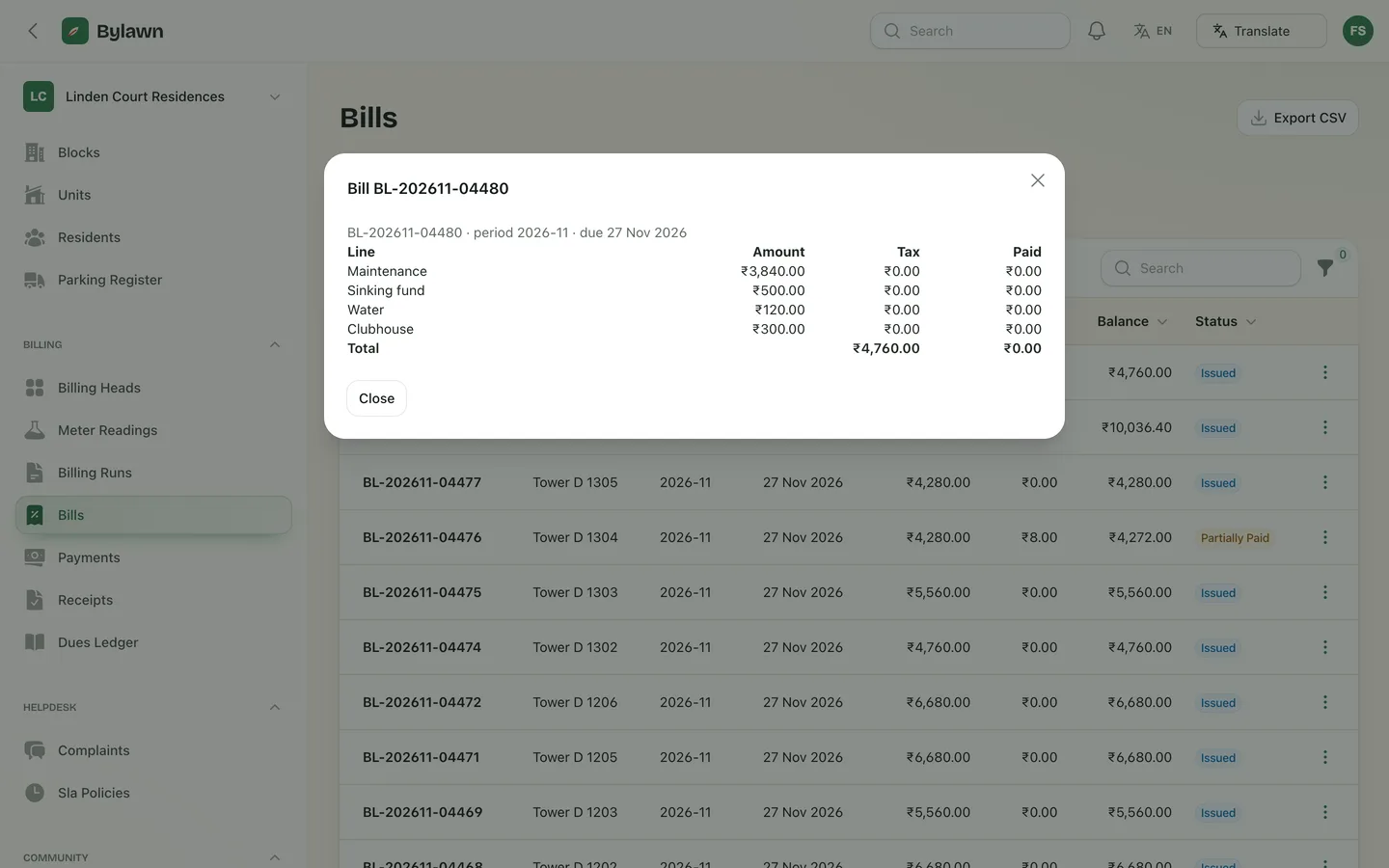
- Maintenance billing. Fixed, per-area, metered and one-off heads, a sinking fund, optional tax above a threshold, and an advance-credit balance. A billing run is a draft you review, the committee approves and you issue; one live run per period.
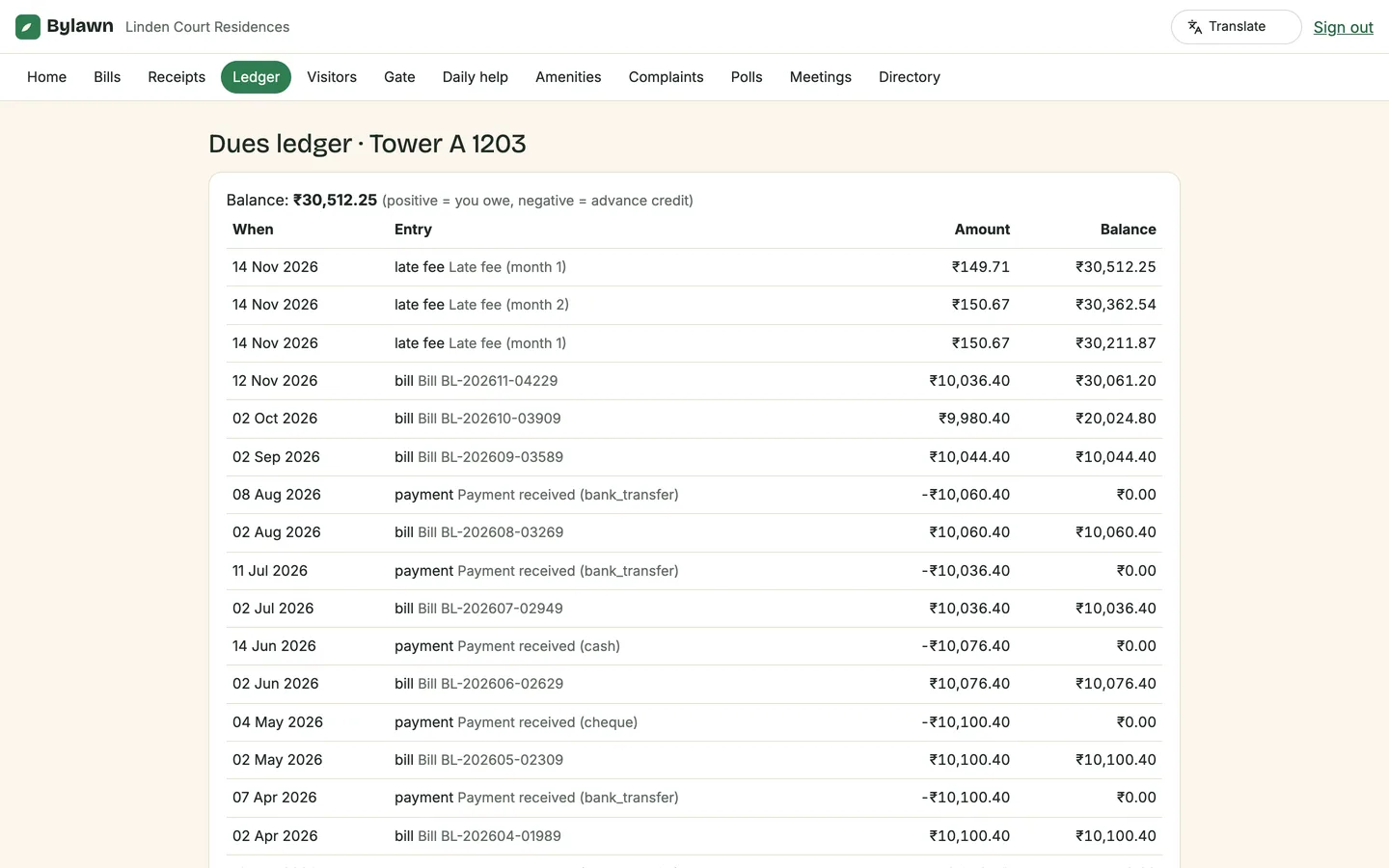
- Late fees on the overdue bill. Simple, compound or pro-rata fees land as late-fee lines on the overdue bill itself, and the next bill's statement shows them as previous dues. Fees can be waived and are never split on a transfer.
- Payments, receipts and the dues ledger. Online payments, cash, cheque and bank transfers, allocated oldest-first, reversible, with one statement per unit. Amenity fees and deposits show as memo lines that never change the balance.
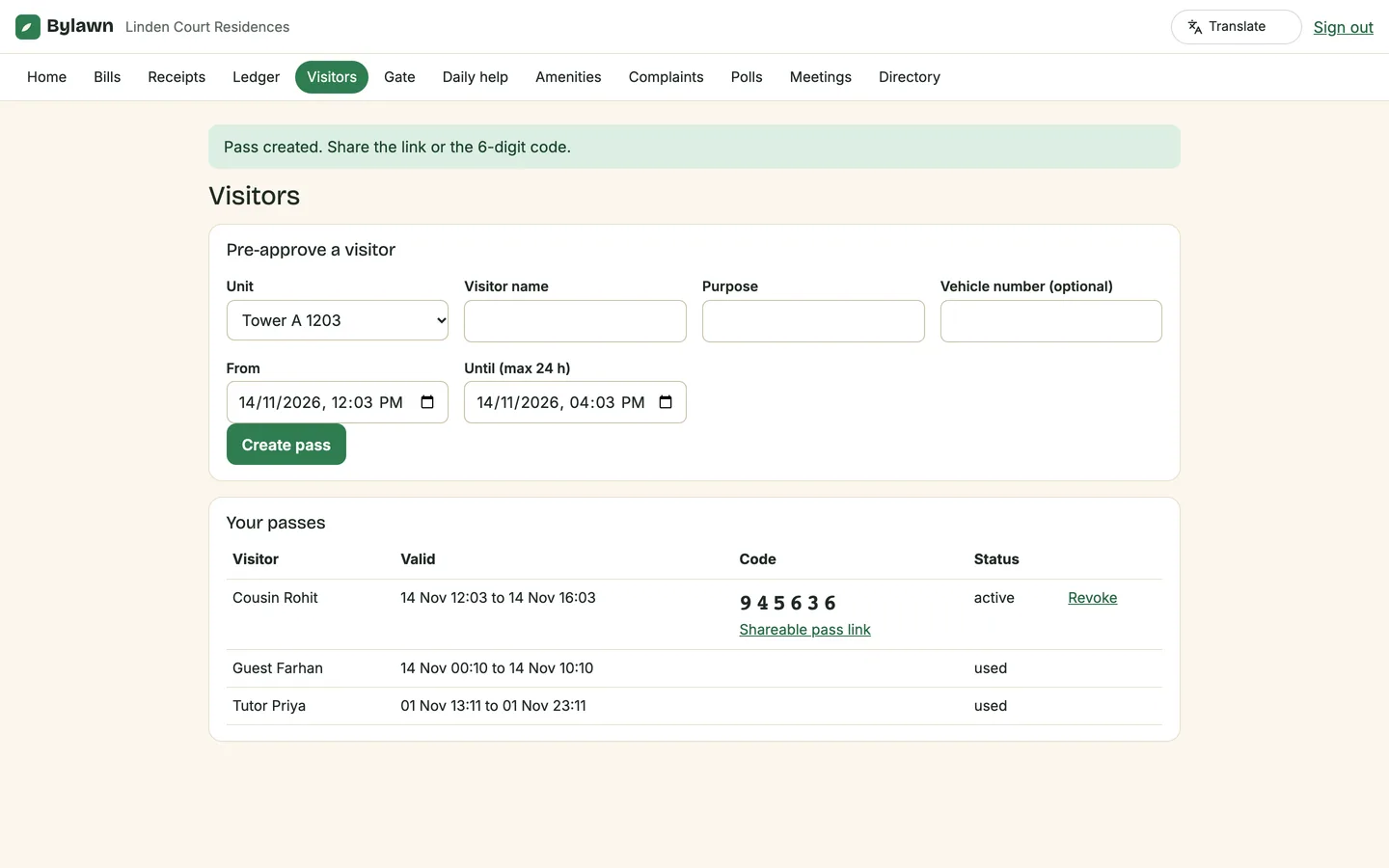
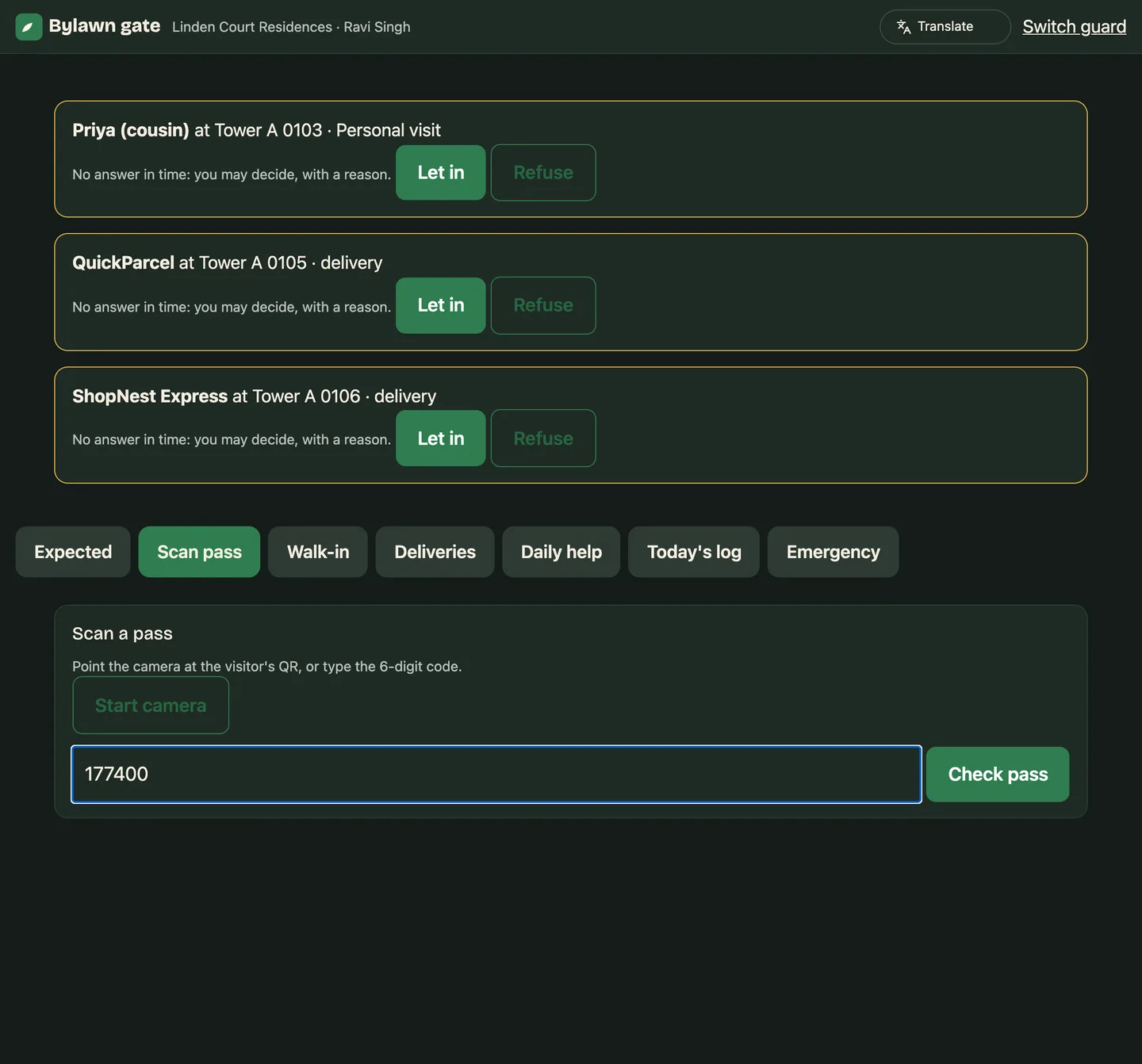
- Gate management. Residents pre-approve visitors and share a signed, single-use pass with a QR code and a six-digit code. Guards scan or type it, record walk-ins for the resident to approve, log deliveries, check daily help in and out, and see emergency contacts. Guard overrides need a reason and are audited.
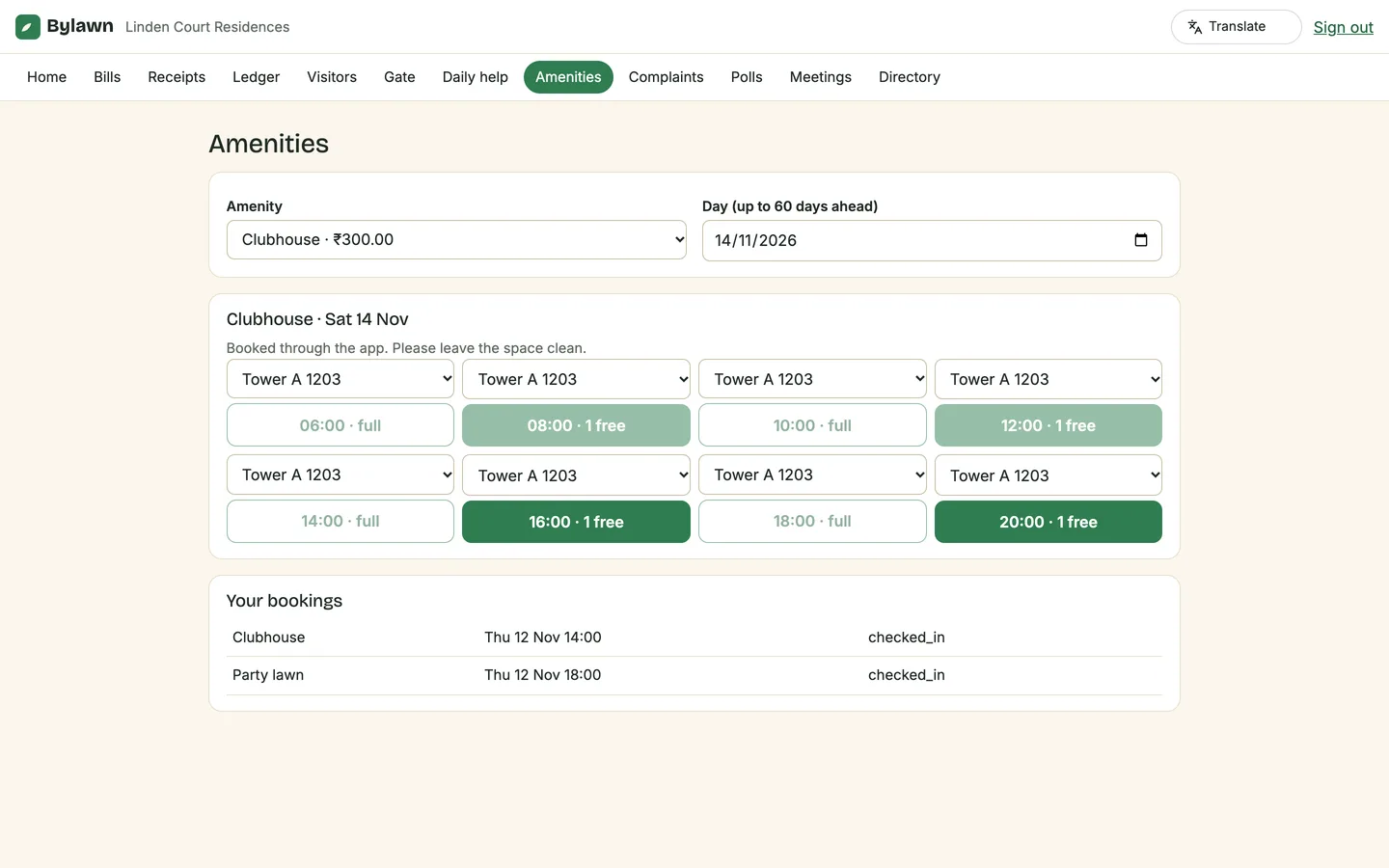
- Amenity booking. Slots with capacity and a monthly quota per unit, a fee and a refundable deposit, cancellation rules and a hold while paying.
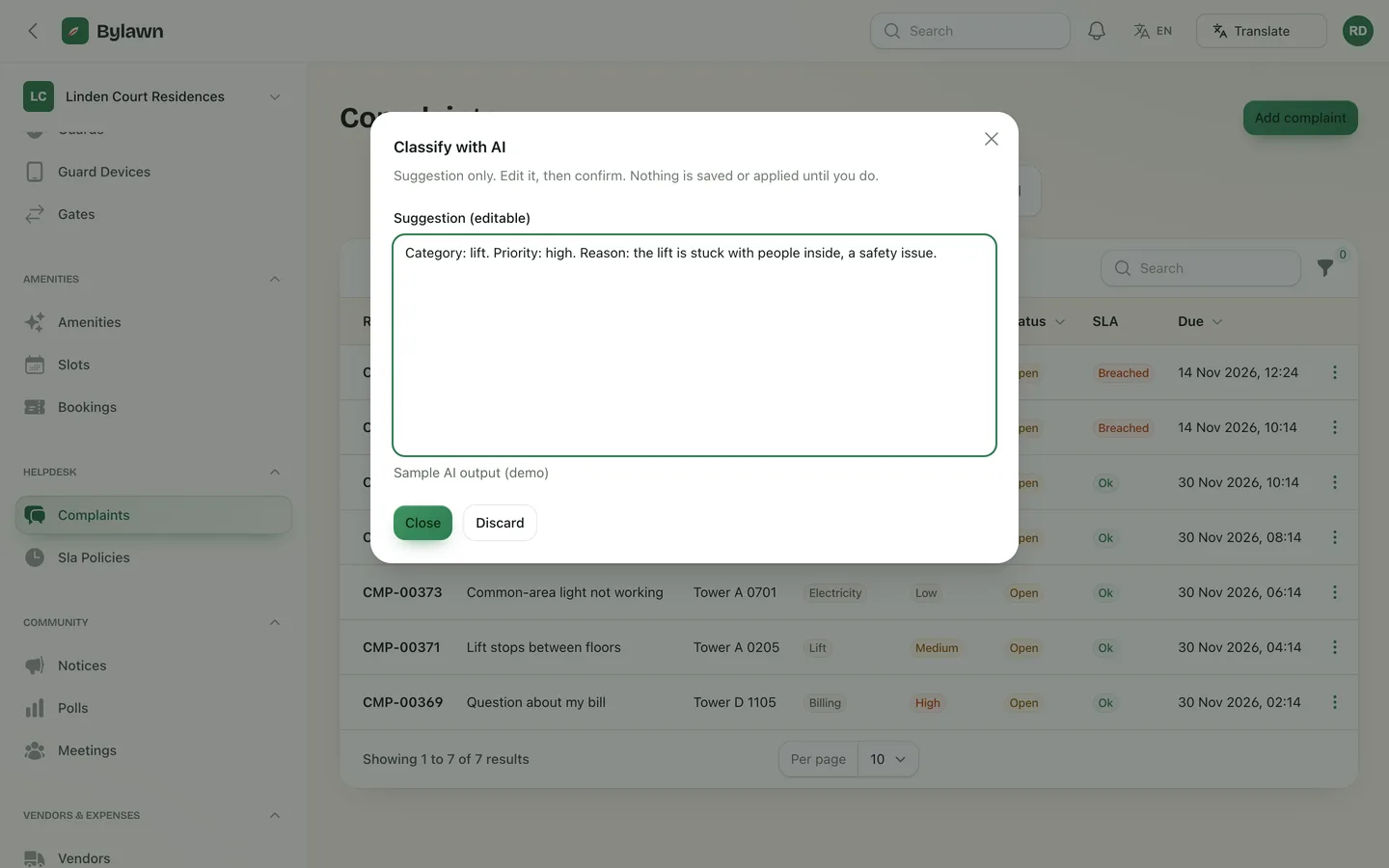
- Complaints with SLA. Categories, SLA policies, due times and breach tracking, a thread with the office and a rating when closed.
- Notices, polls and meetings. Notices, polls weighted by unit area or one vote per unit, and committee meetings with minutes and action items.
- Vendors and expenses, reports, API. A vendor and expense book, collection, dues-aging, fund, expense, gate-traffic and SLA reports, a key-based REST API with an OpenAPI document, and webhooks for bills, payments, complaints and visitors.
- Resident portal and guard screen on the web.
/my for residents and a large-type /gate screen for a shared tablet, besides the Filament manager panel.
The Flutter app
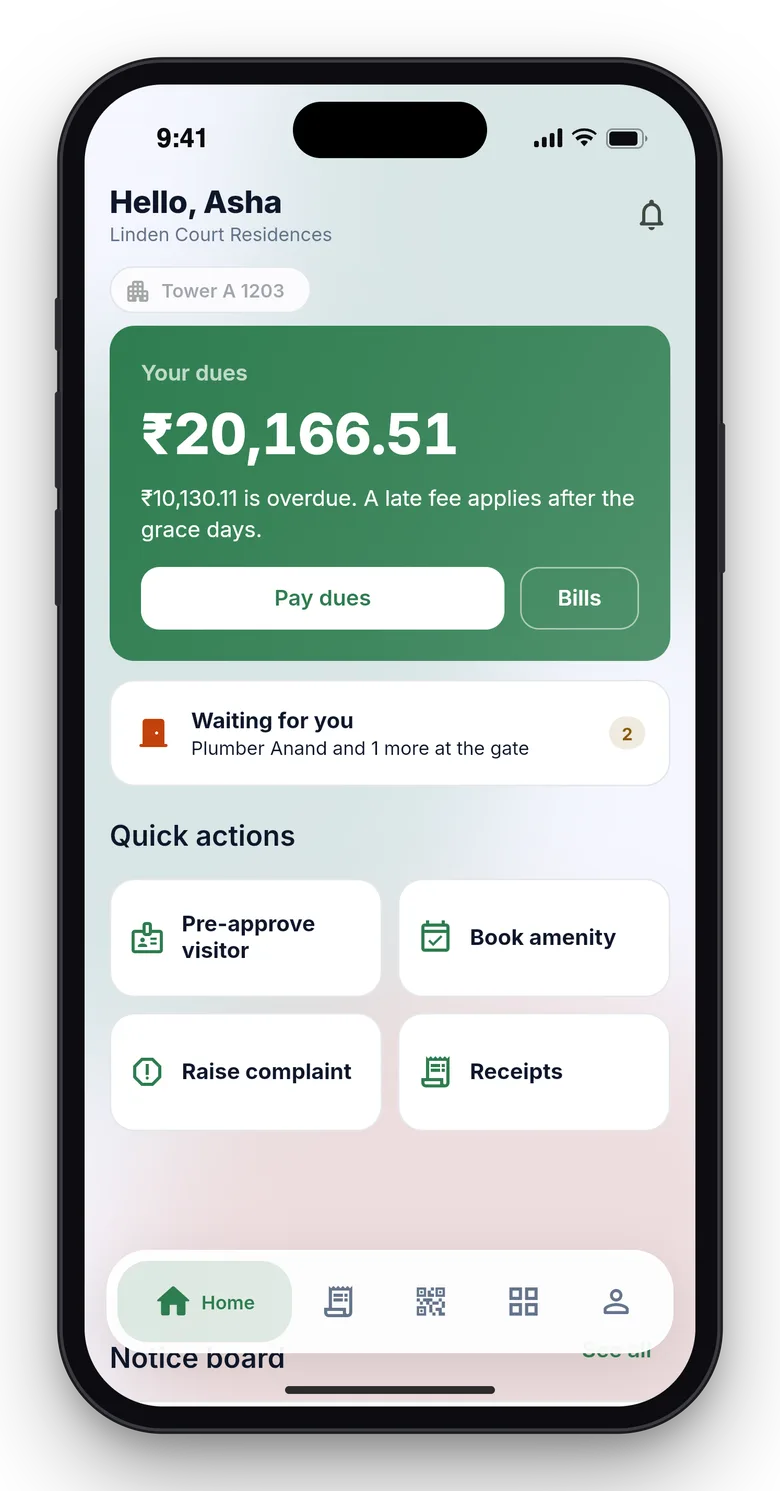
The society app (apps/society) is one login with a resident mode and a guard mode. Residents see dues, pay a bill, pre-approve a visitor and share the pass, let in or turn away walk-ins, book amenities, raise complaints and vote. Guards bind a tablet once, switch guard with a PIN, scan a pass with the camera or type the code, log walk-ins and deliveries and see today's log; guard screens show no bills or payments. It starts in demo mode, has an in-app language picker (English, Hindi, Marathi, Tamil, Telugu, Kannada, Bengali, Arabic) and a store-publishing guide in docs/STORE-PUBLISHING.md. There are no visitor photos and no AI in the app.
Gemini AI admin tools
Optional, bring your own key: add your own Gemini key after purchase (Google bills your account); with no key the AI buttons stay disabled and say to add your key in Settings. Every result is an editable draft; nothing is saved, billed, charged, sent or applied automatically, and accepted results are marked in the audit log.
- Dashboard and reports: explain the dashboard, a billing run, a dues-aging report, the complaint SLA report, the gate traffic report or any report in plain words, and flag risks such as rising dues aging.
- Units and residents: clean up an imported CSV and filter in plain words ("tenants in Tower C with dues over 2 months"), checked against an allow-list of fields.
- Helpdesk: classify and prioritise a complaint, summarise the thread and draft a reply.
- Community: write or rewrite a notice, make a poll question neutral, summarise meeting notes into minutes and action items, and write amenity rules.
- Expenses: flag duplicate-looking bills and spikes and suggest a category.
- Settings: explain what a setting changes.
- A Google Translate language switcher in the public header, the resident portal, the guard screen and the admin bar.
Visitor logs, gate entries, phone numbers, vehicle numbers, payments and ledgers are never sent. Complaint text has names, unit numbers, phones and emails replaced first, and dues analysis uses totals and opaque unit tokens only. You remain responsible for your own privacy notices and your agreement with Google.
Quality checks
The release passed seven gates on the final code: Larastan level 6 with 0 errors, Pint clean, a Pest suite of 386 tests (2,560 assertions), a build with a 23 KB page budget and no 3D, migrations and the full demo seed on MySQL 8 and SQLite, a headless run of 23 happy paths plus 13 MySQL race groups (concurrent payments with one key, the last amenity slot, guard PIN attempts, payments racing the hourly job, and more), the web installer driven from the zip, and a secret scan. A consistency command (bylawn:check) proves bills equal their lines, allocations never exceed payments, ledgers match open bills less credit, no pass is used twice and no photo column exists, on the demo data. The Flutter app passed analysis, 115 tests and simulator builds, and ran once against the live API. Lighthouse mobile scores 96 for performance, 95 for accessibility, 100 for best practices and 100 for SEO on the home page.
What you should know before buying
- Billing is not certified accounting or tax filing. Heads, taxes and late fees are configurable; check them with your accountant.
- Late fees land on the overdue bill itself. The next bill's statement lists them as previous dues.
- Ownership transfer is pro-rata by days. With the setting on, the current period's head lines are split between the outgoing and incoming owner; late-fee lines are never split and open arrears stay with the unit.
- Visitor photos are off, with no code path to turn them on. There are no intercom calls and no face recognition.
- Gate passes are signed and single-use. A guard device needs the network to mark a pass used; offline it only verifies the signature, and a replay is rejected when it syncs.
- Payments, SMS/OTP and push are simulated in the demo. Payment, SMS and other third-party connections run in demo mode until you configure your own provider; demo drivers refuse to run in production.
- Gemini AI admin tools need your own Google Gemini API key (Settings → AI); no key or AI usage is included. Without a key the AI buttons stay disabled.
- Translate and privacy. A Google Translate language switcher is on the public site and admin; it needs Google's widget to load in the visitor's browser, and private areas (bills, ledgers, gate logs, residents) are excluded from translation.
- One Flutter app (resident and guard modes) with source and a store-publishing guide. Building, publishing and store approval are your step; the app was verified in simulator builds, automated tests and against the live API, not on a physical device.
- Use MySQL or MariaDB for a live site; the concurrency checks were run on MySQL 8. One cron entry every minute is required.
Included
Source code, the web installer, the Flutter app source with a store-publishing guide, a buyer guide, demo data for three fictional societies (520 units, about 1,100 residents, about 7,300 bills, about 6,800 payments, about 9,000 gate entries and 381 complaints) and six months of support.
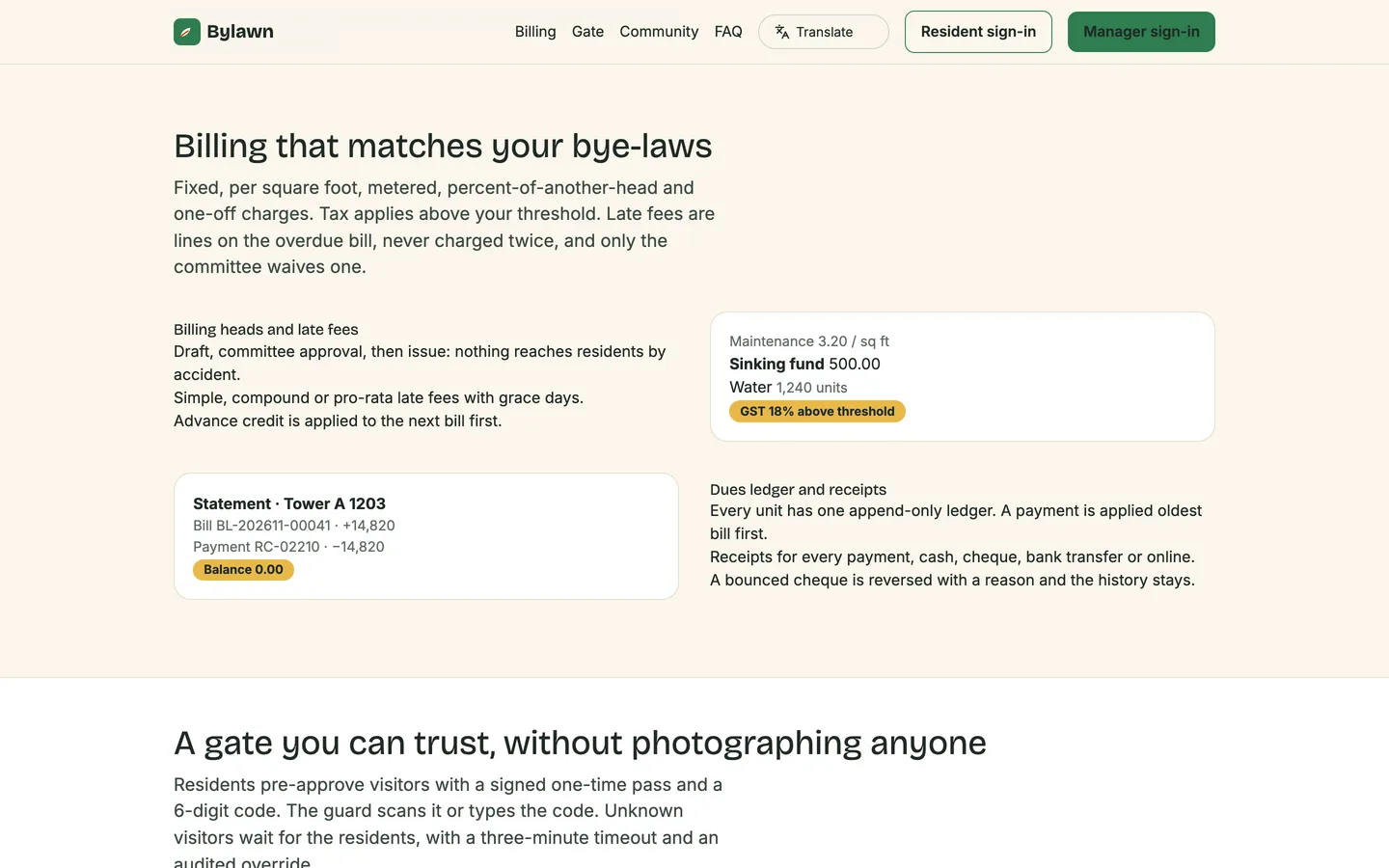 Billing heads and late fees — Fixed, per-area, metered and one-off charges with late fees on the overdue bill.