DEV3 Technologies home

DEV3 Spannerly – Auto Workshop & Garage Management SaaS Laravel Script with Inspections, Approvals and Invoices

A self-hosted garage software SaaS on Laravel 12 and Filament 4: online booking, job board, digital inspections, estimates approved by link with a signature, technician clocking, parts and purchase orders, invoices and reminders. Web installer and demo data included. No mobile apps.
by DEV3 TechnologiesVerified AuthorUpdated 11 Nov 2026

Black Friday: up to 30% off

This item is 30% off: $69.30 instead of $99

Ends in
--
Days
--
Hrs
--
Min
--
Sec

Video tour. Pick a section below to browse 35 screenshots in 7 sections.

App & phone tours

Tap play to watch each app. Nothing downloads until you do.

  • Mobile web0:12

Spannerly is a workshop management system for garages, tyre centres and small chains. It is built by DEV3 Technologies on Laravel 12 and Filament 4. You run it as the operator: you sell plans to workshops, and each workshop gets its own sites, bays, staff, customers, vehicles, parts and invoices.

What it does

  • Online booking. A public booking page per workshop with a service menu you edit. Slots come from the bay capacity at the site, so two cars are never promised the same lift. Service reminders link straight into a pre-filled booking.
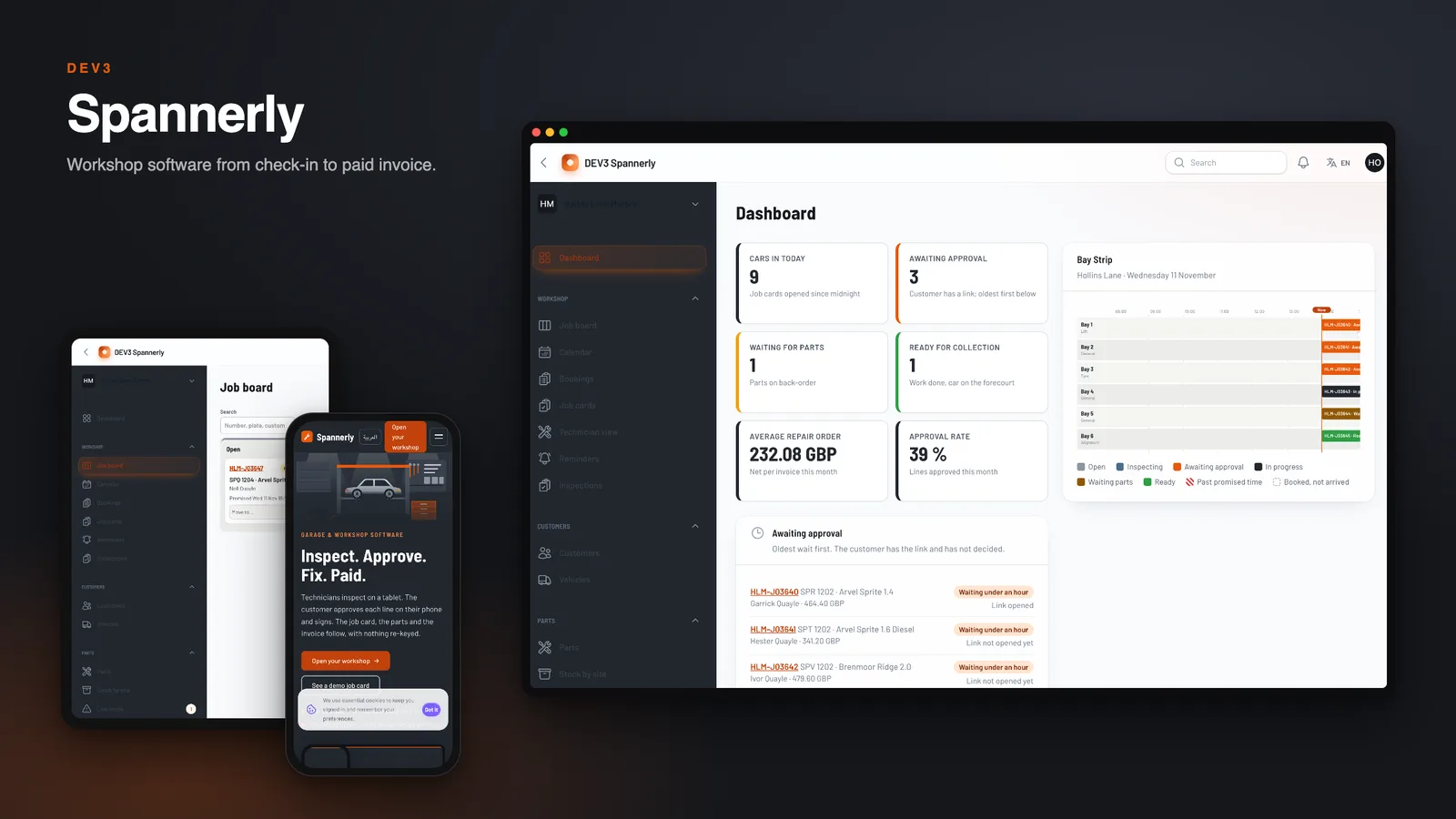
  • Job board and bays. Nine job stages on a drag-and-drop board, a Bay Strip for the day, and a state machine that refuses illegal moves and says why. An approved estimate moves the job on; a part arriving wakes a waiting job.
  • Digital inspections. Your own checklists with measurements, photos and a traffic light on every item, always with a text label. A red item suggests its labour code and part for the estimate.
  • Estimates approved by link. Labour by hours and rate, parts, fees and discounts with a manager limit. The customer opens a link on their phone, approves or declines each line, acknowledges declined safety items and signs with a finger. The record keeps the name, time, IP address and signature. Revised estimates supersede the old one.
  • Technician clocking. Approved lines become tasks; technicians start and stop a timer per task on a tablet. Forgotten timers close automatically and are flagged. Efficiency is hours sold against hours clocked. Technicians see no prices unless you grant it.
  • Parts and purchase orders. Parts per site with reservations, back-orders, average cost, transfers, supplier returns and CSV import. Raise purchase orders from back-orders, email the PDF and receive in parts.
  • Invoices and payments. Invoices can only bill what was approved. Pay links, cash and bank records, partial payments, credit notes, statements for business customers and an aged receivables view.
  • Reminders. The next service is planned by date and mileage when a job closes. Customers who have not agreed to marketing go to a call list instead.
  • Reports and multi-site. Cars in, average repair order, approval rate by priority, parts margin, stock value and efficiency. Sites have their own bays, hours and tax; managers see only the sites they are granted.
  • Operator panel, API and webhooks. Workshops with meters, plans, subscriptions, SaaS invoices, an outbox and audited view-only impersonation. A scoped REST API with idempotency keys, an OpenAPI document and signed webhooks for seven events. A customer portal and an Arabic right-to-left marketing page are included.

Quality checks

The release passed seven gates on the final code: Larastan level 6 with no baseline, Pest, a build inside the page budget, migrations and the full demo seed on MySQL 8 and SQLite, a headless smoke test with happy paths for booking, inspection, approval, clocking, parts, invoicing and payment, race checks on MySQL (approvals against edits, stock reservations, payments, parallel timers), the installer driven from the zip, and a secret scan. Estimate and invoice money is checked against 48 independently computed vectors.

What you should know before buying

  • No manufacturer data. There are no labour-time guides, no parts catalogue feeds and no wiring diagrams. Each workshop keeps its own labour menu and parts list.
  • No vehicle lookup service. VIN and registration lookup is a driver interface: manual entry by default and a simulated decoder in the demo. A real service is yours to connect.
  • No authority integrations. There is no MOT or inspection-authority, emissions or insurer connection.
  • Payments are simulated until you connect a gateway. Each workshop is the merchant for its own customers; the operator takes no share. Cash and bank transfers are recorded by staff.
  • Approvals are a record, not a qualified e-signature. Invoices use configurable tax rates and are not submitted to any e-invoicing system.
  • Web only. There are no mobile apps; the technician and customer screens run in the browser. Supplier ordering is by emailed PDF, with no supplier catalogue integrations.
  • Use MySQL or MariaDB for a live site. A cron entry every minute is required, and a queue worker is advised when you switch the queue to the database.

Included

Source code, the web installer, a buyer guide, demo data with fictional workshops (a six-bay garage, a two-site tyre centre, a motorcycle workshop and a fleet-care business), fixed demo links for the customer pages, and six months of support.

How it's built

Architecture, stack, key decisions and the quality gates DEV3 Spannerly passed before release.

The engineering behind Spannerly: estimates approved line by line, an invoice that can never exceed the approval, stock reservations under row locks and customer links stored only as hashes.

The problem it solves

A workshop app looks like a job list until two advisers edit one estimate, a customer approves while the price changes, two jobs reserve the last part or a link leaks. Each must end with consistent money and stock, and the customer must never need an account.

Architecture and approach

Spannerly is a Laravel 12 application with Filament 4 workshop and operator panels and hand-built board, technician and customer screens. Every change goes through services: a job state machine, an estimate builder, an approval gate that locks job, estimate and stock rows in a fixed order, and an invoice service that caps each line at the approved gross. Customer links store only a SHA-256 hash, are rate limited per token and answer with no-store caching and a strict content security policy. Money is integer minor units rounded half up per line, and spannerly:check reconciles stock, reservations, invoices, timers and odometer readings.

Quality gates and results

The release passed seven gates, including race checks on MySQL for approvals against edits, stock reservations, payments and parallel timers, and 48 estimate and invoice vectors computed by an independent oracle. The reconciliation command passes on the demo data: ten workshops, tens of thousands of jobs and invoices.

Tech stack

Area Technologies
Application Laravel 12, Filament 4, Blade, REST API
Data MySQL 8, SQLite
Frontend Tailwind CSS 4, Vite
Quality Pest, Larastan level 6, Playwright

Inside the build

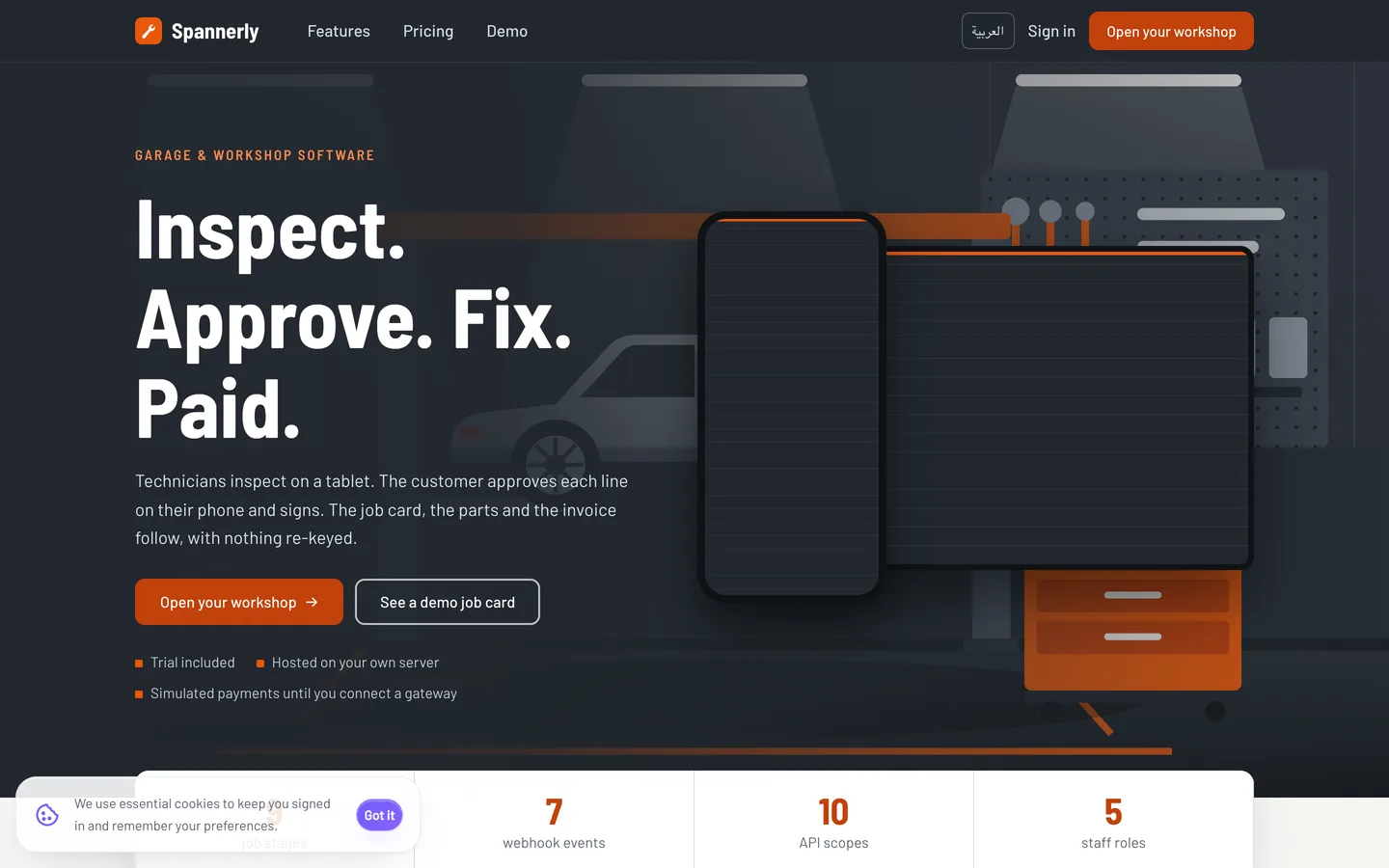
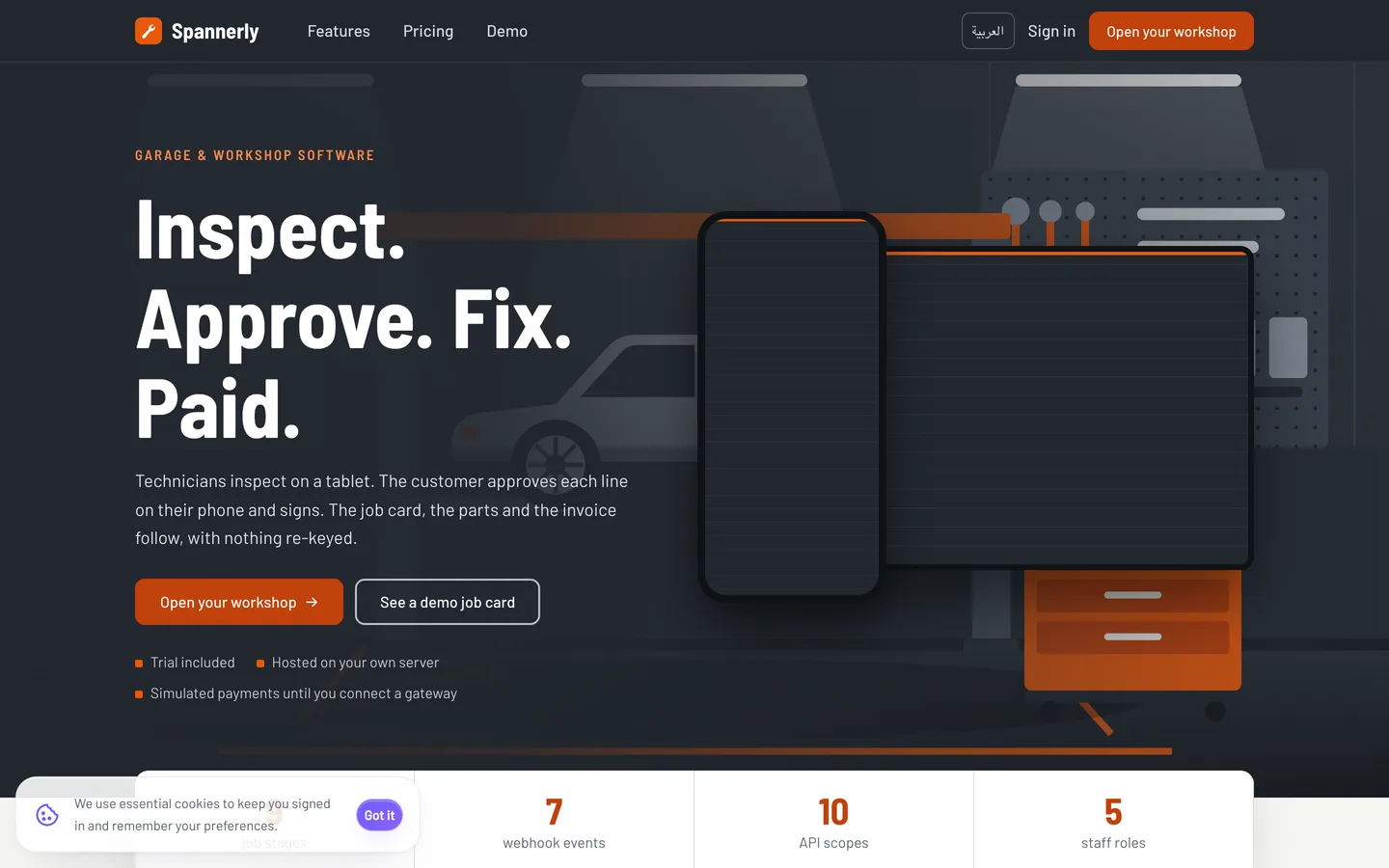
Inspect. Approve. Fix. Paid.: The home page hero: an empty workshop bay with a car on a lift. Inspect. Approve. Fix. Paid. — The home page hero: an empty workshop bay with a car on a lift.

Hero and first section: the home page below the hero, with the stats strip. Hero and first section — the home page below the hero, with the stats strip.

Guides & articles

Practical guides and engineering write-ups for DEV3 Spannerly.

Garage management software: 6 things to check before you pick one

Last updated
Garage management software: 6 things to check before you pick one: DEV3 Spannerly

A workshop does not lose money in the bay, it loses it in the gaps: the red item nobody wrote up, the estimate nobody answered, the part that was not there. Here are six things to check before you pick workshop software, with DEV3 Spannerly as the worked example.
Spannerly home page: an empty workshop bay with a car on a lift, a phone approval page over the job board

1. Do inspections turn into estimates?

A checklist on paper is a list nobody types in. Look for traffic lights with measurements and photos, and for red items that bring their labour and parts into the estimate by themselves. In Spannerly a technician marks the pads red and the line is waiting for the adviser.
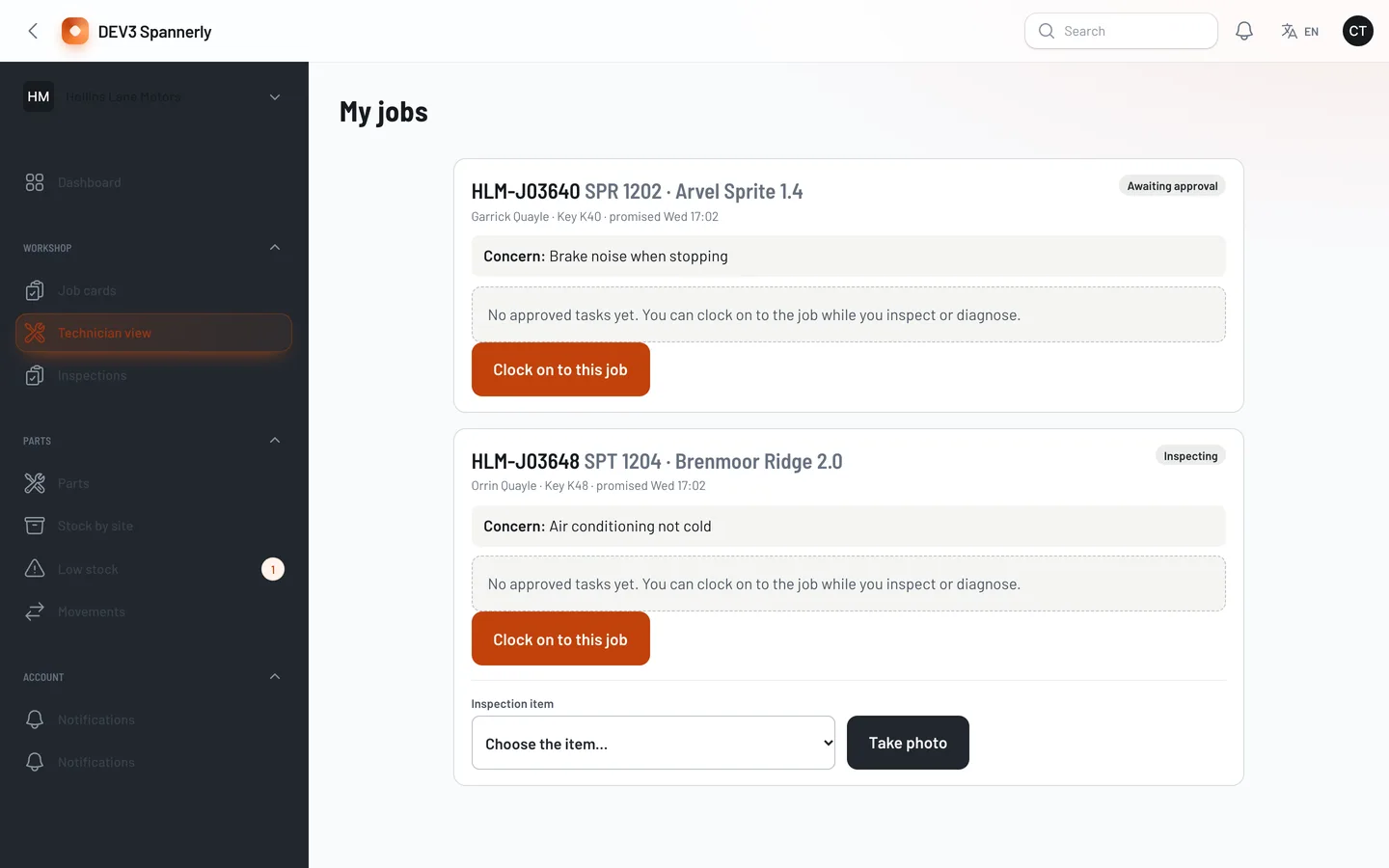
A traffic-light mini: tapping an item red adds its line to the estimate

2. Can the customer approve on their phone?

The customer should get a link, not an account. Each line should be approved or declined on its own, a declined safety item should need an acknowledgement, and the workshop should keep who approved, when, from where and a signature.
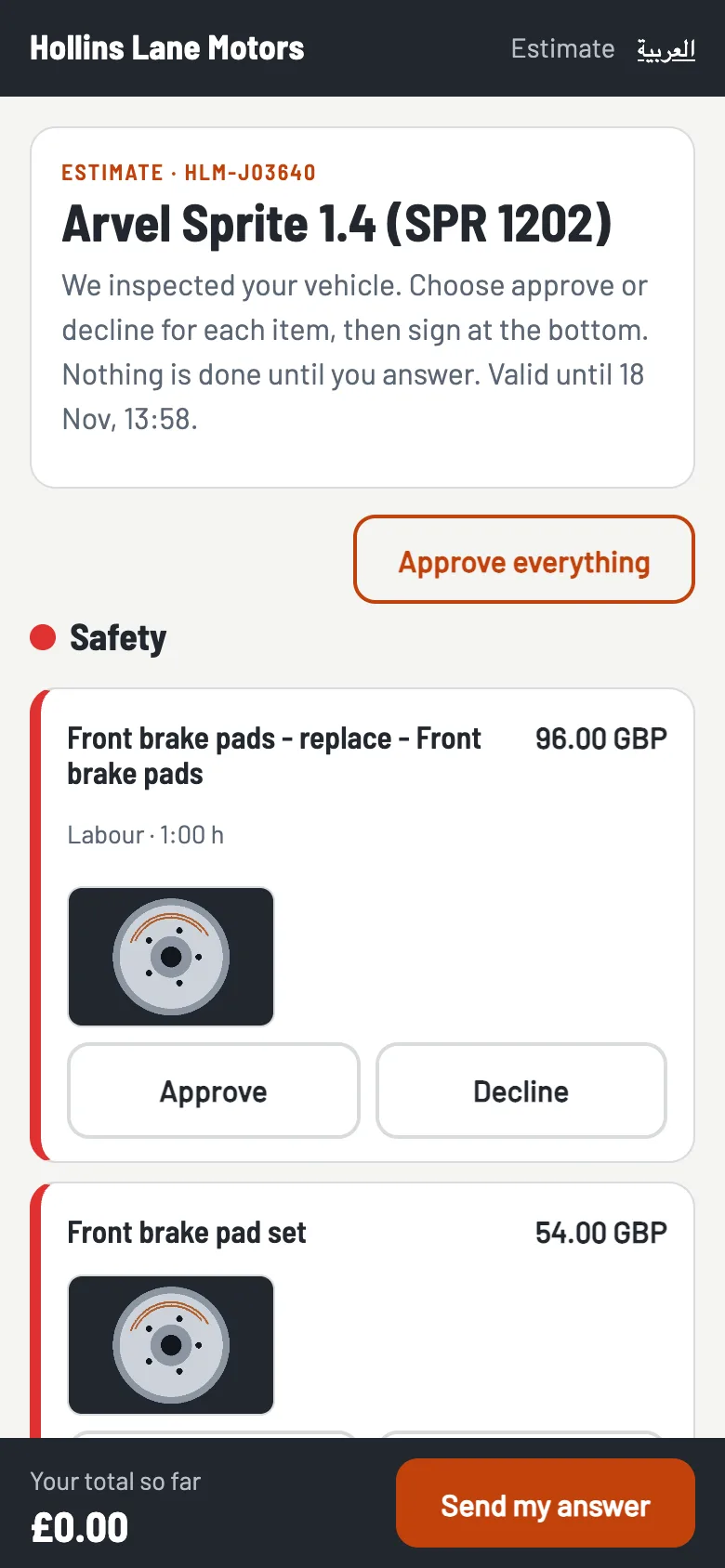
The approval page on a phone with each line and its photo

3. Is there a report the customer can keep?

A private inspection report with photos answers the question "did you really need that?" before it is asked.
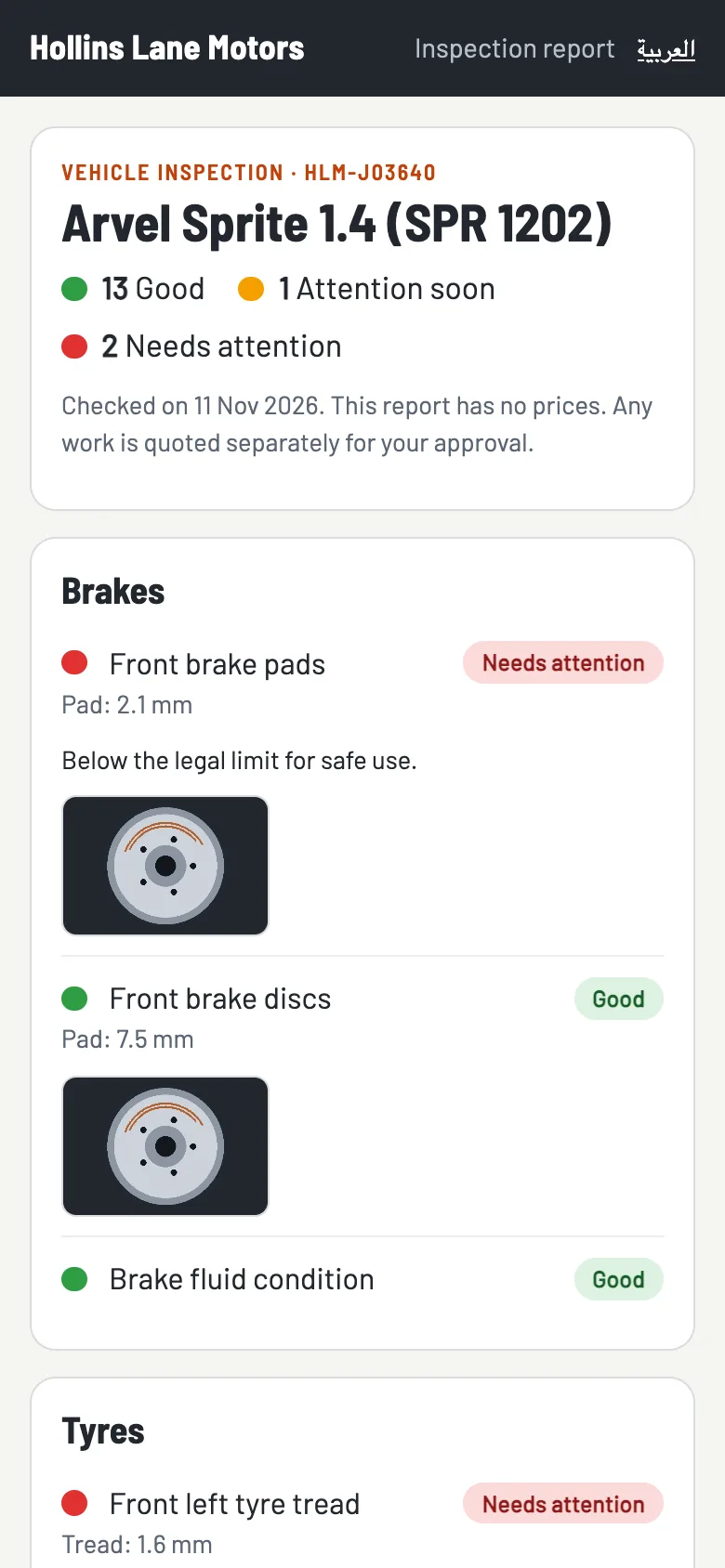
The inspection report with measurements and photos

4. Does the board match the floor?

Cars in the building should sit on one board by stage, and moves should have rules: no collecting a car with an unpaid invoice, no skipping approval. Spannerly refuses an illegal move and says why.
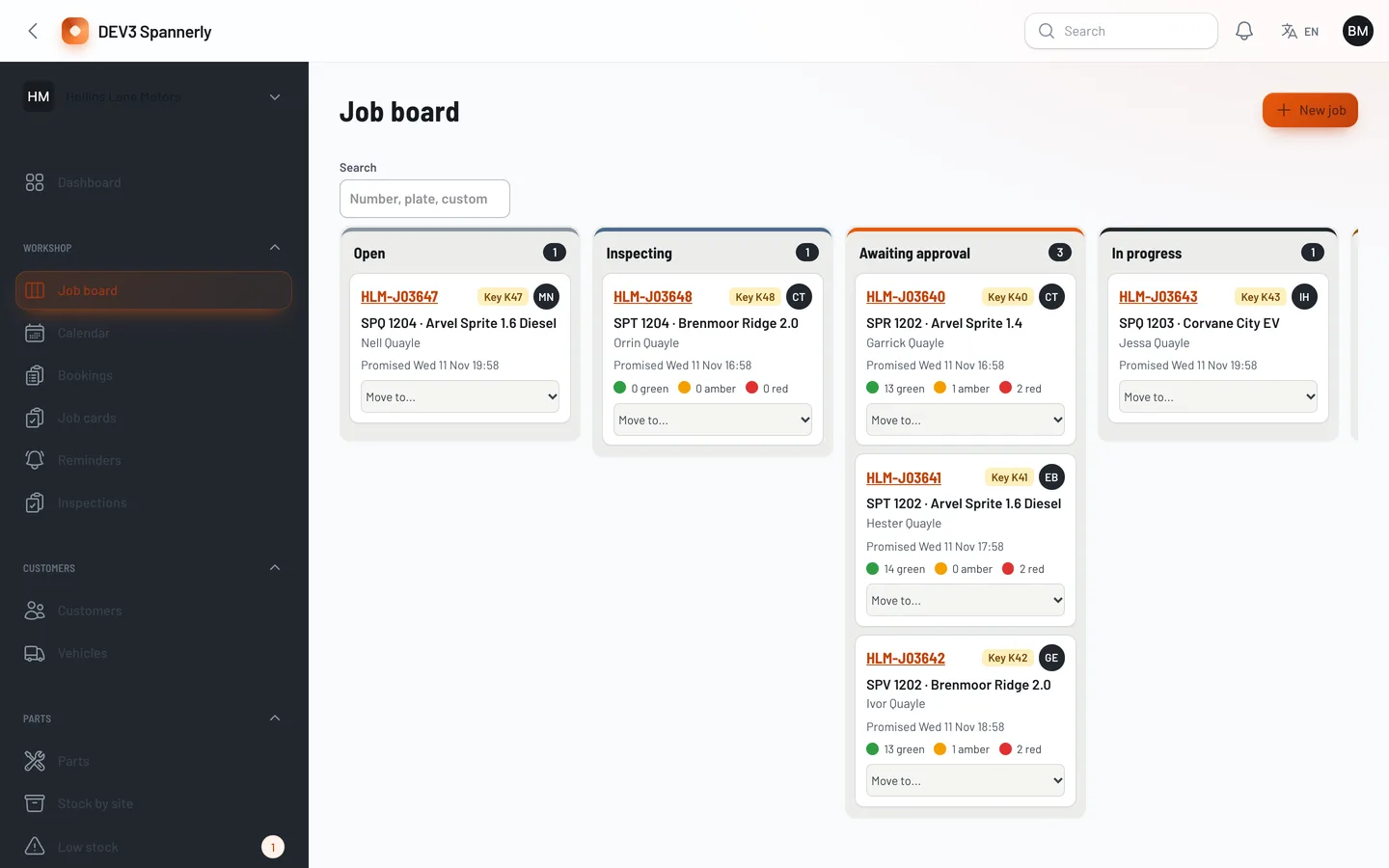
The job board with cards in every stage

5. Are parts and invoices tied to the approval?

Approval should reserve stock, a short part should pause the job and suggest a purchase order, and the invoice should only bill what was approved. If an invoice can exceed the estimate, someone will eventually argue about it.
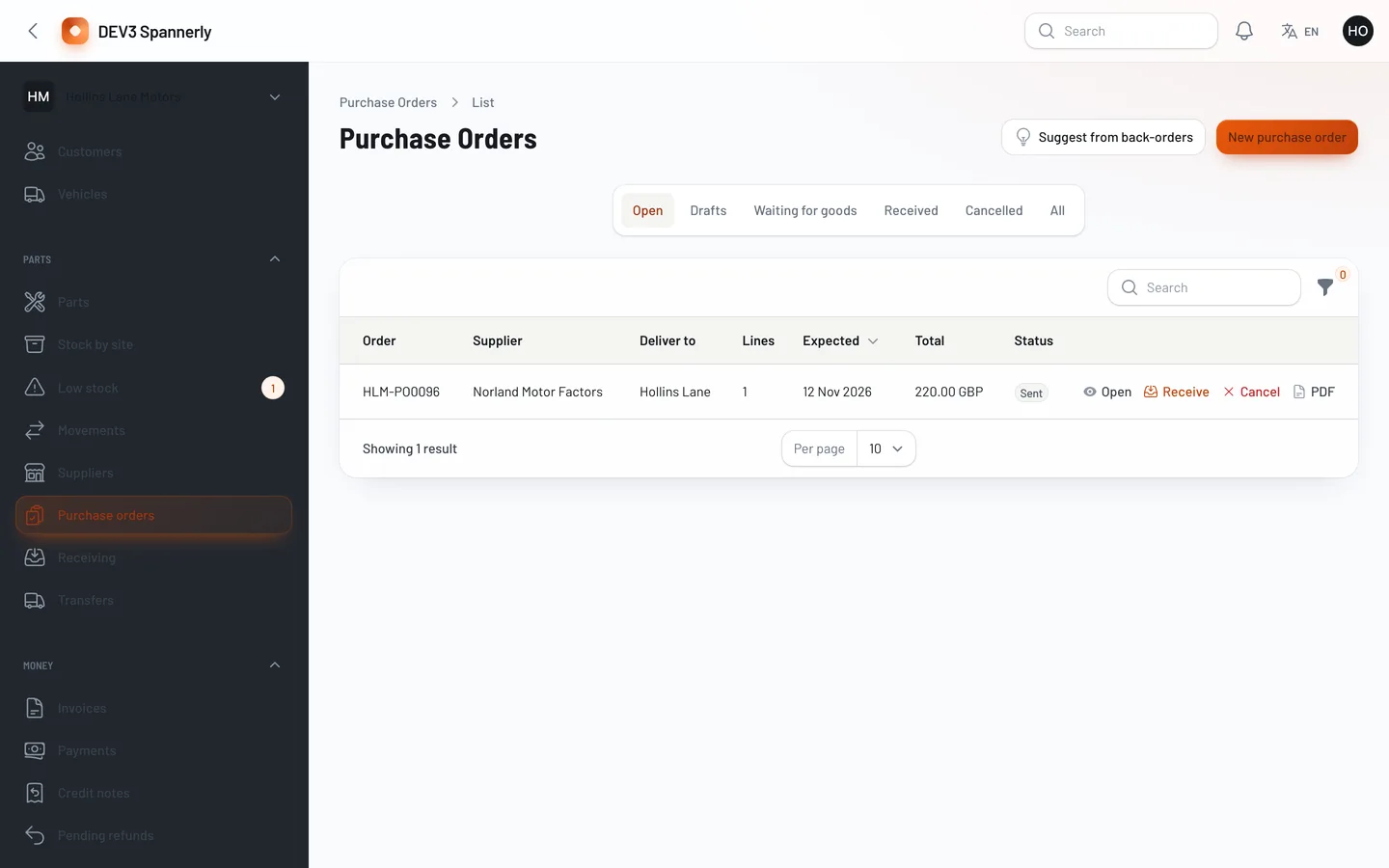
A purchase order raised from a back-order

6. Are the limits honest?

Spannerly is a web app, not a mobile app. It has no manufacturer labour-time guides, no parts catalogue feeds, no wiring diagrams and no vehicle lookup service of its own (manual entry, with a simulated decoder in the demo). It has no MOT, emissions or insurer integrations, payments are simulated until you connect a gateway, and an approval is a record, not a qualified e-signature. Say that plainly to your buyers.


Video: The Spannerly tour

Frequently asked questions

The complete source code (version 1.0.1) as a download from your account, with the setup and usage guides shown on this page. You can modify the code to suit your product.

Buying guides: Laravel scripts with Filament panels and a web installer · Next.js or Laravel for a SaaS script?

Questions about this product (0)

Answers from the DEV3 team and the community.

Ask a question

No questions yet.

Wondering about setup, licensing or customisation? Ask, and the DEV3 team will help.

More from this author

View all

Related in Web Scripts & Software

View all